Eng English
China 中国人

Eng English
China 中国人
  • News
  • World
  • Business
  • Entertainment
  • Sports
  • Law
  • Education
  • Health
  • Lifestyle
  • Travel
  • Science
  • Digital
  • Automobiles
  • Trở lại Thể thao
  • Health
Sunday, 28/12/2025 | 08:02 GMT+7

When should cancer patients undergo PET/CT scans?

Doctors recommend PET/CT scans for cancer patients when distinguishing between benign and malignant tumors, locating primary cancer sites, or staging cancer.

PET/CT combines two imaging techniques: positron emission tomography (PET), which provides early molecular-level images, and computed tomography (CT), which offers clear anatomical views. This combination aims to detect and assess the malignancy and spread of tumors, lymph nodes, and distant metastatic lesions earlier than conventional imaging methods.

Doctor Vu Huu Khiem, head of the Oncology Department at Tam Anh General Hospital Hanoi, explained that during a PET/CT scan, patients receive an intravenous injection of a mildly radioactive substance, typically fluorodeoxyglucose (FDG). FDG is a glucose-like molecule that all body cells use for fuel, but it is tagged with Fluor-18 to act as a tracer.

In the body, cells absorb FDG just as they would glucose. Cancer cells require more energy for proliferation and growth, leading them to absorb higher amounts of glucose and FDG. PET/CT utilizes sensors to pinpoint locations with increased positron emissions, which correspond to the sites of primary and metastatic cancer cells.
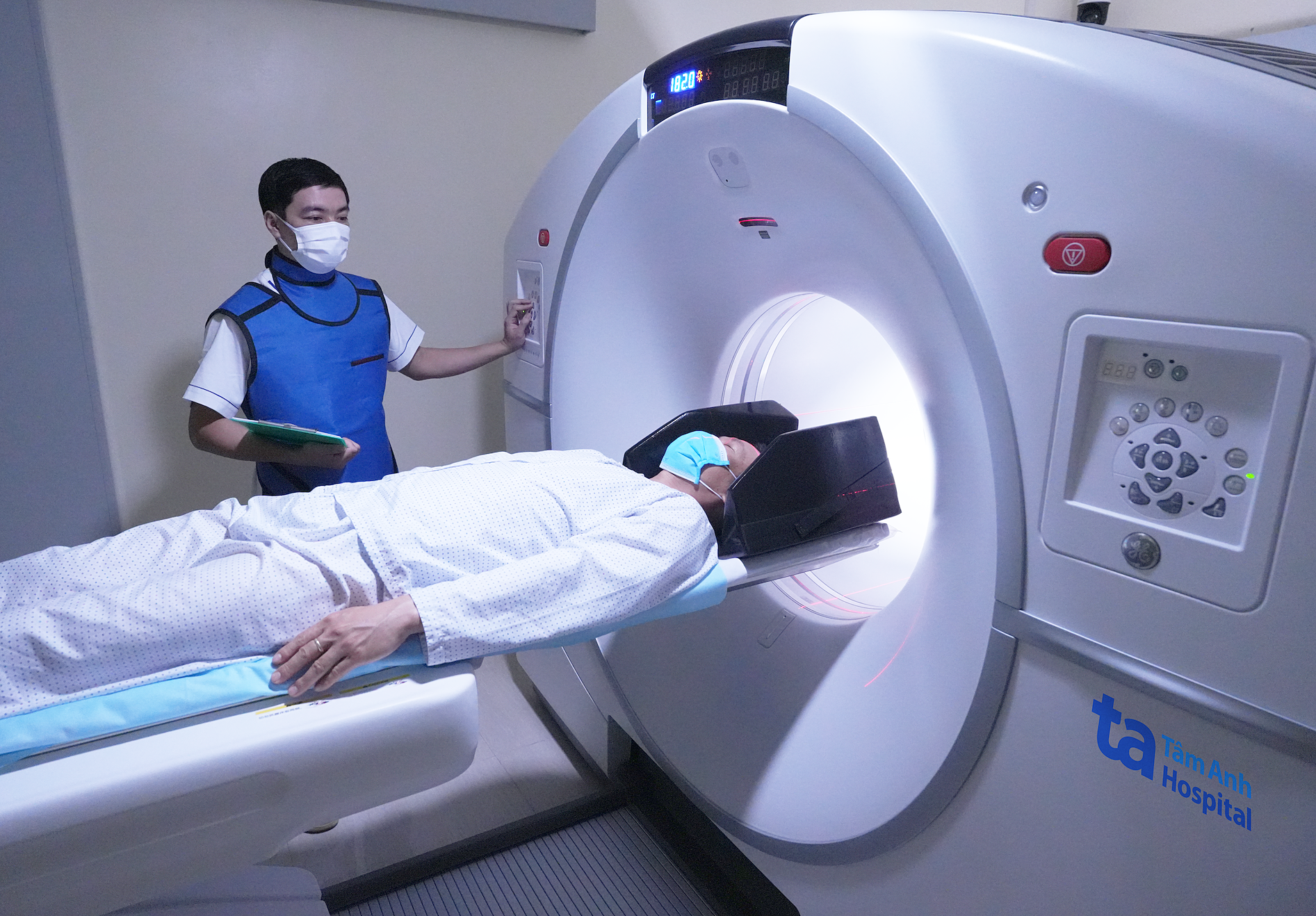
A patient undergoing a PET/CT scan. Photo: Tam Anh General Hospital.

Doctors prescribe PET/CT for cancer patients in several situations:

To distinguish between benign and malignant tissue: When other imaging techniques, such as computed tomography (CT) and magnetic resonance imaging (MRI), only reveal the morphology of a lesion, like a mass or nodule, without clearly indicating whether it is benign or malignant, a PET/CT scan enhances the ability to differentiate more accurately by evaluating the tumor's characteristics. This can reduce the need for unnecessary biopsies.

To locate the primary cancer site: When doctors suspect cancer based on blood tests and clinical symptoms but are unsure of the tumor's location, a whole-body PET/CT scan helps identify the suspected primary cancer site, supporting biopsy for disease confirmation.

To stage cancer: PET/CT also assists doctors in determining tumor size and whether the cancer has metastasized to lymph nodes or other organs. The whole-body scanning capability of PET/CT allows for the detection of small metastatic lesions that other methods might overlook.

For treatment planning: This method helps doctors accurately identify the location and extent of the developing cancer. This information is crucial for planning surgery or radiation therapy, ensuring that radiation beams are precisely aimed at the tumor, reducing the risk of missing lesions, preventing recurrence, and limiting damage to surrounding healthy tissues.

To evaluate treatment effectiveness: During chemotherapy, radiation therapy, targeted therapy, or immunotherapy, doctors may order a PET/CT scan to assess the tumor's response to treatment.

To monitor for cancer recurrence: After treatment is completed and the patient is in complete remission or cured, doctors may prescribe PET/CT during routine follow-up appointments to check for cancer recurrence, allowing for timely intervention. PET/CT detects lesions at the molecular level, often several months earlier than other conventional techniques.

PET/CT scans are not indicated for pregnant women due to the potential impact of CT radiation on the fetus. Breastfeeding women who require a PET/CT scan should suspend breastfeeding for 24 hours post-scan. Patients with a history of contrast dye allergy or kidney failure can undergo PET/CT without contrast.

Doctor Khiem notes that PET/CT scans are not recommended for cancer screening due to the risk of false positives and high costs. Images showing strong FDG metabolic activity can also indicate infection or inflammation, not necessarily cancer. A definitive cancer diagnosis ultimately relies on biopsy results for histopathological examination. Patients should only undergo PET/CT when specifically indicated by a specialist, after a careful consideration of the clinical benefits outweighing the risks and costs.

By Thanh Long

Readers can ask questions about cancer here for doctors to answer.
By VnExpress: https://vnexpress.net/khi-nao-benh-nhan-ung-thu-nen-chup-pet-ct-4998974.html
Tags: cancer screening lung cancer

News in the same category

Vietnam risks a shortage of 1,3 million marriageable women in the next 20 years

Vietnam risks a shortage of 1,3 million marriageable women in the next 20 years

The general statistics office forecasts that by 2049, Vietnam will face a shortage of about 1,3 million women of marriageable age, a direct consequence of a prolonged sex imbalance at birth.

Are people with blood type O more susceptible to dengue shock?

Are people with blood type O more susceptible to dengue shock?

"I have blood type O, and I've heard that if I get dengue fever, I'm more prone to shock. Is this true?" asks Thuy Anh, 26, from Dong Thap.

Why can a c-section scar cause infertility?

Why can a c-section scar cause infertility?

Three years ago, I had my first child via c-section. Since then, I have not conceived, and an examination revealed a c-section scar defect causing secondary infertility. What treatment methods are available to help me have a child soon? (Lan Phuong, TP HCM)

Eating unripe papaya and pineapple on an empty stomach can cause stomach irritation

Eating unripe papaya and pineapple on an empty stomach can cause stomach irritation

A nutritionist warns that unripe papaya, kiwi, and pineapple contain high levels of protein-digesting enzymes, which can severely irritate the stomach lining if consumed on an empty stomach.

What happens when you drink coffee every morning?

What happens when you drink coffee every morning?

Drinking coffee every morning can boost energy and contribute to preventing heart disease and diabetes, but some individuals may experience sleep difficulties, tooth erosion, and digestive upset.

6 reasons to eat ripe papaya for breakfast

6 reasons to eat ripe papaya for breakfast

Eating papaya for breakfast provides energy, supports healthy digestion, nourishes skin, and improves overall health.

What type of protein is best for kidney health?

What type of protein is best for kidney health?

A 57-year-old patient with chronic kidney disease from Dong Thap asks for advice on the best types of protein and dietary portions to support kidney health.

Should you choose fillers or botox to reduce eye wrinkles?

Should you choose fillers or botox to reduce eye wrinkles?

I am 39 years old and have wrinkles at the corners of my eyes. Should I choose botox to soften them or fillers to plump them? (Nhu Quynh, Ninh Binh)

Drinking alcohol in the evening, will the body still have alcohol content the next morning?

Drinking alcohol in the evening, will the body still have alcohol content the next morning?

If I drink alcohol in the evening, will my body still have alcohol content the next morning? (Minh, 35, Tay Ninh)

6 indoor games to boost children's brainpower

6 indoor games to boost children's brainpower

Indoor games such as reverse storytelling, blindfolded building, and drawing stimulate imagination and critical thinking, supporting children's brain development.

Eng English
China 中国人
  • News
  • World
  • Business
  • Entertainment
  • Sports
  • Law
  • Education
  • Health
  • Lifestyle
  • Travel
  • Science
  • Digital
  • Automobiles
FPT Tower, 10 Pham Van Bach Street, Dich Vong Ward,
Cau Giay District, Hanoi, Vietnam
Email: contacts@vnportal.net
Tel: 028 7300 9999 - Ext 8556
Advertise with us: 090 293 9644
Register
© Copyright 2025 vnnow.net. All rights reserved.
Terms of use Privacy policy Cookies