The World Health Organization (WHO) has issued an urgent warning regarding the Ebola outbreak, stating it is spreading faster than current containment efforts. Dr. Tedros Adhanom Ghebreyesus, WHO director-general, stated on 25/5, "We are urgently scaling up response activities, but currently the disease is spreading faster than our pace." He urged neighboring countries to act immediately, as they face a very high risk of infection. Earlier this month, the agency declared a public health emergency of international concern, raising the risk assessment to "very high" at the national level, with Dr. Tedros believing the actual scale of the outbreak is much larger.
The outbreak's immediate impact is evident in both Uganda and the Democratic Republic of Congo (DRC). On 25/5, Uganda's Ministry of Health confirmed two additional healthcare workers in the capital, Kampala, had contracted the disease, bringing the nation's total cases to 7. In the DRC, health officials recorded over 900 suspected cases and 220 deaths.
Efforts to control the epidemic in the DRC are severely hampered by attacks on health facilities. Local residents' attacks on health facilities in Ituri province are severely impeding epidemic control efforts. On 23/5, 18 patients fled Mongbwalu General Hospital after unidentified individuals set fire to isolation tents operated by Doctors Without Borders. Two days prior, a crowd burned down a treatment center in Rwampara after authorities refused to release victims' bodies to their families.
Traditional burial practices are a primary factor in the virus's rapid dissemination. The traditional funeral practice of washing and touching the deceased is a core reason for the virus's rapid spread. To control this particularly dangerous source of infection, authorities must directly manage the burials of victims.
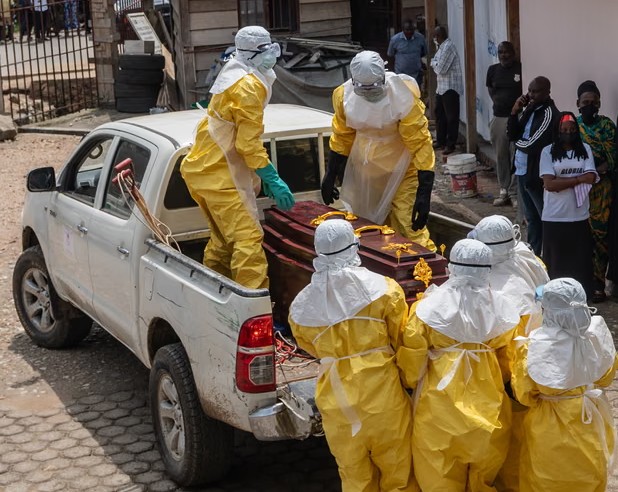 |
Healthcare workers transport the body of an Ebola victim for safe burial at a hospital in Bunia, Ituri province, DRC, last weekend. *Photo: EPA* |
The current outbreak is caused by the rare Bundibugyo Ebola virus strain, for which global medicine has no specific treatment or vaccine. The crisis is concentrated in Rwampara, Mongbwalu, Nyankunde, and Bunia within Ituri province. This gold-rich region has endured significant losses from armed conflicts between the Hema and Lendu ethnic groups, which have claimed over 50,000 lives since 1999. Health teams have also identified many cases in rebel-held areas of North Kivu and South Kivu provinces. Dr. Tedros noted that security instability and vaccine shortages are increasingly complicating efforts to contain the severe disease.
The Ebola virus typically transmits from fruit bats to humans and spreads through direct contact with infected bodily fluids. The Ebola virus is believed to transmit from its natural hosts, fruit bats, to humans. After an incubation period of 2-21 days, patients suddenly develop symptoms like fever, malaise, and muscle pain, which rapidly progress to vomiting, diarrhea, liver failure, and kidney failure. The virus spreads quickly in the community through direct contact (broken skin, mucous membranes) with the blood and bodily fluids of infected individuals, or via burial rituals involving direct contact with corpses.
In response to the escalating situation, Vietnam's Ministry of Health has issued warnings and preparedness measures. On 22/5, Vietnam's Ministry of Health issued a warning to prepare for an Ebola outbreak, noting that actual case numbers in Congo and Uganda were higher than reported. Previously, the ministry also advised citizens not to panic but to self-monitor their health for 21 days if returning from affected regions. To date, Vietnam has not recorded any Ebola cases.
Binh Minh (According to The Guardian, WHO)