


Ms. Huong, 63, endured two years of difficult and painful urination before doctors at Tam Anh General Hospital in Ho Chi Minh City diagnosed her with a bladder diverticulum nearly twice the size of her bladder. Dr. Cao Vinh Duy, from the Department of Urology at the hospital's Urology - Nephrology - Andrology Center, stated that Ms. Huong suffered from persistent and recurrent urinary tract infections (UTIs), suggesting a bacterial reservoir within her urinary system. A CT scan revealed an abnormal sac-like mass next to her bladder.
During a cystoscopy, doctors found a large opening, the neck of the diverticulum, leading into a sac measuring over 8 cm. This was nearly double the size of an empty bladder, which is typically about 5 cm. Doctors diagnosed Ms. Huong with a large bladder diverticulum caused by a urethral stricture.
Bladder diverticula form when the bladder muscles contract excessively to expel urine, causing the bladder lining to bulge outward. Since the diverticulum consists only of this lining, it cannot contract actively. This can lead to the formation of stones and increases the risk of bladder cancer if left untreated.
In Ms. Huong's case, the large size of the diverticulum indicated that the bladder outlet obstruction had been progressing silently for many years. After she finished urinating, the bladder would empty, but urine from the diverticulum would flow back in, causing her to feel an immediate need to urinate again.
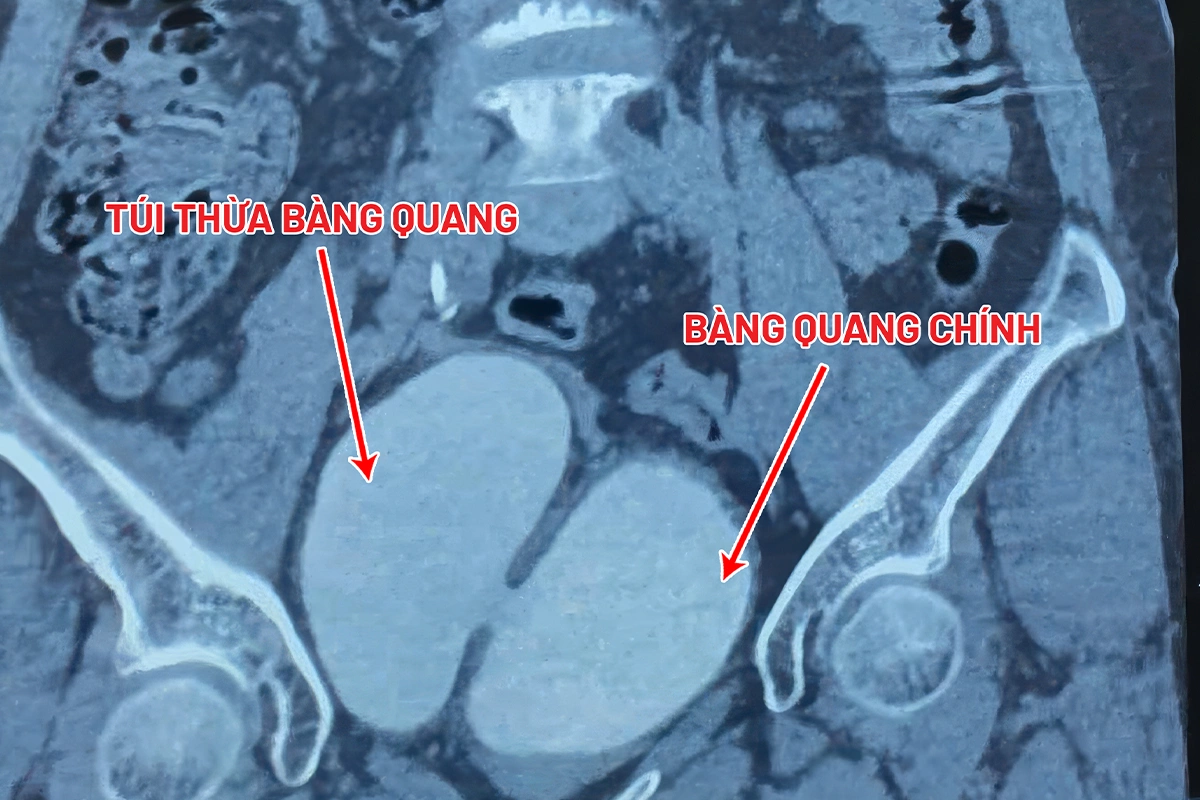 |
A CT scan shows the patient had a large diverticulum, bigger than the main bladder. Photo: Hospital provided |
Dr. Duy recommended laparoscopic surgery to address the infection first. Surgeons inserted instruments through small incisions in the abdominal wall, carefully dissecting the diverticulum from the surrounding tissues. The diverticulum's wall was very thin, posing a risk of rupture during dissection, which could lead to urine spilling into the surrounding tissue or even peritonitis. Its large size also made it prone to inflammatory adhesions due to chronic infection.
The four-hour procedure successfully removed the entire diverticulum from her body. A biopsy later confirmed the growth was benign.
Ms. Huong was discharged four days after surgery. She needed to use a urinary catheter for about 7-10 days to prevent bladder distension from urine, which aided in the healing of the surgical site.
She will have a follow-up examination to re-evaluate her urethral stricture. This will help doctors plan further treatment to address the root cause and minimize the risk of diverticulum recurrence.
 |
The medical team performing laparoscopic surgery on Ms. Huong. Photo: Tam Anh General Hospital |
Bladder diverticula are primarily of two types: congenital, resulting from developmental defects during fetal growth, and acquired, occurring when the bladder is subjected to prolonged high pressure to expel urine due to various medical conditions. Many bladder diverticula are asymptomatic and are only discovered incidentally during an ultrasound.
If a diverticulum is small and causes no symptoms or complications, patients are often placed under observation. If the cause is prostate enlargement or a urethral stricture, these underlying conditions are treated first. However, for large diverticula that cause recurrent infections, stones, or are suspected of being cancerous, like in Ms. Huong's case, surgical removal of the diverticulum is necessary for a complete cure.
Dr. Duy advises that individuals experiencing symptoms such as difficult urination or recurrent urinary tract infections should consult a urology specialist. Early detection and timely treatment can address abnormalities effectively.
Dinh Lam
*Patient's name has been changed


