Han had experienced myopia and astigmatism since university. She frequently had itchy eyes and rubbed them, attributing it to dust or seasonal allergies, and did not seek medical attention. Her astigmatism nearly doubled compared to a measurement two months prior, prompting her to visit a doctor.
Doctor Duong Minh Phuc from the High-Tech Eye Center at Tam Anh General Hospital Ho Chi Minh City, reported Han's left eye had a 5.25 diopter myopia and 8 diopters astigmatism, with uncorrected vision of only 1/10. Her right eye had 1.5 diopters myopia and 3.5 diopters astigmatism, with uncorrected vision of 4/10. Noticing significant corneal bulging, Doctor Phuc ordered specialized tests, including measurements of corneal thickness, curvature, and a corneal topography.
Test results confirmed bilateral keratoconus in Han's eyes, categorized as between stage two and three (moderate stage). This condition causes the cornea to progressively thin and bulge into a cone shape, rather than its normal spherical form, leading to distorted vision and gradual vision loss. Currently, there is no complete cure for keratoconus. However, early detection and appropriate intervention can control its progression and improve vision, preventing severe advancement to permanent blindness.
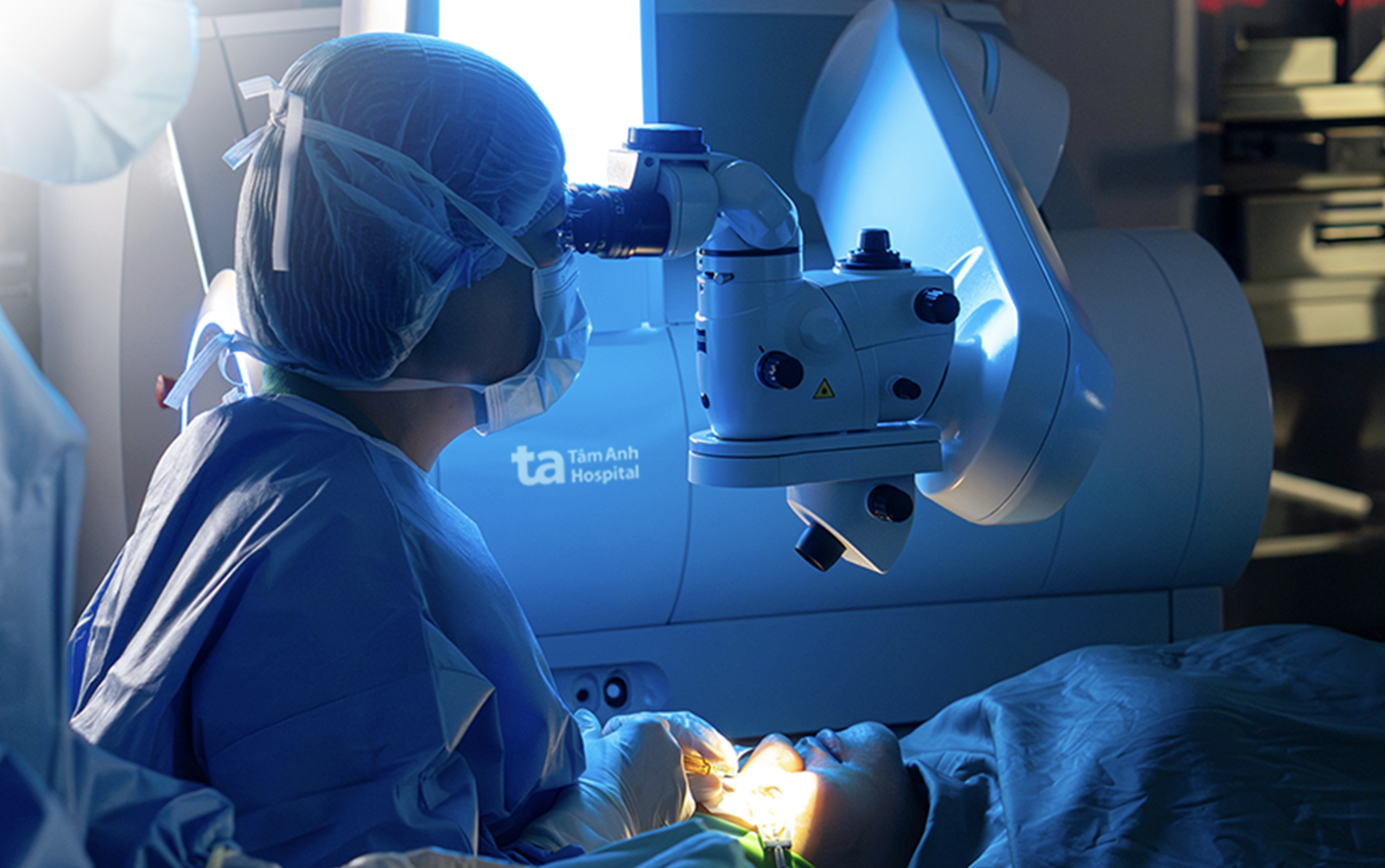 |
The doctor turned off the operating room lights, focusing the light source to perform keratoconus treatment for Han. Photo: Tam Anh General Hospital
For Han's case, Associate Professor Doctor Nguyen Thi Thu Hien, Head of the Refractive Department at the High-Tech Eye Center, prescribed cross-linking and fitting contact lenses. This treatment aims to enhance corneal strength, slow disease progression, and improve vision.
The treatment regimen involves two stages. First, the cross-linking procedure strengthens the collagen fibers within the corneal stroma. These strengthened bonds act as structural supports, making the cornea more robust and ensuring its mechanical durability. Subsequently, once the cornea stabilizes, the patient will be fitted with contact lenses tailored to their specific corneal condition.
Han's cross-linking procedure for keratoconus lasted 30 minutes. During the surgery, all operating room lights were turned off, except for the light directed at the patient's eye. The doctor treated each eye separately, administering riboflavin (vitamin B2) drops continuously in two rounds. The first round involved 4 minutes of drops. The second round lasted 6 minutes and was combined with 5 minutes of ultraviolet (UVA) light exposure. Riboflavin is a photosensitive substance that reacts strongly to UVA light, enhancing its ability to create cross-links. This substance degrades easily upon light exposure and after opening its packaging, necessitating precise timing for administration and application in a darkened room for maximum effectiveness.
One month after surgery, Associate Professor Hien re-evaluated Han's corneal condition and prescribed contact lenses. With the lenses, Han's vision improved to 7/10 in her left eye and 8/10 in her right eye. Patients can wear contact lenses during the day and remove them before sleeping, ensuring proper cleaning and storage to prevent scratches. Regular follow-ups are also crucial to monitor the cornea, vision, and contact lenses.
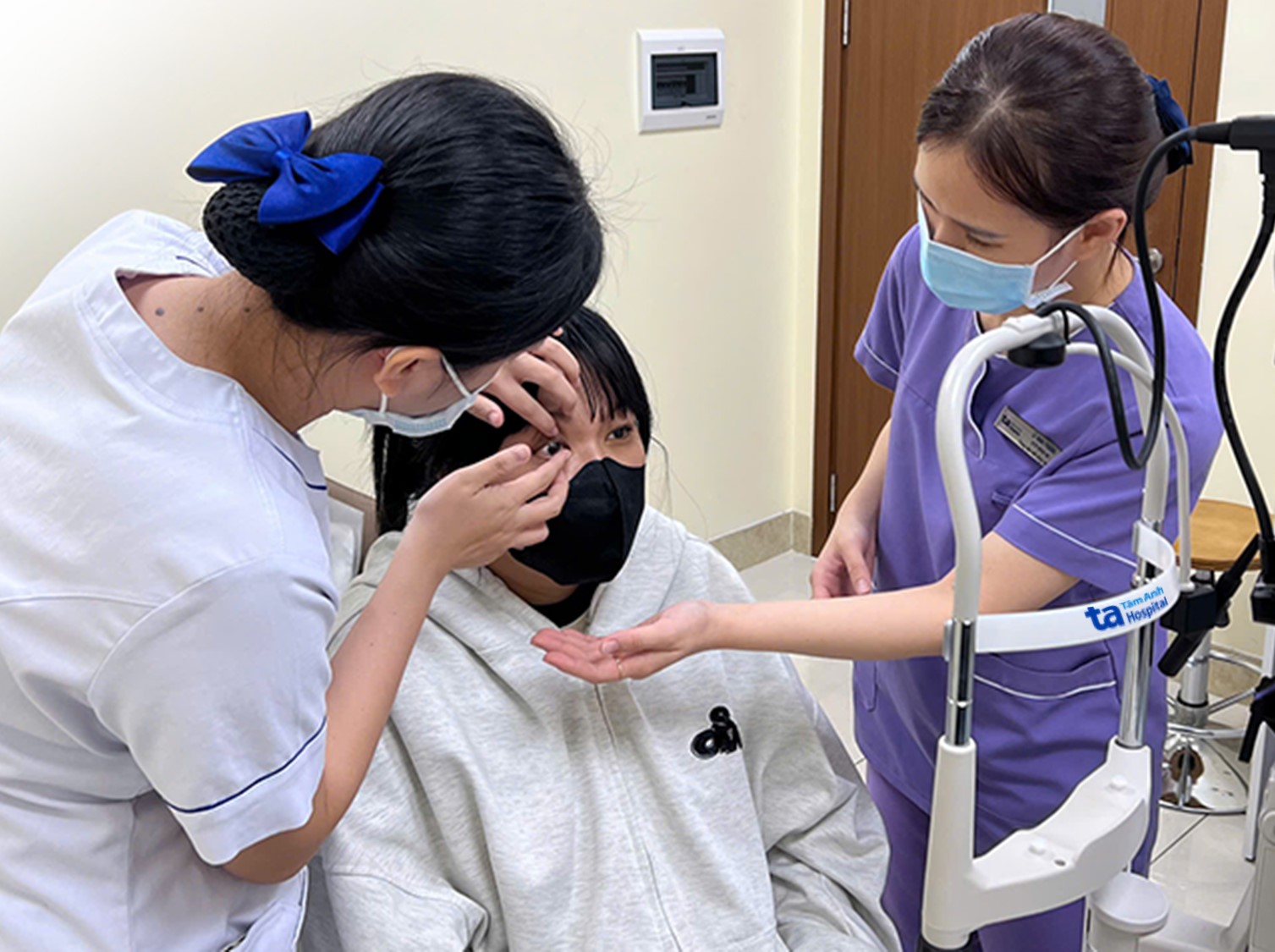 |
A refraction technician fits contact lenses for a patient. Photo: Tam Anh General Hospital
Associate Professor Hien advised that after the cross-linking procedure, patients might experience mild discomfort and tearing, which typically resolves within one to two days. Patients must wear protective glasses and avoid water, smoke, and dust during the first week post-procedure. Crucially, doctors emphasize never rubbing the eyes, as this can damage the cornea and worsen the condition.
The exact cause of keratoconus remains unclear. However, genetic factors, hormonal imbalances (post-puberty), and frequent, vigorous eye rubbing are considered high-risk factors. The disease primarily affects individuals under 30 years old. Keratoconus progresses silently, often without clear symptoms until vision rapidly declines, myopia and astigmatism quickly worsen, or vision fails to improve even with corrective lenses. Some patients present for examination at severe stages 4 or 5, requiring a corneal transplant to prevent blindness.
By Nhat Minh
| Readers can submit ophthalmology questions here for doctors to answer. |