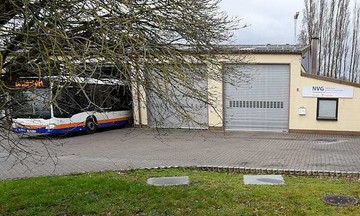
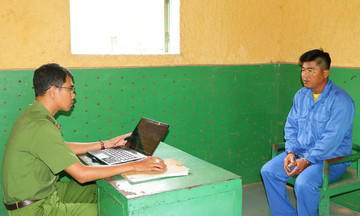
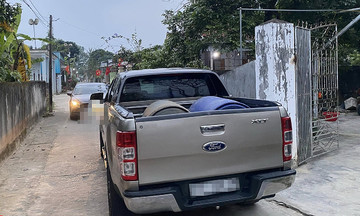
On 26/1, Hanoi Police announced that after more than one week of implementation, 269 cases of urban order and environmental hygiene violations were administratively penalized based on AI camera recordings. Additionally, nearly 580 other cases were processed following reports from organizations and individuals.
 |
Clearly recorded images of violations. Photo: Hanoi Police |
Clearly recorded images of violations. Photo: Hanoi Police
One week after issuing the guidelines for retrospective penalties, Hanoi Police assessed the application of science and technology in addressing urban order and environmental hygiene violations as highly effective. This proactive step helps maintain urban stability throughout the city.
Previously, starting 14/1, Hanoi Police expanded the features of its AI camera system to record and issue retrospective penalties for urban order violations. These include: encroaching on roadways and sidewalks, displaying goods for sale, erecting unauthorized awnings, hanging illegal advertisements, and stopping, parking, or leaving vehicles on roads and sidewalks. Other environmental hygiene behaviors are also monitored, such as: collecting and disposing of trash, personal hygiene, discarding cigarette butts, and littering in violation of regulations.
Among these behaviors, AI cameras will closely monitor: roadway encroachment, stopping and parking, waste dumping, discarding cigarette butts, and personal hygiene violations.
Concurrently, the police piloted two camera monitoring centers in O Cho Dua and Tay Ho wards. From these locations, the commune-level police camera centers have initially proven effective in proactively ensuring local security and order, operating "without stops or bottlenecks".
At the Hanoi Police Command Information Center, officers from the Administrative Management Department for Social Order and the Advisory Department collaborate in 24/7 working groups, overseeing security and order across the entire city. The high-resolution surveillance camera system is likened to "all-seeing eyes" that clearly record sharp images. Police officers can "zoom in from a great distance", with each violation point of sidewalk encroachment clearly demarcated.
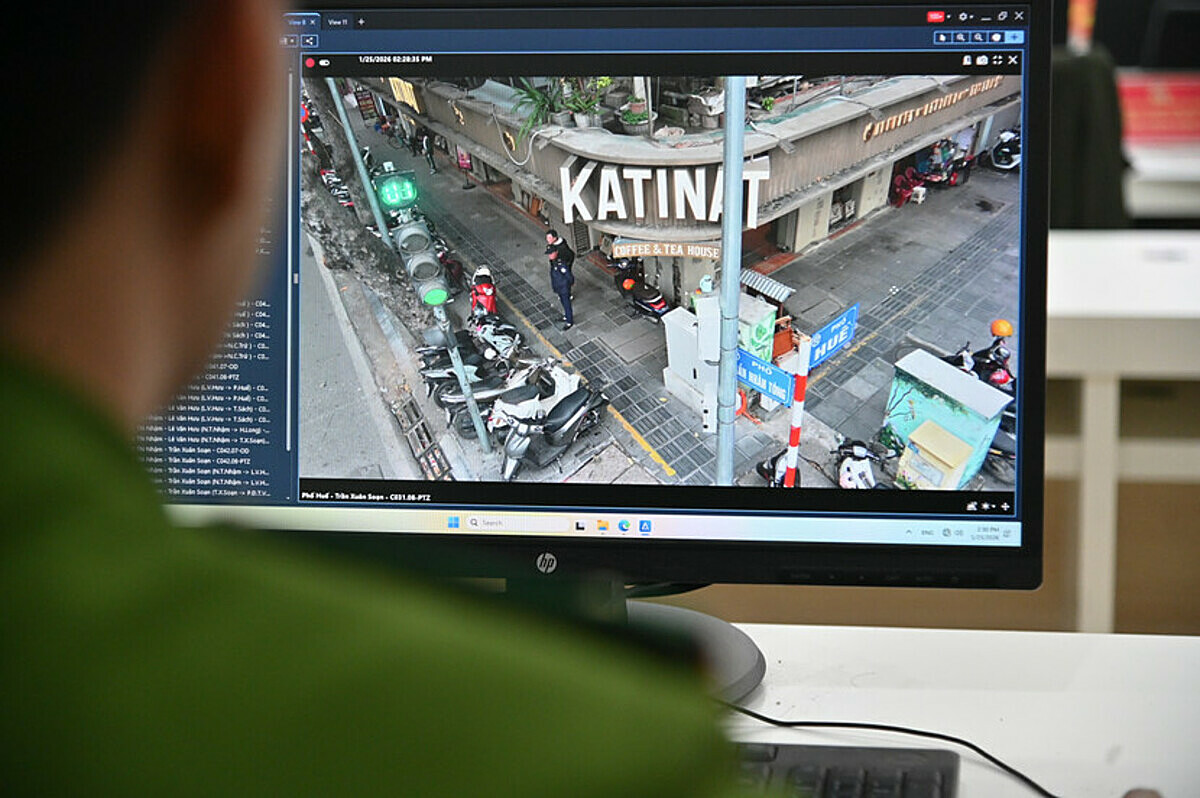 |
Violations are immediately reported by the command center to local police for processing. Photo: Hanoi Police |
Violations are immediately reported by the command center to local police for processing. Photo: Hanoi Police
Violation image data recorded by AI cameras is processed by the Command Center and forwarded to commune- and ward-level police to create retrospective penalty records. The violation images recorded by the camera system serve as objective evidence, helping reduce disputes and objections from violators.
Businesses that have committed violations and been penalized will also be regularly monitored. According to authorities, after receiving a retrospective penalty for sidewalk encroachment, one business has shown good compliance with regulations.
On 25/1, police identified 332 cases with sufficient grounds to confirm violations of urban order, public order, and environmental hygiene. Among these, some communes and wards with high numbers of urban order violations included Van Mieu - Quoc Tu Giam ward (50 cases) and Hoan Kiem ward (32 cases).