On 13/7, the Hanoi People's Court sentenced Pham Vu Kiem to a total of 26 years in prison for three crimes: 11 years for producing and trading counterfeit food, foodstuffs, and food additives; 9 years for violating accounting regulations causing serious consequences; and 6 years for money laundering.
Kiem's wife, Tran Thi Hue, who managed and operated Herbitech company, received a sentence of 7 years for producing and trading counterfeit food, foodstuffs, and food additives, and 5 years 6 months for violating accounting regulations causing serious consequences. Her combined sentence of 12 years 6 months is the second highest, after her husband's.
The remaining 17 defendants, all employees of the company, were convicted of one of the aforementioned crimes.
Sentences handed down to 19 defendants
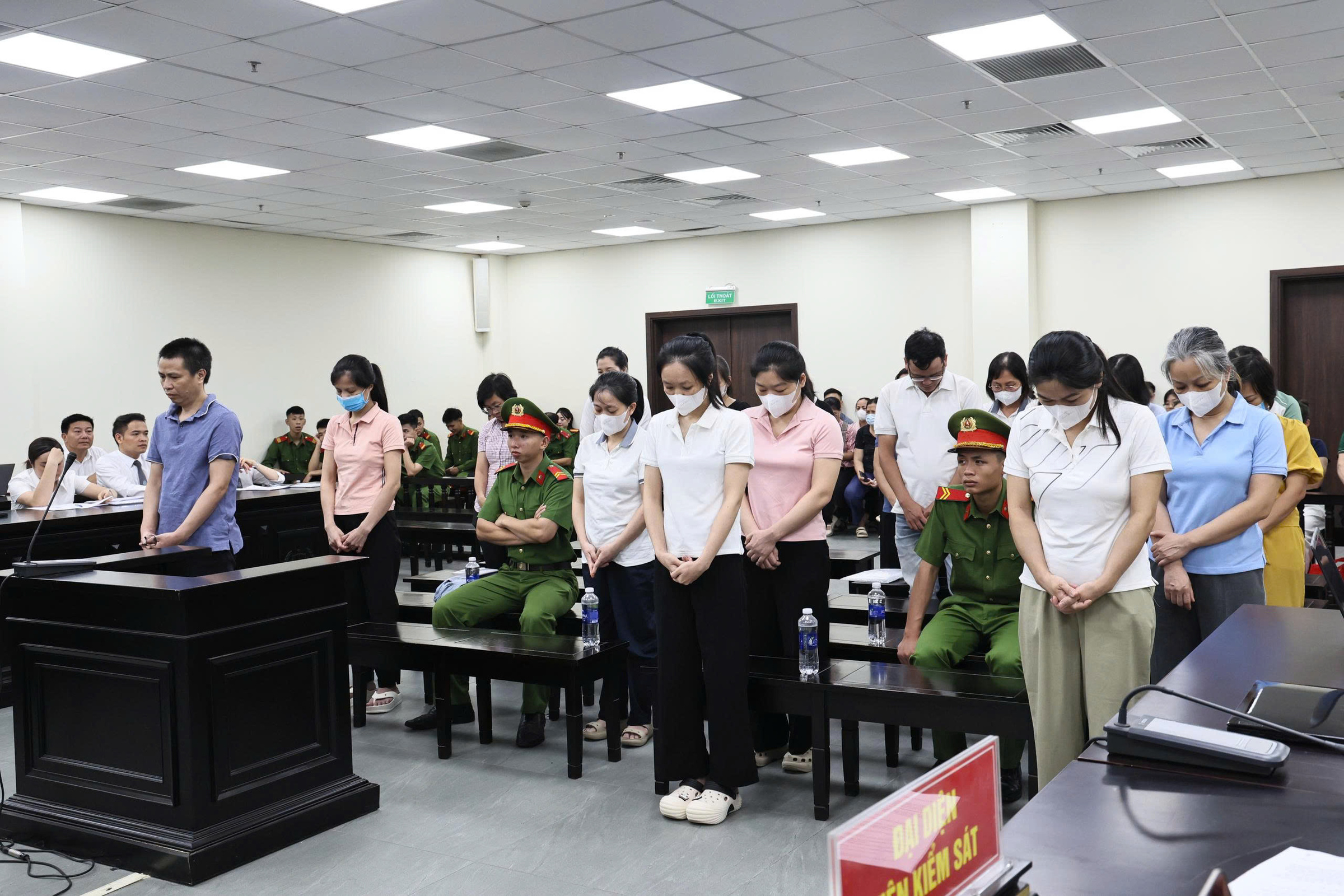 |
Kiem (top row, left) and his accomplices listening to the verdict on the afternoon of 20/7. Photo: Danh Lam.
In addition to their prison sentences, the court ordered the Kiems to return all illicit gains from selling counterfeit goods and falsifying accounting records, as they were the masterminds who directed all violations and reaped the main profits.
Court recommends Ministry of Health and authorities closely manage this product sector
Beyond the prison sentences, the trial panel also recommended that the Ministry of Health and relevant authorities, within their functions and duties, recall counterfeit products manufactured by Herbitech that are still circulating in the market.
This action aligns with the investigative police agency's request to protect consumer health.
Based on the case, the court further recommended that regulatory agencies promptly cross-reference functional food products with their declared public records. This is to detect discrepancies in ingredients and content compared to registrations early, preventing and timely addressing counterfeit production and deterring businesses from unilaterally altering product formulas.
The trial panel also noted that the investigative agency and relevant parties should examine discrepancies between the actual quantities of goods purchased and sold versus the records of individuals and other customers associated with Herbitech, as these signs may indicate other legal violations that require clarification.
For customers who purchased counterfeit Herbitech products, the trial panel stated they could exercise their right to seek compensation from the defendants through separate civil lawsuits, if desired.
According to the indictment, even though the health protection food products had registered quality declarations, Kiem still directed the reduction of ingredients, decreased content, or replaced raw materials with cheaper alternatives to boost profits and competitiveness.
To evade inspection, the group of defendants created false documents, including test certificates and warehouse import-export slips, to legitimize the batches of goods. The company produced 67 product lines identified as counterfeit, totaling over 13 million product units (packs, boxes, bottles, etc.).
The People's Procuracy determined that during six years of operation, Herbitech achieved revenues of 335 billion Vietnamese dong but only declared 145 billion Vietnamese dong for tax purposes, concealing 190 billion Vietnamese dong and causing a loss of 55,8 billion Vietnamese dong to the state budget.
Additionally, prosecutors accused Kiem of using 12,3 billion Vietnamese dong from illegal profits to acquire land use rights and invest in real estate for money laundering.
During the trial, Kiem argued that using money for investment could not be considered money laundering. Meanwhile, his lawyer contended that if his client merely reduced minor ingredients without affecting product quality, it should not be classified as producing counterfeit goods.
In response, the People's Procuracy stated that this interpretation was "misleading or deliberately distorting" legal provisions to justify criminal behavior.
According to the People's Procuracy, violating just one of the conditions regarding quality standards or technical specifications is sufficient legal grounds to conclude that a product is counterfeit. Given the nature of nutritional products, both main and auxiliary ingredients are linked to consumer trust. The law does not protect a business model where profits are enjoyed but responsibility is shirked.
Thanh Lam