Citizens are increasingly engaging with legal matters and holding higher expectations for the clarity, consistency, and practical applicability of the country's legal framework. This growing public interest signals a demand for a legal system that is more accessible and relevant to daily life, extending beyond the realm of legal professionals.
A recent survey, "Completing the Legal System Structure", conducted by VnExpress in collaboration with the Ministry of Justice last October, highlighted these public sentiments. The survey, which gathered responses from over 3,400 readers, found that nearly 86% of participants (2,947 people) had encountered situations requiring them to consult legal documents in the past 5 years. This indicates that accessing legal information is becoming a common part of daily life, showing that the law is increasingly integrated into people's lives and that citizens are more aware of protecting their rights by consulting regulations.
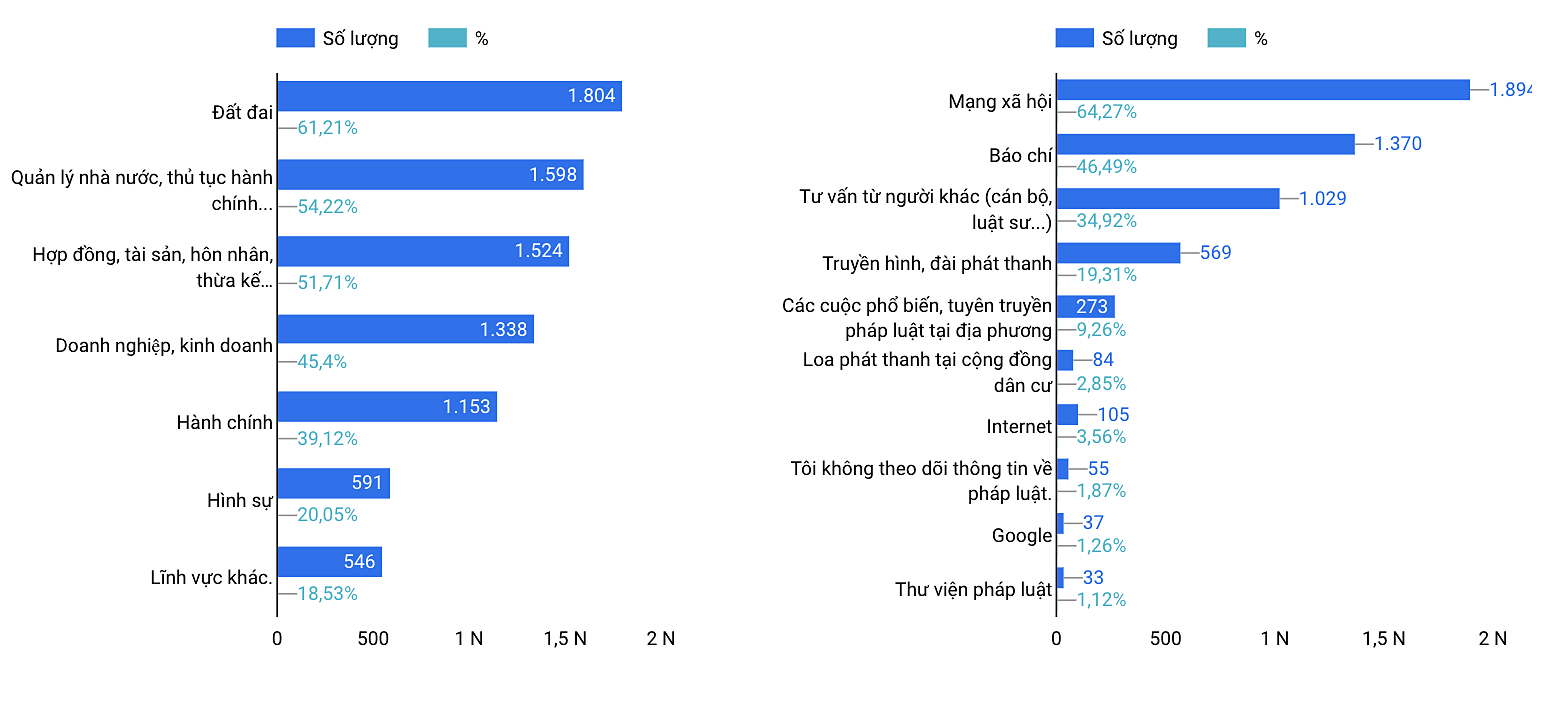
The areas where people most frequently sought legal information included: land (61,21%), administrative procedures (54,22%), marriage – inheritance – property (51,71%), business – commerce (45,4%), and general administration (39,12%). These categories of regulations directly impact the rights and daily activities of citizens and businesses.
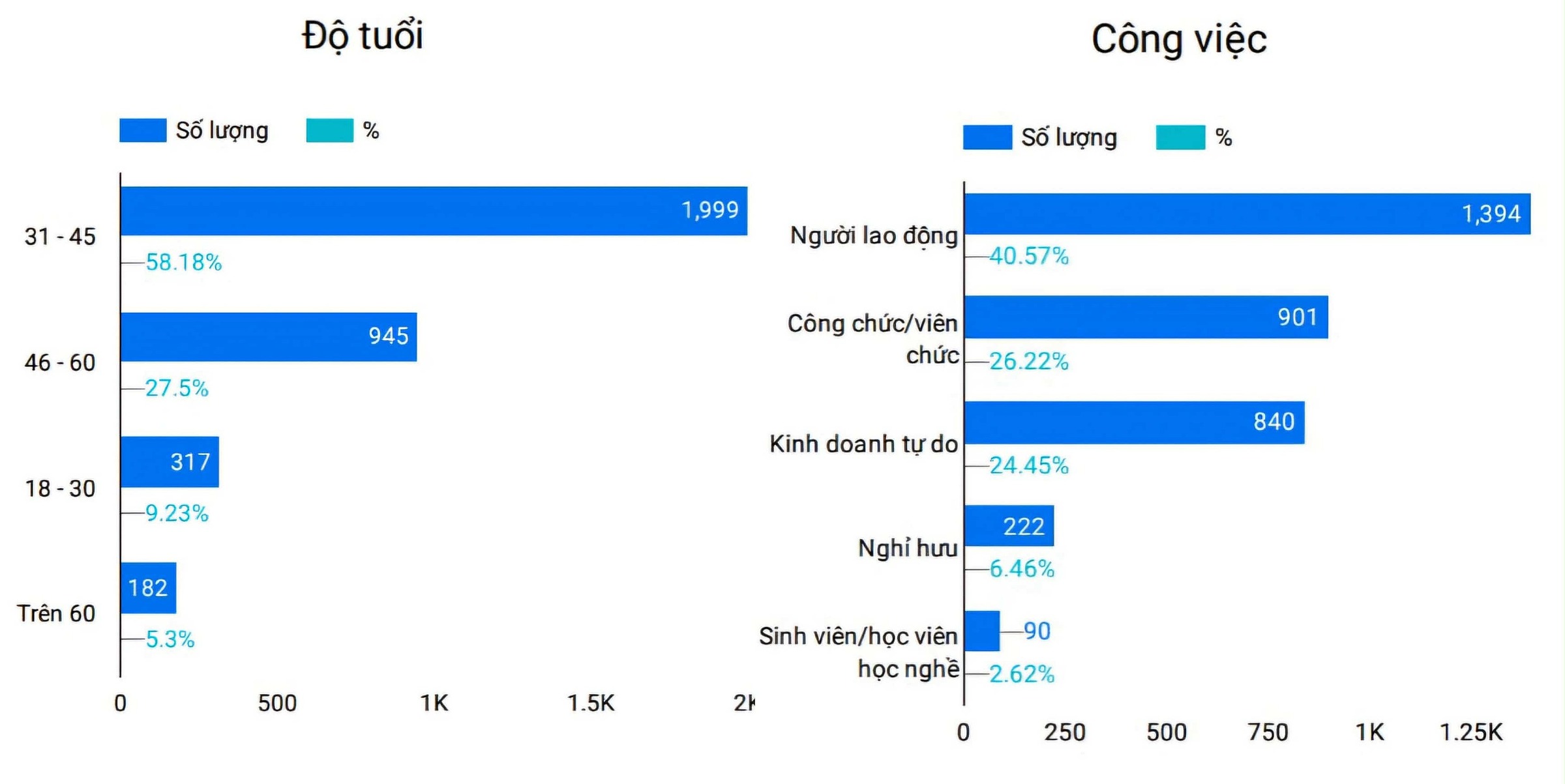
The participant breakdown shows that most respondents were from the 31-45 age group (58,18%), followed by 46-60 years old (27,5%). These age groups are actively working, conducting business, and handling administrative procedures, making them acutely aware of the need for legal improvements. Regarding occupations, 40,57% identified as laborers, 26,22% as civil servants or public employees, and 24,45% as self-employed business owners, reflecting diverse perspectives from groups significantly affected by policies.
The widespread participation of various groups, from laborers and civil servants to self-employed business owners, is a positive signal. It indicates that the need to understand the law is becoming a common societal topic, no longer a field exclusively for legal professionals. This forms a crucial foundation for future legal improvements to receive broader public consensus and support.
 |
Areas of inquiry (left) and popular sources for legal information |
The most sought-after source for legal information was social media (64,27%), followed by journalism (46,49%) and advice from officials or lawyers (34,92%). Notably, social media topped the list, indicating that legal information is being 'democratized' as quickly and widely as other lifestyle content.
 |
Citizens at an administrative procedures counter. *Photo: Dinh Van* |
Despite proactively seeking information, many people reported that accessing legal information is not truly convenient, with only 20,9% rating it 'very convenient'. Meanwhile, 31,83% found it inconvenient, and 44,15% perceived it as only 'moderately convenient'. This reflects a common challenge, as exemplified by Minh Thu, 38, residing in Hai Phong, who is currently undergoing divorce proceedings. Her parents offered to gift her land and a house as a safeguard. However, Thu is unsure about the legal implications: if her parents gift the property solely to her, would it still be divided equally with her husband during the divorce? If not, and something were to happen to her unexpectedly without a will, would her ex-husband inherit a portion? Or would it be safer for her grandparents to transfer the title directly to her daughter?
Thu, who sells fruits for a living, admitted this was her first time needing to understand a legal issue. She searched online for answers, but the links led her to numerous legal documents filled with terminology that made her pause. "I hope laws are written in an easier-to-understand way, and if they undergo multiple amendments, a consolidated document should be available", she said, adding that she often reads a regulation only to find it has been amended, forcing her to search for the new one for comparison, which is "very difficult."
Regarding document quality, despite numerous suggestions, most survey participants acknowledged that current laws are largely practical. The combined percentage of those who rated them 'appropriate' or 'quite appropriate' reached nearly 49%, indicating that many regulations have kept pace with societal changes, particularly in areas of daily life, business, and administrative procedures.
Increasing expectations for legal reform
Concerning the quality of legal documents, citizens commonly cited limitations such as unclear regulations, overlapping or conflicting provisions, lack of practical relevance, and insufficient foresight for various situations. This highlights that the demand for legal reform is not narrow but comprehensive, encompassing writing style, document structure, and consistency with practical implementation.
A survey of over 200 free-form comments revealed clear public expectations for a modern, accessible legal system that accurately reflects daily life. The most prominent demands were for consistency and synchronicity, avoiding overlaps and conflicts between documents.
 |
Many people believe that having to cross-reference too many decrees and circulars confuses even officials. They hope for a single, consolidated document for each area, complete with an effectiveness diagram, clear definitions, and limited convoluted cross-referencing.
Alongside this is a strong desire for practicality and real-world applicability. Many people reported that regulations are often out of touch with daily life or difficult to apply, especially in areas like land, residency, taxes, and traffic. The discrepancy between 'one way online – another way at the agency' causes wasted time, so they hope laws will come with specific guidelines, sample scenarios, practical examples, and that implementers will apply laws consistently.
Regarding transparency, most opinions called for an official, free, data-linked, and timely updated search portal. Many suggested integrating all legal documents into the VNeID application, incorporating artificial intelligence (AI) to summarize information, answer questions, and help citizens understand quickly and accurately.
Feasibility was also frequently mentioned: a law is only effective if implementers understand and apply it correctly. Citizens hope to limit 'arbitrary interpretation', avoid unnecessary difficulties, and prevent buck-passing. Many opinions emphasized the need for strict penalties for official misconduct, to prevent situations where 'laws exist but are ineffective'.
Furthermore, stability was strongly emphasized: documents change too quickly, making it difficult for both citizens and businesses to keep up and often requiring them to pay fees for updates. They hope that each amendment will be clearly announced and allow for a period of public awareness before implementation.
Finally, many opinions expressed a desire for legal policies to be comprehensive, humane, and easy to understand: using unambiguous, concise language; popularized in schools; protecting vulnerable individuals; enhancing deterrence while still aiming for sustainable development.
All share a common desire for a legal system that is close to the people, clear, and truly serves daily life.
Hai Thu