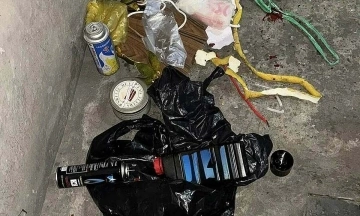
On the evening of the incident, a 15-year-old girl named Truong died after falling from her bedroom window in an apartment building. She was reportedly trying to sneak out for a date. Her parents subsequently filed a lawsuit against her boyfriend, Dinh, and the apartment management company, demanding over 300,000 CNY in damages.
According to the lawsuit filed by Truong's parents, police investigation determined that Truong's death was an accident from a fall, not a murder or criminal case. The parents accused Dinh of meeting Truong through a social media application and entering a relationship with the minor. They claimed that Dinh had previously encouraged Truong to climb out her bedroom window and use the fire escape to sneak out of the house. On the night of the incident, the couple had planned to meet. The parents alleged that Dinh again enticed Truong to climb out her bedroom window, which led to her fall from the building. They further claimed that Dinh entered the apartment complex, took the elevator down to the fire escape to observe the scene, but took no action to help her.
Truong's parents also accused the apartment management company of negligence. They asserted that the company failed to fulfill its service contract obligations, was lax in its management, and did not install warning signs or safety equipment. These management failures, they argued, were the cause of Truong's fall.
The apartment management company, however, argued that the building's design and the construction of the fire escape met all legal standards. They contended that Truong's guardians and Truong herself were responsible for her death. They pointed out that Truong was over 15 years old and had started working, implying she should have been aware of her own safety. Given her age, mental capacity, and education level, Truong should have recognized the dangers of climbing at height. The company also stated that as guardians, Truong's parents did not adequately monitor her behavior and failed to prevent dangerous actions, thus bearing responsibility for not fulfilling their guardianship duties.
The first-instance court focused on whether the two defendants were at fault for Truong's death and if they should compensate the plaintiffs. The court acknowledged the police finding that Truong's death was an accident. The evidence presented by Truong's parents did not show that the apartment management company had illegally modified the apartment. The distance between the apartment and the fire escape, as well as the height of the fire escape railing, complied with legal regulations. Regarding safety signs, the property management service contract had no related provisions. Moreover, the court found no legal causal link between these issues and Truong's death. The court concluded that Truong should have been aware of the dangers of climbing from her bedroom window to the fire escape. She put herself in an extremely perilous situation, which exceeded the scope of the apartment management company's reasonable safety obligations. Therefore, the apartment management company was found not at fault for Truong's death.
Regarding Dinh, the court stated that while his relationship with a minor might be ethically questionable, the available evidence did not prove he enticed Truong to climb out the bedroom window on the night of the incident or that he subsequently failed to rescue her. The court determined Dinh was not at fault, as there was no legal causal link between his actions and Truong's accidental death.
On 4/2, Hongxing News reported that the Puyang County People's Court in Henan Province issued its first-instance ruling, dismissing the parents' lawsuit and rejecting their claim for over 300,000 CNY.
Tue Anh (according to Chinacourt, Qilu Evening News)