On the morning of 4/4, at the Ministry of Justice headquarters, General Luong Tam Quang, Minister of Public Security; Nguyen Manh Hung, Minister of Science and Technology; and Nguyen Hai Ninh, Minister of Justice, co-chaired the signing ceremony for the "inter-agency coordination regulation on administrative procedure reform".
In his opening remarks, Minister Nguyen Hai Ninh stated that administrative procedure reform has received significant attention from the Party and the State, who consider it a key breakthrough. This reform also plays a crucial role in the transition from e-government to digital government, using data as a foundation to cut and simplify administrative procedures.
Regarding recent achievements, Mr. Ninh noted that from 2021 to 2025, ministries and sectors appraised over 3,600 administrative procedures within 377 policy proposals, projects, and draft legal documents. In 2025 alone, the Prime Minister approved plans to cut and simplify more than 3,000 administrative procedures related to production and business activities.
Furthermore, based on the connection and sharing of the Ministry of Public Security's National Population Database, the Government directed the reduction and simplification of 1,000 administrative procedures related to citizen documents. The Government also issued 30 Decrees, decentralizing and delegating 748 administrative procedures from the central level to provinces and 268 procedures to the commune level.
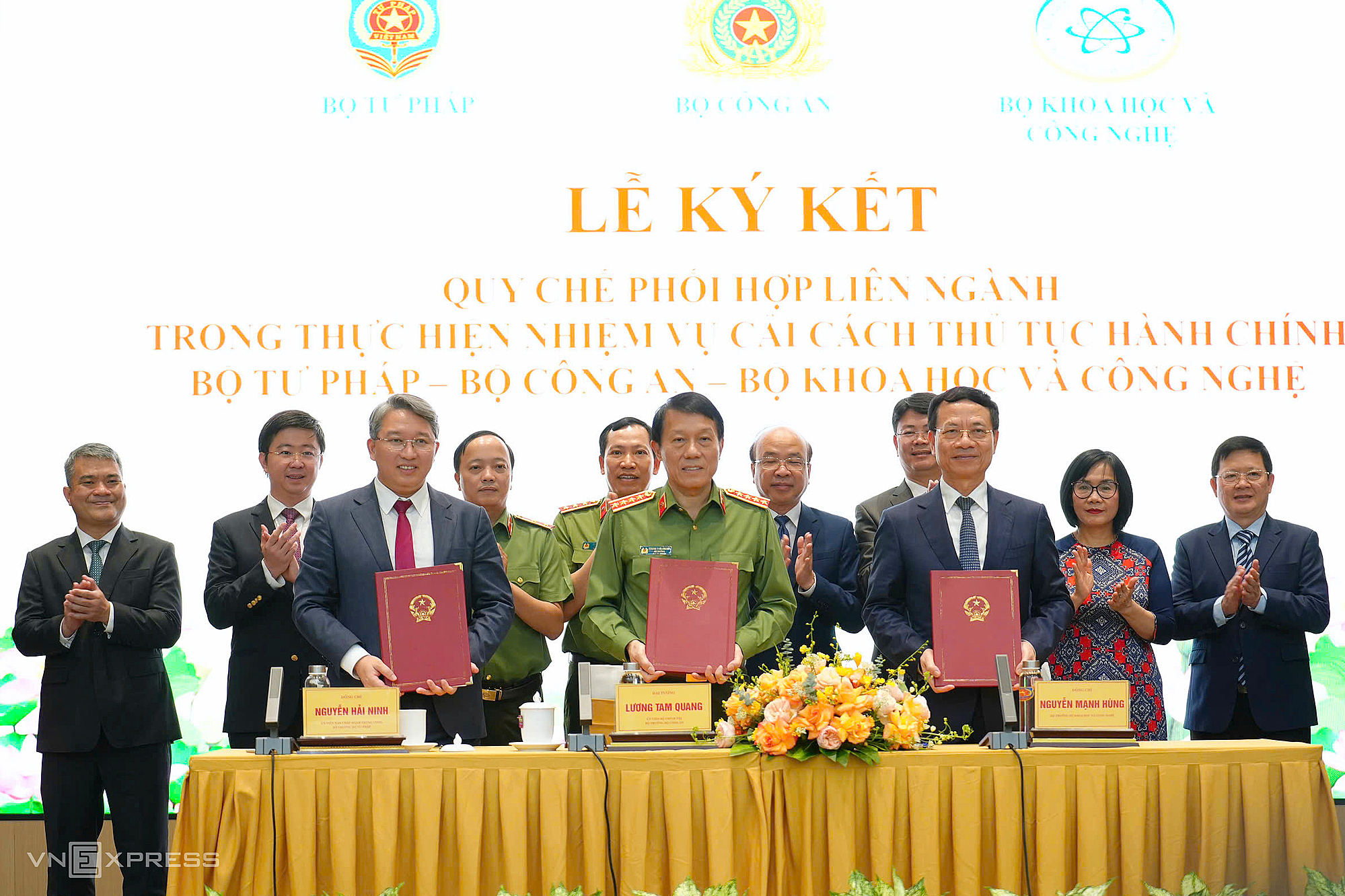 |
Ministers of the three ministries co-chair the signing ceremony. *Photo: Linh Dan*
According to Minister Ninh, these results directly impacted the online Service Index (OSI), one of the three components of the e-government index evaluated by the United Nations. International organizations recognized Vietnam as a leading model in the region for rapid improvement in its e-government index, approaching leading nations like South Korea and Denmark.
In the coming period, the demand for administrative procedure reform is increasingly urgent, especially regarding institutions, data, and infrastructure platforms. Therefore, he views the roles of the Ministry of Public Security, Justice, and Science and Technology as "direct and important."
The signing of the regulation aims to ensure implementation is "unified, effective, consensual, and closely coordinated". Mr. Ninh hopes that the signing and implementation of this inter-agency coordination regulation among the three ministries will make administrative procedure reform "substantive and effective", thereby better meeting the nation's development requirements and public expectations in the new period.
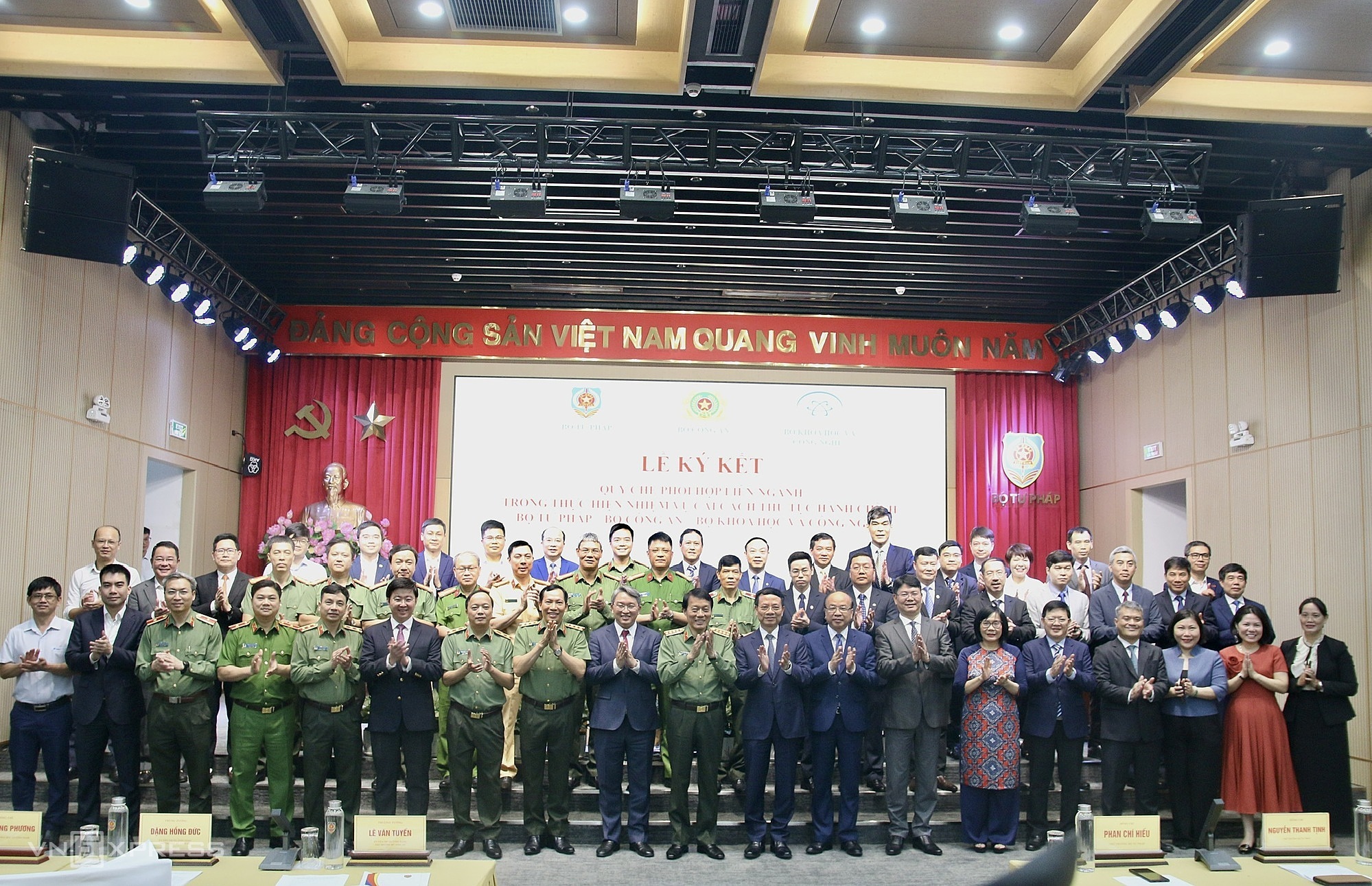 |
Delegates attend the signing ceremony. *Photo: Linh Dan*
According to the Ministry of Justice, the coordination regulation comprises 3 chapters and 12 articles, clearly stipulating the coordination mechanism for administrative procedure reform. Specifically, the Ministry of Justice serves as the general coordinating agency for institutional and reform tasks and leads the implementation of administrative procedure control operations.
The Ministry of Public Security leads on data management and usage, electronic identification, and authentication. The Ministry of Science and Technology leads on developing platforms and technical infrastructure.
The regulation also establishes the principle that all changes related to public service provision and procedure resolution in the digital environment must have the unanimous agreement of the three ministries, except for technical aspects.