This content is included in the draft revised 2026 Criminal Code, prepared by the Ministry of Public Security, and is expected to be submitted to the National Assembly for feedback during its August session.
The current Criminal Code stipulates that courts only consider probation for prison sentences not exceeding three years. In the draft, the Ministry of Public Security proposes extending the application of probation to 5 years, based on personal background and mitigating circumstances, if imprisonment is deemed unnecessary.
In such cases, the court may grant probation with the condition of "paying a sum of money to replace the prison sentence" and set a probationary period of one to two years.
Cases typically eligible for probation up to three years would not require a substitute payment.
To ensure strict enforcement, the draft maintains the provision that if a person on probation intentionally violates obligations under the Law on Criminal Judgment Enforcement two times during the probationary period, the court may compel that person to serve the original prison sentence.
**Prioritizing asset recovery**
The Ministry of Public Security assesses that the scope of offenses currently subject to monetary penalties is relatively narrow. The current law only recognizes an exception for "first-time offenders of less serious crimes committed unintentionally with a clear place of residence" (Article 38, Clause 2, Criminal Code).
In practice, very serious offenders involved in corruption-related crimes can be subject to this penalty, in line with the spirit of judicial reform strategy. Anti-corruption policies also prioritize the recovery of lost assets.
Expanding the range of offenses for which monetary penalties can be applied instead of imprisonment will help reduce incarceration and prison management costs, while increasing state budget revenue from cases motivated by illicit gains.
This is particularly significant for economic and official position crimes without corruption elements, where the main goal of punishment is to "restore the original state and compensate for damages."
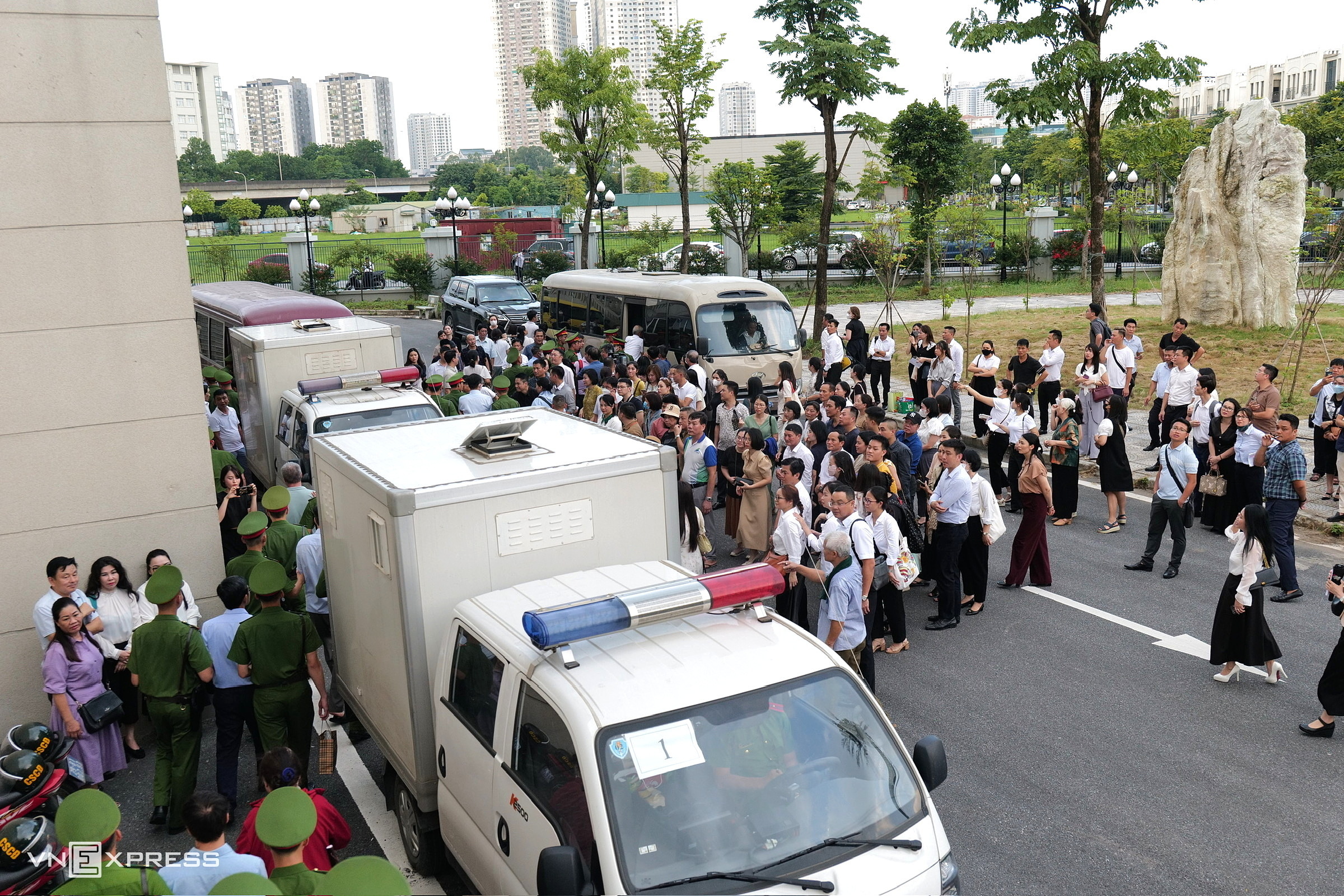 |
Relatives of defendants wait outside the courtroom after the Hanoi People's Court announced its verdict. Photo: Ngoc Thanh |
The mechanism of replacing prison sentences with financial obligations for less dangerous crimes is widely adopted in other countries.
In Germany, approximately 632,100 people were convicted in 2024. Of these, 506,500 cases (80%) received only monetary penalties, about 14% were sentenced to prison, and the remainder received sanctions under juvenile law.
A study by the University of Chicago also shows that only about 5% of convicted individuals serve immediate prison sentences, about 10% receive suspended sentences, and the majority only face monetary penalties.
This reflects Germany's philosophy of prioritizing monetary penalties and alternative measures over incarceration for less serious offenses.
England and Wales follow a similar trend. Statistics from the Ministry of Justice show that in 2025, courts imposed nearly 929,000 monetary penalties. In contrast, prison sentences were significantly lower, affecting 88,000 people.
More than 77,500 community sentences and nearly 53,000 suspended sentences were also applied. Facing prison overcrowding, the British Government continues to consider expanding the scope of probation and short-term alternative measures.
Data from World Prison Brief indicates that countries prioritizing monetary penalties, probation, and non-custodial measures generally have significantly lower incarceration rates.
Japan has only about 36-38 incarcerated people per 100,000 population, among the lowest in the world. Germany has about 69 people per 100,000 population.
In contrast, the US has about 541 incarcerated people per 100,000 population, nearly 8 times higher than Germany and about 15 times higher than Japan.
Hai Thu