In a suburban New Jersey park, a lively atmosphere replaces the usual silence of the digital age. Girls swing on monkey bars, draw with chalk, while boys play an impromptu football game. Electronic screens are notably absent.
This scene embodies a "reverse revolution" quietly spreading from the East Coast to Seattle. Holly Moscatiello, founder of The Balance Project, a nonprofit, describes it as a journey of correction. "We have seen the consequences of technology overuse," she stated.
 |
Ryan Glubo, a parent in Oceanport with children aged 8 and 4, plans to wait until they are 16 before allowing smartphones and 18 for social media. *Photo: AOL* |
Escaping the 'glass cage'
The year 2025 marks a turning point for the "no-smartphone children" movement. This trend gains momentum from social psychologist Jonathan Haidt, author of the bestseller *The Anxious Generation*, who advocates banning smartphone use for children before the age of 14.
Previously, American parents were caught in a "helicopter parenting" culture, often referred to as "raising children in a glass cage". From birth, every breath and sleep was monitored via cameras and smart wearable devices.
Data from the Pew Research Center reveals that over half of children under 12 use smartphones. Yet, a paradox emerges: increased exposure to the virtual world correlates with decreased real-life freedom. Haidt's survey shows most children aged 8-12 cannot go out unsupervised, and 25% are not permitted to play alone even in their own front yard.
"I remember my childhood; my parents simply told me to 'be home by dinner time'. Now, excessive safety fears keep children indoors, and social media fills that void," one father shared.
Ryan Glubo, a parent of two children aged 8 and 4 in Oceanport, stated he will wait until his children are 16 before allowing them smartphones. "I want my children to have a real childhood, not one experienced through a screen," he explained.
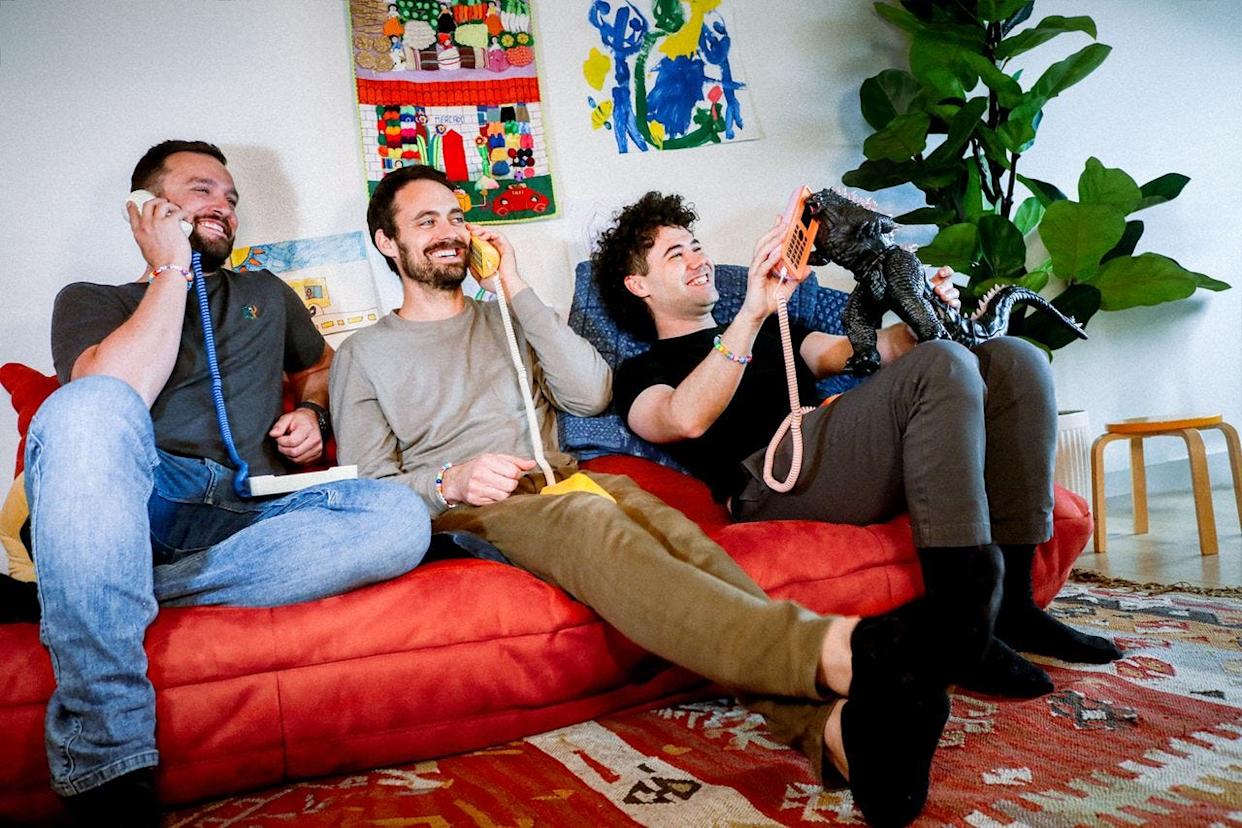 |
From left to right: Tin Can co-founders Graeme Davies, Chet Kittleson, and Max Blumen. *Photo: AOL* |
'Brick' phones make a comeback
In Seattle, a group of parents seeking to foster independence while firmly rejecting social media have embraced low-tech solutions. They provide their children with phones resembling toy landline models, which support Wi-Fi but offer only basic call functions.
Produced by the startup Tin Can, this device allows free calls to emergency numbers and other Tin Can phones. Parents can set "quiet hours" and block unknown numbers. With a monthly subscription fee of about 10 USD, these phones are selling out across 50 states.
In communities like Oceanport, the trend's ripple effect is pronounced. When one parent pioneered buying a "brick" phone, the entire neighborhood quickly followed. Megan Timmermann, a Seattle mother, shared, "I want my children to experience the independence and innocence our generation had."
Beyond individual family efforts, this movement is expanding to a policy level. As of 11/2025, 36 states and Washington D.C. have enacted regulations restricting phone use in schools.
Over 130,000 parents nationwide have signed the "Wait Until 8th" pledge, committing not to provide smartphones until their children reach 8th grade. Hundreds of chapters for organizations like Landline Kids and Log OFF have formed, creating a support network for families aiming to shield their children from social media algorithms.
By Bao Nhien (USA Today)