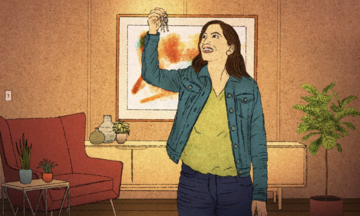
The trend began with videos by Zhou Yuan, a Chinese KOL self-proclaimed as a "sex index expert." She became known for courses teaching women to manipulate men using eye contact and posture for financial and social gain.
Zhou Yuan was banned from broadcasting due to content promoting distorted and morally decadent views. Nevertheless, her "flirty glance" techniques quickly became memes and parodies across many forums. Numerous videos now teach how to use eye contact for "power" in the workplace or when interacting with relatives during Tet (Lunar New Year).
Setting aside harmful elements or manipulative tactics, psychology experts affirm that, when used correctly, controlling eye contact, posture, and tone are scientifically grounded communication skills.
 |
Illustration: Pexels. |
Below are three non-verbal communication techniques proven through research, helping you master conversations civilly.
How long is enough eye contact?
Eye contact shows respect, but staring causes discomfort. According to Equilibrium Theory, proposed by researchers Michael Argyle and Janet Dean, people consistently maintain a stable level of intimacy by compensating adjustments between "standing distance" and "gaze duration."
For general social interaction: At close range (around 0.6 m), you should only maintain eye contact for about 30% of the conversation time to reduce pressure on the other person. If standing further away (around 1.8 m), this ratio needs to increase to 66% to compensate for the distance and show active listening.
To build rapport: Eye contact lasting around 5 seconds is much more effective than 2-3 seconds. However, prolonged eye contact at close range is only appropriate when a certain level of intimacy exists. Reckless application, as seen in online videos, will activate defense mechanisms, causing anxiety and fear in the other person.
To set boundaries: When offended, maintaining a high gaze and looking directly at the other person is the strongest non-verbal signal for warning, instead of bowing your head and avoiding eye contact.
Open posture activates biological confidence
Psychology divides body posture into two types: open posture (arms spread, head held high) and closed posture (arms crossed, hunched).
In 2010, social psychologist Amy Cuddy and her colleagues at Harvard University published research on "Power Poses." Results indicated that maintaining an open posture for two minutes could increase testosterone (a confidence and dominance hormone) and decrease cortisol (a stress hormone). While this research sparked debate regarding its ability to increase biological hormone secretion, changing posture is still recognized to temporarily improve psychological confidence.
This aligns with Embodied Cognition Theory, which suggests that the body's state not only reflects the mind but also reciprocally impacts and shapes our thoughts.
When stressed, instead of hunching over, stand up, stretch, and open your chest to "hack" your brain into becoming calmer. When giving a presentation, stand with your feet shoulder-width apart to create a sense of authority.
Paralanguage
The same phrase, "You're great," can become a compliment or sarcasm depending on the tone. This is paralanguage, the factor determining how listeners interpret your message.
According to research by Professor Albert Mehrabian (University of California, Los Angeles), when there is a conflict between words and gestures, listeners tend to trust body language (55%) and tone (38%) more than the verbal content (7%).
To persuade: Use a moderately fast speaking pace and a slightly low tone to convey certainty.
To comfort: Lower your tone and speak slowly to create a sense of safety (associated with calmness).
To assert authority: Suddenly lowering your voice and slowing down at key points will carry more weight than shouting.
Experts conclude that while techniques are important, sincerity and inner confidence are the core elements that create attraction in communication, more than any "acting" with the eyes.
Bao Nhien (According to Wenxuecity)