In mid-March, Sadlu, 21 years old, a factory worker in Surat, Gujarat, saw his work hours cut as his textile plant reduced production due to fuel shortages. Supply disruptions from the Gulf region caused gas prices to escalate. Migrant workers like Sadlu were forced to purchase gas on the black market, where prices surged from 1,000 rupees to 4,000-5,000 rupees per cylinder. Unable to afford the rising cost of living, Sadlu and his brother decided to return to their hometown in Prayagraj district, Uttar Pradesh, 1,400 km away, sacrificing their daily income of 500 rupees (7 USD).
Sadlu's story reflects a common situation across many of India's industrial centers. At train stations, long lines of workers, burdened with belongings, queue for trains departing urban areas.
Congestion in the Strait of Hormuz, a critical gateway for one-fifth of global oil and gas, has created a ripple effect, negatively impacting India's economy. In Surat, a city attracting a large number of migrant laborers, gas for industrial production is not subsidized, causing costs to multiply. Ashok Jirawala, President of the Gujarat Textile Workers Welfare Association, estimates businesses could incur losses of up to 10 million rupees daily. Consequently, workshops have reduced workdays from seven to five per week. Approximately 150,000 workers, representing 30% of Surat's migrant labor force, have vacated their rented accommodations and left the city due to dwindling incomes.
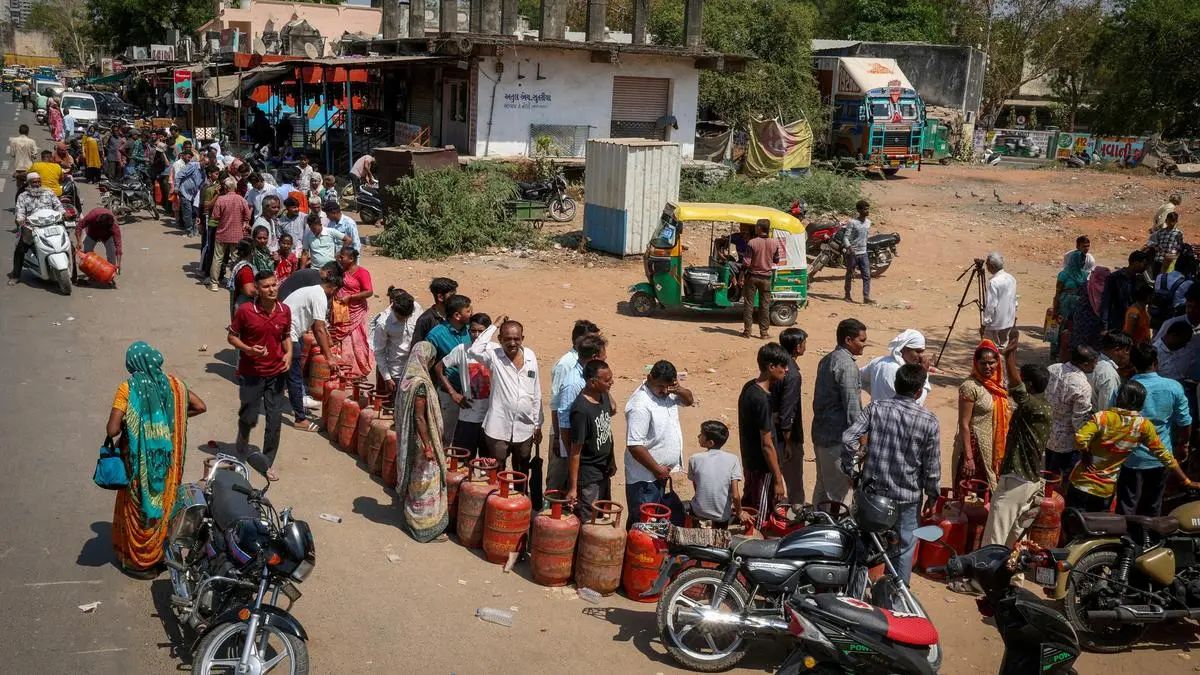 |
Residents in Ahmedabad, Gujarat, queue to exchange gas cylinders for cooking, 3/2026. Photo: The Hindu
Residents in many urban areas are also impacted. In Bengaluru, long lines of auto-rickshaws wait at liquefied petroleum gas filling stations. People spend hours queuing to buy domestic gas cylinders, and demand for electric stoves has surged, while many impoverished households have reverted to burning wood for cooking.
Even after returning home, laborers carry the burden of financial insecurity. Rural states like Uttar Pradesh, Odisha, and Bihar, which inherently offer limited job opportunities, struggle to absorb the influx of returning migrants.
Back in his village, Sadlu feels temporarily safe but remains concerned about financial instability. He has sufficient funds for immediate food expenses but not for other needs, while job prospects in his hometown are very limited. "I will have to return to the city, but I haven't determined the timing," he stated.
At a garment workshop in Surat, director Naseem Khan reported that half of his workers had departed. If the workshop were to close completely, he himself would not be able to sustain himself in the city. "I have a wife and five children; how could I support them if I stay? I will likely return to my village and farm," he said.
Ngoc Ngan (Based on Straits Times, The Hindu)