Data from the National Institute of Technology and Evaluation (NITE) of Japan reveals a concerning trend: between 2021 and 2025, the agency recorded 345 incidents involving air conditioners. Of these, 322 cases, accounting for over 90%, were fires, resulting in 7 fatalities and 33 injuries. Nearly half of these incidents did not stem from manufacturing defects but from flammable objects placed near the outdoor units or indoor units.
In 2022, an outdoor air conditioner unit in Miyagi Prefecture caught fire. The unit was covered with a plastic tarp and had a water bottle placed on top, intended to prevent wind damage. Under the intense sun, the water bottle inadvertently acted as a magnifying lens, concentrating sunlight and igniting the tarp.
Another fire in Tokyo in 2024 originated from a user stripping the insulation from a power cord, twisting the copper wires, and connecting them to another cable. This loose connection generated an electrical spark, leading to the fire.
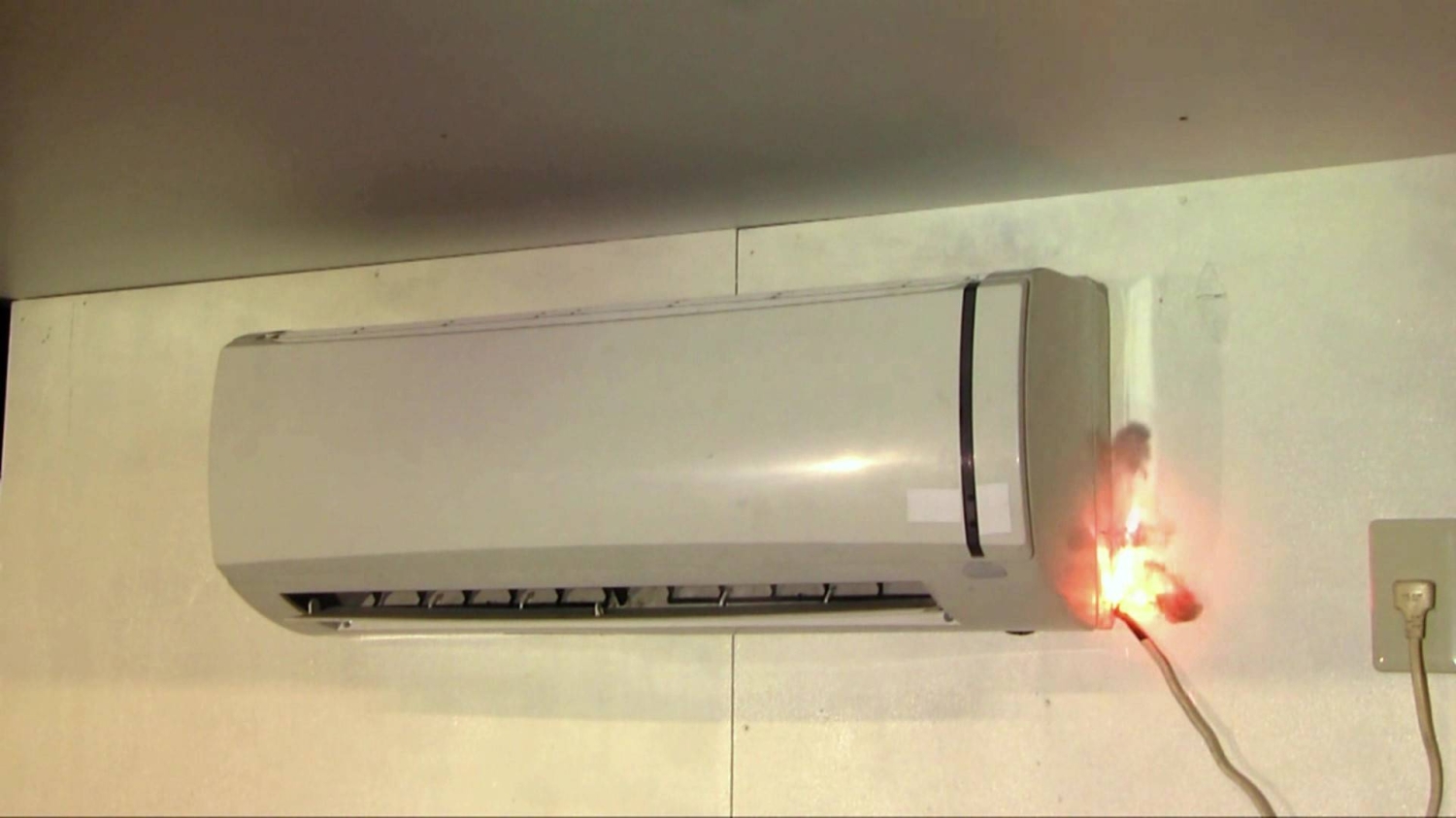 |
An experiment demonstrates that stripping insulation from an air conditioner power cord and connecting it to another cable can lead to a fire. Japan Times. |
An experiment demonstrates that stripping insulation from an air conditioner power cord and connecting it to another cable can lead to a fire. Japan Times.
NITE also warns against the common habit of leaving trash bags or old cardboard boxes around outdoor units. These materials are highly flammable, and the risk escalates significantly when the outdoor unit operates during peak sunny days. A cluttered area around the unit also attracts animals and insects, which can build nests and chew through internal cables.
Dust accumulation and moisture build-up on neglected equipment can cause electrical discharge between circuit boards. Users must perform regular maintenance and immediately disconnect the circuit breaker if they detect a burning smell, unusual sounds, or an abnormally hot power cord.
The Tokyo Fire Department (TFD) emphasizes that blocking the airflow of an outdoor unit not only wastes electricity but also causes the compressor to overheat, leading to internal short circuits. TFD advises residents to clear all flammable debris and avoid placing obstructions in the path of air expelled from the outdoor unit.
Bao Nhien (According to Japan Times)