An egg consists of two components with different protein structures and cooking temperatures. The egg white, primarily containing ovalbumin, begins to set at around 62 degrees C and fully solidifies at 80 degrees C. The yolk starts to set at 65 degrees C and becomes completely firm at 70 degrees C.
Chef Vu Nhat Thong from Eric Vu Cooking Class explains that heat must penetrate the egg white to reach the yolk. Therefore, cooks need to precisely time the process so the white sets just as the heat has not yet deeply impacted the center. A grayish-green ring around the yolk is a chemical reaction between sulfur in the egg white and iron in the yolk, forming iron sulfide (FeS). This indicates the egg has been overcooked.
Achieving the desired doneness for boiled eggs is straightforward if you master precise timing and basic conditions. These include: using medium-sized chicken eggs (55-60 g), allowing eggs to reach room temperature (removing them from the refrigerator 30 minutes prior), adding eggs to boiling water, maintaining a gentle simmer, and starting the timer immediately upon placing eggs in the pot.
| Doneness Level | Time | Characteristics | Application |
| Level one | 5 minutes | White is just softly set, yolk is completely liquid and glossy. | Onsen-style egg, served with hot rice and soy sauce. |
| Level two | 6 minutes 30 seconds | Outer yolk is set, center is soft, moist, and deep orange. | Ramen dish, perfect jammy egg. |
| Level three | 8 minutes | Yolk is fully set but still moist, bright yellow, and creamy. | Sandwiches, salads. |
| Level 4 | 9 minutes 30 seconds | Yolk is fully set but still moist, bright yellow, and creamy. | Soy-marinated eggs, braised eggs. |
| Level 5 | 11 minutes | Perfectly hard-boiled, yolk is dry but without a green ring. | Egg salad, mashed eggs. |
| Level 6 | Over 13 minutes | Yolk is dry and crumbly, with a grayish-green ring and a slight sulfur smell. | Overcooked, best avoided. |
Immediately after removing the eggs, submerge them in an ice bath for at least 5 minutes. This shock treatment stops the residual cooking process. Skipping this step could turn a level one egg into a level two.
The issue of eggs being difficult to peel often relates to the egg's age, not solely technique. Very fresh eggs have a low egg white pH, causing the membrane to cling tightly to the shell. Eggs stored in the refrigerator for 5 to 7 days will see an increase in pH, allowing the membrane to separate more easily, making peeling simpler.
For easier peeling, place eggs into boiling water instead of cold water for a few minutes. Then, gently tap the large end of the egg, as this is where the air pocket is located, making it easier to peel.
Adding salt or vinegar to the boiling water only helps the egg white set faster, preventing spillage if the shell cracks, but it does not aid in easier peeling.
Avoid boiling cold eggs directly from the refrigerator, as the temperature difference can cause the shell to crack easily and alter cooking times by one to 1,5 minutes from the standard. Also, do not add too many eggs at once, as this significantly drops the water temperature and takes longer to return to a boil, skewing the timing chart. The recommended ratio is a maximum of 4 eggs per one liter of water.
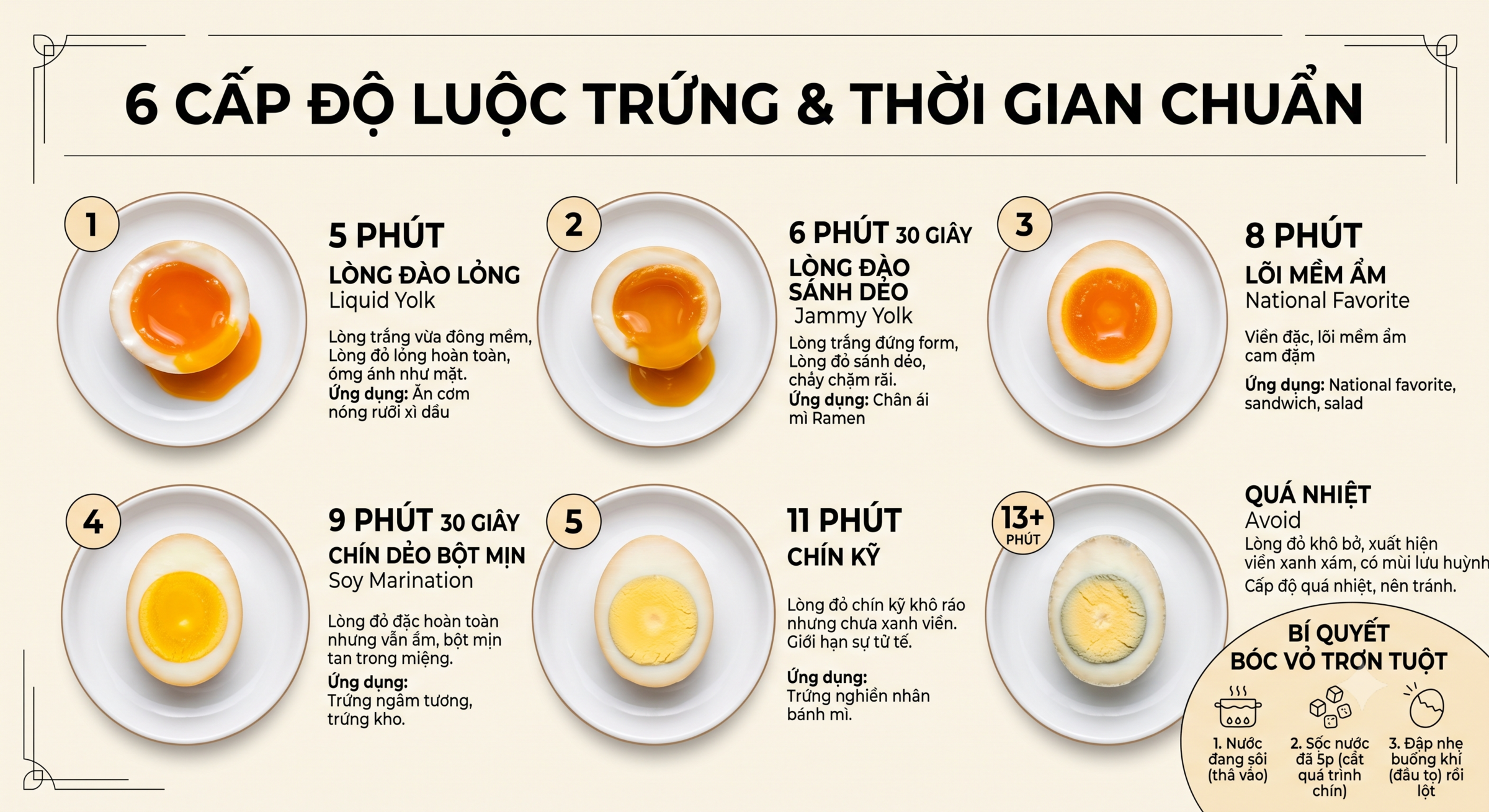 |
Photo: AI |
Bao Nhien