Restaurant-prepared fish sauce often boasts a more harmonious and appealing flavor than homemade versions. Culinary expert Vu Nhat Thong from Eric Cooking Class explains that the perfect blend of sweet and sour fish sauce involves a complex series of chemical reactions. Osmosis allows sugar to infuse into ingredients, while lemon's acid reacts with the fish sauce's alkalinity to create new flavors. Essential oils from garlic and chili are released upon contact with sugar solution and protein. Notably, the combination of protein in fish sauce and sugar triggers a "cold" Maillard reaction, intensifying umami after a specific fermentation period.
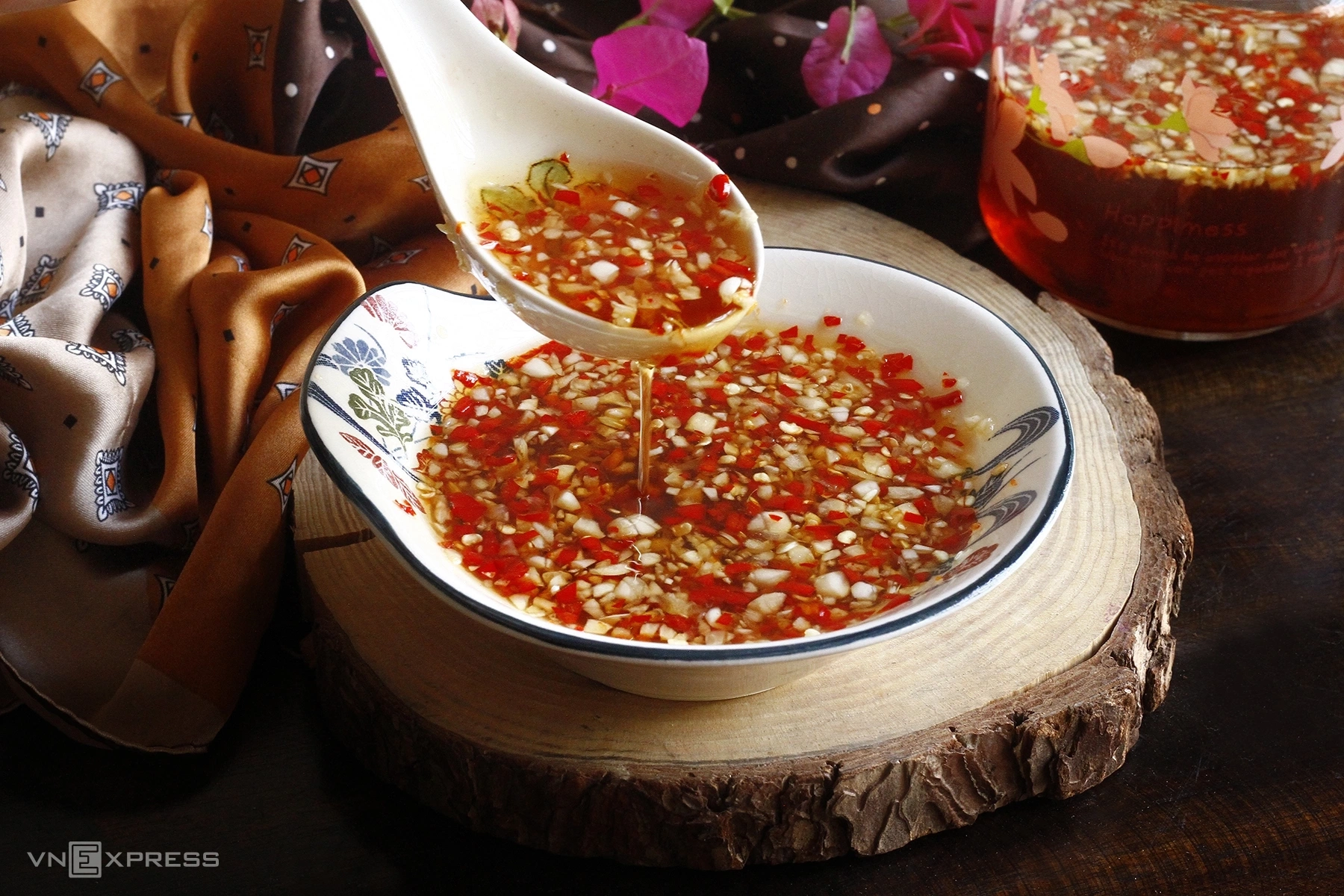 |
An appealing and rich bowl of sweet and sour fish sauce. Photo: Bui Thuy |
The golden ratio
A common mistake in home cooking is measuring ingredients by volume, such as with spoons. The expert recommends using a precision scale for accurate measurement according to the 3:2:1.5:1 weight ratio:
- Three parts fish sauce: Use a variety with a protein content of 30N or higher for a rich aftertaste.
- Two parts sugar: Mix 70% white sugar and 30% rock sugar for a delicate sweetness.
- 1.5 parts lemon or vinegar: Use fresh, pure juice.
- One part filtered water: Use purified water, boiled and cooled.
This ratio ensures the fish sauce achieves a pH of 4.5-5.0, an ideal level to simultaneously stimulate taste receptors.
Spice awakening techniques
Instead of mincing raw garlic and chili from the start, professional chefs often employ heat treatment techniques to enhance their aroma:
- Low-temperature soaked garlic: Crush garlic, soak it in oil, and dry at 60°C to preserve its natural sweetness and completely neutralize its pungent odor.
- Dry-roasted chili: Lightly roast chili in a hot pan, then soak in warm water to create a mellow, non-harsh spiciness.
- Grilled lemon: Briefly grill the cut side of the lemon before squeezing to yield a complex sourness.
The three-step flavor infusion process
For the ingredients to truly blend, cooks must adhere to an infusion period rather than serving immediately after mixing:
- Foundation building (15 minutes): Completely dissolve sugar in warm water, then add fish sauce and lemon juice, stirring gently.
- Flavor infusion (3-24 hours): Add the treated garlic and chili to the mixture, cover tightly, and let it rest for a minimum of 3 hours. This step is essential for the spices to release their natural essential oils.
- Refinement: Discard the old spice residue before serving, replacing it with freshly minced garlic and chili to stimulate both sight and taste.
Fish sauce variations for different dishes
| Dish | Additional ingredients | Effect |
| Spring rolls | Peanut butter, sesame oil | Creates a smooth texture, helping the sauce adhere better to the rolls |
| Fried spring rolls | More sugar, pickled carrots, pickled daikon | Thickens the dipping sauce, allowing it to penetrate the spring roll wrapper easily |
| Bun cha | Increased fish sauce, bone broth | Boosts umami, suitable for grilled meat |
| Banh xeo | Coconut milk, mint leaves | Provides a fresh, light sensation when eaten with herbs |
| Steamed dishes | Less fish sauce, young ginger | Preserves delicate flavors, without overpowering the sweetness of seafood |
| Cuon diep (lettuce rolls) | Increased sourness, added scallion oil | Creates richness and fattiness to balance the slight bitterness of the greens |
| Lotus stem salad | Increased sweetness and sourness, added grated lemon zest | Creates a refreshing, invigorating flavor that stimulates the palate |
"A perfect bowl of fish sauce contains not only spices, but also time and patience," said expert Vu Nhat Thong.
Bao Nhien