The Japanese consider rice washing, or togu, a strict process crucial for the quality of cooked rice. In contrast, many Vietnamese families still wash rice intuitively, often leading to less than optimal results.
Chef Vu Nhat Thong, founder of Eric Cooking Class culinary center, provides guidance on proper rice washing:
The essence of rice washing
After industrial milling and polishing, rice grains retain a layer of free starch, primarily amylopectin. This branched starch rapidly absorbs water and gelatinizes. This layer, along with bran dust and other impurities, causes cloudy rinse water. Washing rice is a mechanical process designed to clean the grain's surface.
During cooking, starch absorbs water and gelatinizes at 60-75 degrees C. If the outer starch layer is not rinsed, it gelatinizes directly in the cooking water, forming a sticky substance that makes the rice clumpy. Furthermore, thick cooking water hinders heat convection in the pot, causing uneven cooking and quicker spoilage once cooled.
Many homemakers tend to scrub vigorously and wash rice repeatedly until the water runs clear. However, data from the US Department of Agriculture (USDA) indicates that B vitamins, particularly B1 (thiamine), are concentrated in the thin bran layer and are highly water-soluble. Over-washing rice can lead to a substantial loss of these essential nutrients.
Despite potential nutrient loss, washing rice provides important benefits. Research from the University of Manchester (UK) indicates that washing rice two to three times removes up to 30% of inorganic arsenic, a natural toxin absorbed by rice plants from flooded environments. Furthermore, a 2021 study by the University of Queensland (Australia) found that this process reduces microplastics adhering to the grains from nylon packaging by 20-40%.
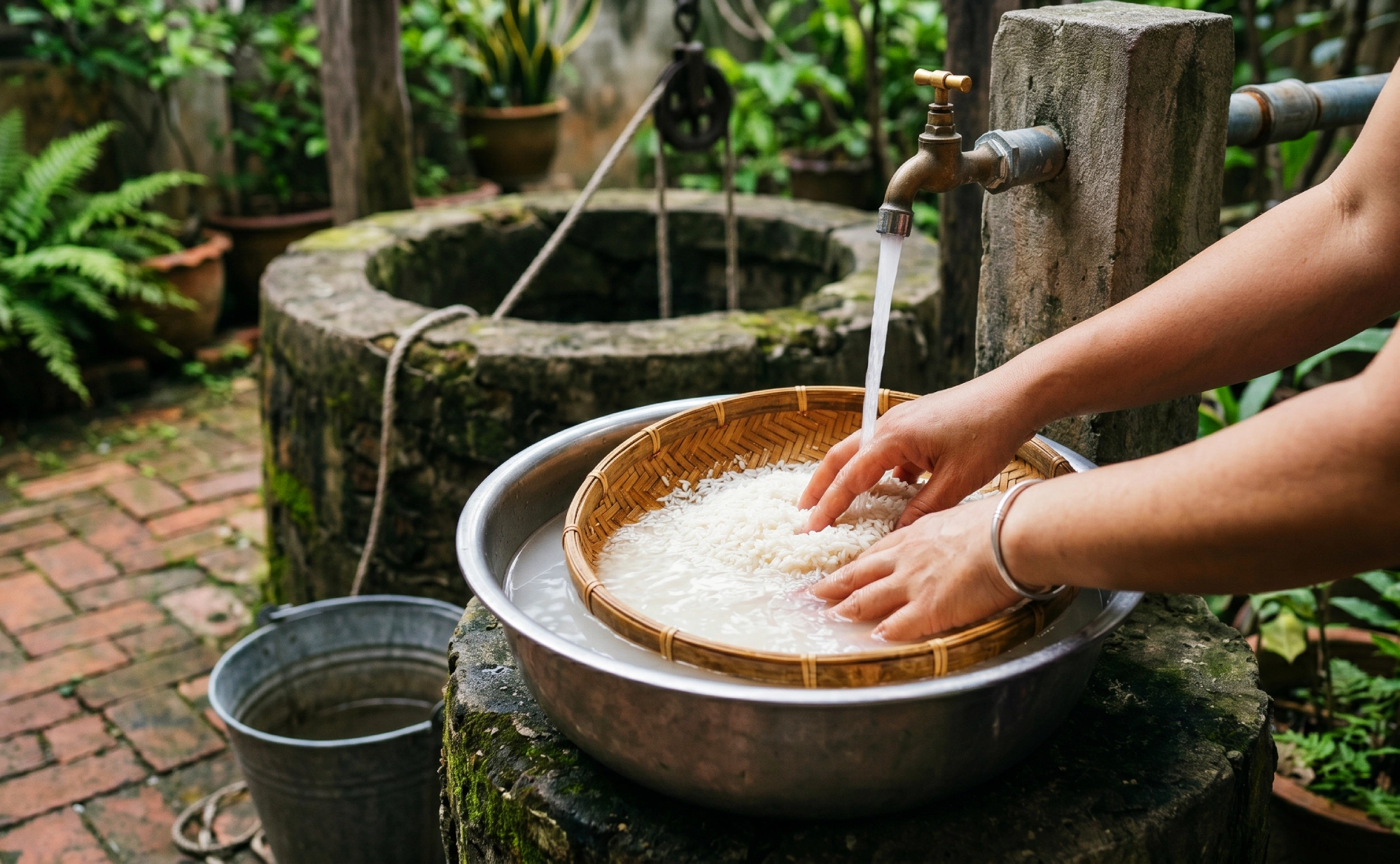 |
Gently washing rice three times helps remove arsenic and microplastics, while also making the rice fluffy. Avoid scrubbing rice vigorously. *Illustration: AI* |
To balance cleaning and nutrient retention, chef Vu Nhat Thong suggests a three-step rice washing process:
- First wash: Cover the rice with water, stir quickly for three to five rotations, and drain within 10 seconds. Dry rice grains absorb moisture very rapidly; prolonged soaking can cause impurities to be reabsorbed.
- Second and third washes: Use fingertips to gently swirl the rice for 10-15 seconds. Avoid scrubbing vigorously with your palm or pressing the grains to prevent breaking their structure.
- Determining the stopping point: Stop washing when the water turns cloudy-opaque. Vietnamese rice typically meets the standard after three washes. Afterwards, drain the rice before measuring the official cooking water.
Rice washing techniques can be flexibly adjusted based on the rice type and dish. Fragrant sticky rice varieties, such as ST25 and Jasmine, only require two to three gentle washes. Rice intended for fried rice or broken rice (com tam) needs more thorough washing for fluffy grains. Glutinous rice must be cleaned before soaking to prevent the cooked sticky rice (xoi) from becoming clumpy and spoiling quickly. For brown rice, a gentle rinse of one to two times is sufficient to preserve its nutritious bran layer.
The drained rice water can be repurposed for various uses. It can soak bitter melon or fresh bamboo shoots to reduce their bitterness. It is also effective for washing fish or pork offal to eliminate odors, or for watering plants and cleaning kitchen tools. Many women also utilize rice water for facial cleansing and hair conditioning.
Bao Nhien