Over 600 million people in China were using generative artificial intelligence (AI) tools by the end of 2025, marking a 141% increase from the previous year, according to the China Internet Network Information Center. This technology is profoundly reshaping how individuals work, live, and connect across the nation.
Lu Hengzhi, an 11-year-old student in Shanghai, exemplifies AI's integration into daily learning. Disliking pre-existing music, he uses AI to customize genres, melodies, and compose songs. His mother introduced him to AI while preparing for an international school interview, leading him to independently write stories, program games, and debug software.
Despite these benefits, Lu expresses concern that over-reliance on AI could diminish critical thinking skills and the ability to verify information. "AI excels at providing answers but doesn't grasp why I need them," he states. "Sometimes the tool offers incorrect answers with a very confident tone."
Lu acknowledges that without AI, his learning progress would slow considerably. He anticipates challenges in organizing his thoughts for new projects and would need to revert to traditional books.
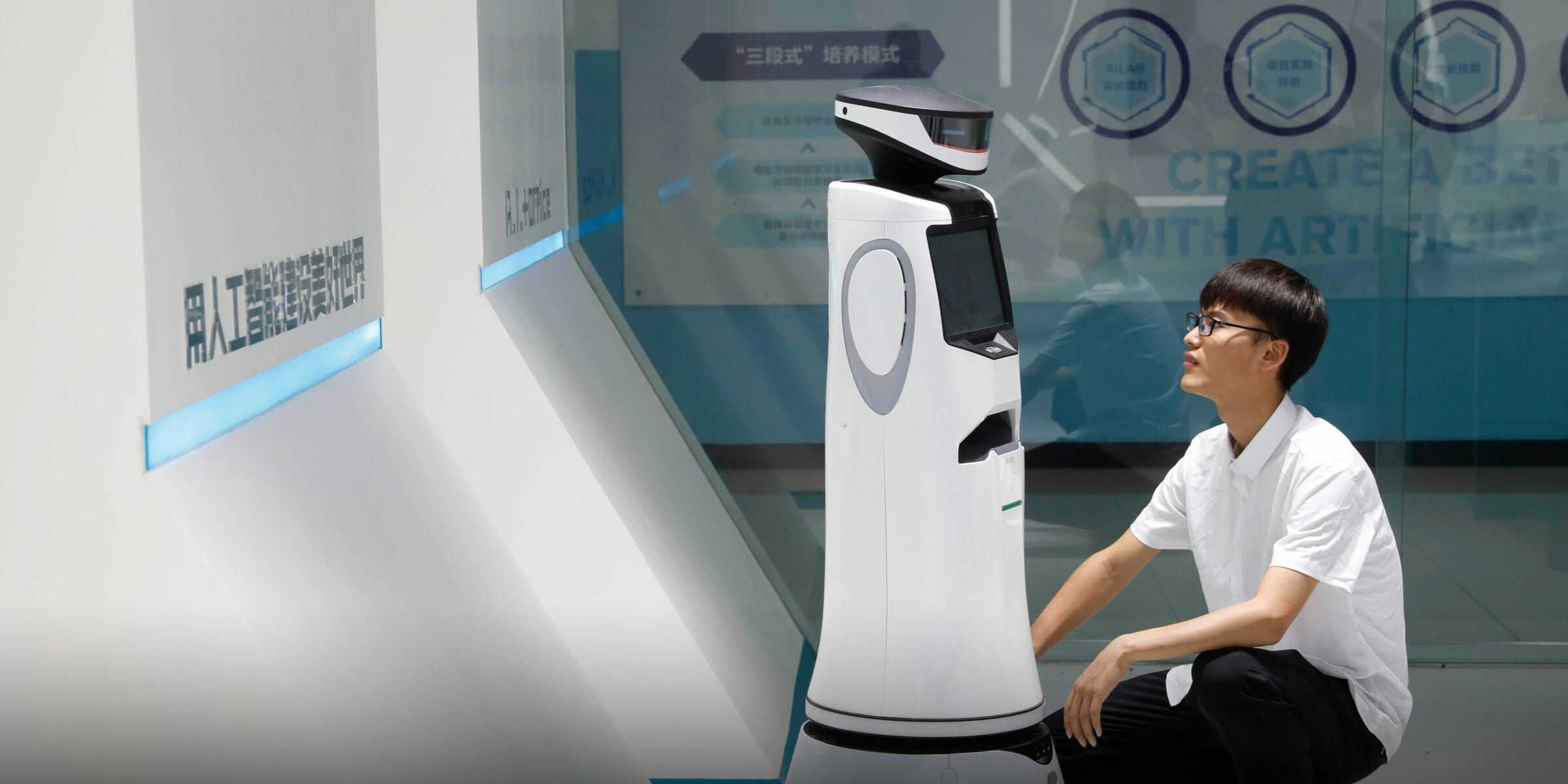 |
Photo illustration: Sixth Tone |
AI also addresses loneliness among the elderly, as seen with 79-year-old Tang Rongrong. Living remotely from her children, she spent a decade primarily reading newspapers and listening to audiobooks, with all interactions being one-sided. Now, she employs an AI-integrated companion robot capable of conversing in the Shanghai dialect. Before leaving home, the robot often reminds her to carry an umbrella or exercise caution in the rain. Tang finds these small interactions provide a sense of warmth and reassurance, highlighting their importance for individuals living alone.
Technology is also reshaping the emotional lives of younger generations. In Jiangsu, 21-year-old student Zhao Jingmiao has trained a virtual boyfriend to meet her personal standards. She notes the character possesses stable emotions and is always available to listen. However, Zhao worries about potential government regulations on AI applications, fearing she might lose access to this service.
In healthcare, Dr. Zhang Qiang, 59, director of a Shanghai hospital, utilizes AI to analyze pathological images, assess disease stages, and interpret test results. Dr. Zhang cautions that over-reliance on such systems is hazardous if a clinician's fundamental knowledge is weak. He emphasizes that while AI systems process data efficiently, they lack human judgment and ethical considerations.
AI is also emerging as an agricultural engineer in rural areas. In Henan province, 36-year-old farmer Wang Zhipeng uploads photos via his phone to an AI system, which identifies weeds and recommends herbicide dosages within seconds. This application helps him monitor crops and reduces the time required to calculate worker wages from one day to 20 minutes. Despite these efficiencies, Wang notes that smart tools might diminish direct human connection.
Wang Boyuan, 39, a former writer in Shaanxi, now uses ChatGPT to transform ideas into software. Despite having no prior programming knowledge, Wang has successfully written code and developed numerous applications. "AI empowers me to accomplish more," he states.
However, Wang admits he still doesn't truly understand programming and remains dependent on the technology. "If artificial intelligence were to disappear," he remarks, "I would likely return to full-time writing."
Bao Nhien (According to Sixth Tone)