Tanja Harter, president of the European Cockpit Association, stated that over the past two years, aviation safety has become increasingly complex due to global positioning system (GPS) spoofing, along with a rise in missile and drone activity. Schedule changes are constant. Recently, an Air France flight was forced to turn back while en route to the United Arab Emirates to evacuate citizens. A day later, a Lufthansa crew also had to divert from Riyadh, Saudi Arabia, to Cairo, Egypt, due to security concerns.
In the Middle East, pilots must adapt to flying under emergency conditions. Images of commercial aircraft taking off from Beirut, Lebanon, amidst smoke from explosions are common. Mohammed Aziz, director general of Civil Aviation Lebanon, admitted that pilots there must always prepare for the worst, as absolute safety is a luxury.
A Middle East Airlines pilot explained that to reach Beirut, they typically fly at high altitudes to avoid the range of shoulder-fired missiles, while also carrying extra reserve fuel. "When we are too busy with dozens of calculations for landing, we no longer have time to focus on the fear surrounding us outside the window," the pilot said.
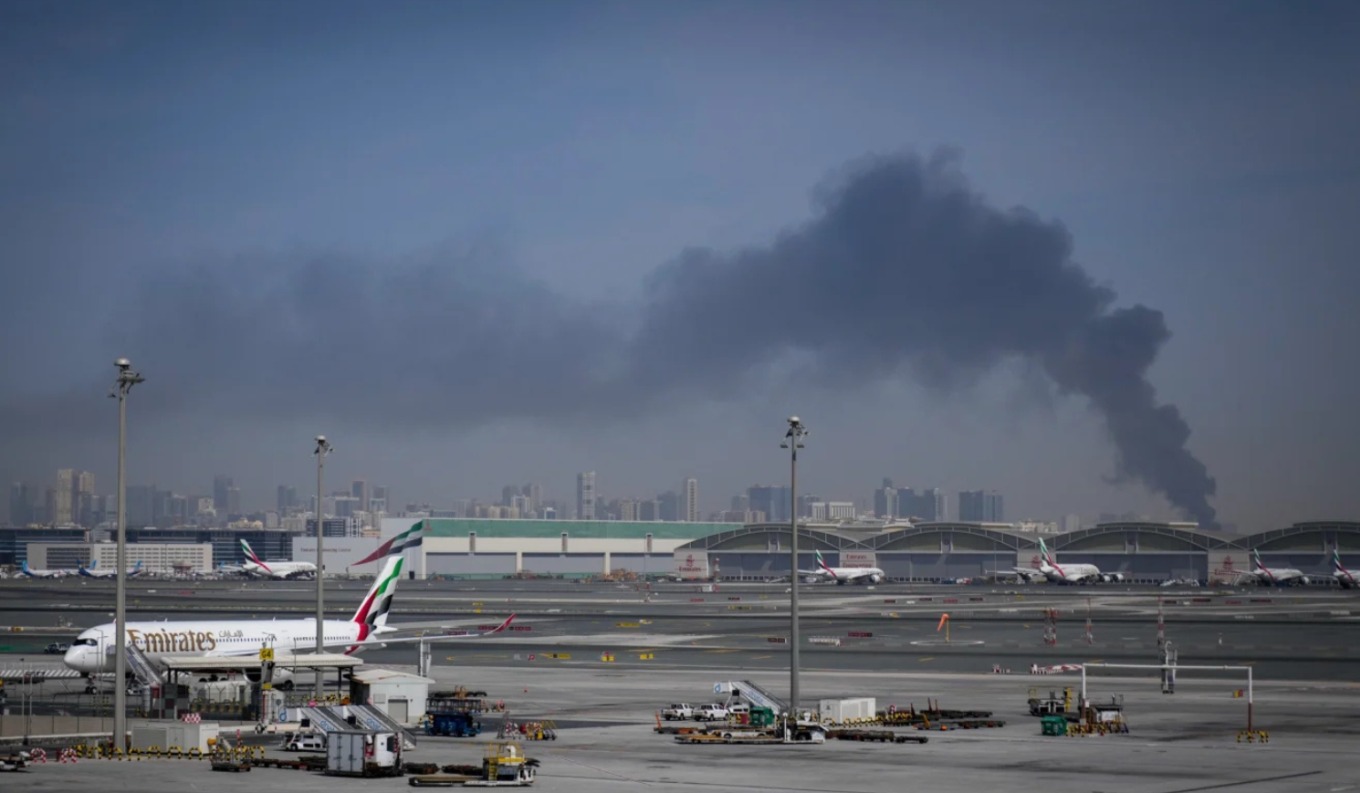 |
Smoke rises at Dubai International Airport on 1/3. Photo: AP |
Former Qantas captain Keith Tonkin stated that current aviation disruptions are far worse than previous conflicts. In the early 2000s, a missile test in India disrupted his flight path from Rome to Singapore. However, at that time, he still had ample airspace to maneuver.
Currently, the conflict in Iran has constricted familiar flight paths. Thousands of flights from Asia to Europe are now funneled into two narrow corridors over Turkey and Egypt. These "aerial highways" have become overloaded, causing global delays.
According to Tonkin, with shrinking airspace, pilots have few options. Many neighboring countries swiftly closing their airspace places immense pressure on flight crews and receiving airport infrastructure. Many aircraft nearing fuel depletion are forced to request emergency landings, even without permission from local air traffic control.
Many other flights choose to turn back even after completing half their journey. A notable example is an Emirates flight from Auckland, New Zealand, bound for Dubai, United Arab Emirates. After 8 hours airborne, due to airspace being blocked, the captain decided to fly back to the departure point instead of waiting in Australia, resulting in passengers spending 16 hours on the aircraft without reaching their destination.
In situations marked by limited information and high risk, calm coordination between the captain and first officer is vital. To avoid causing panic, pilots often carefully consider every announcement made over the intercom. However, sometimes direct honesty proves to be the best approach.
An American Airlines captain once made an impression with a concise, clear announcement when the aircraft was forced to return to Philadelphia instead of continuing into a risk zone: "War has started, airspace is closed, we need to go back."
By Minh Phuong (Source: Guardian, Straits Times)