South Korea's economic downturn and the won's depreciation are altering consumer habits among the 20-30 age group. They are adopting "jjantech," a trend that combines frugality with technology to maximize savings.
To cut costs, these young individuals establish online communities known as "beggar chat rooms" to monitor each other's spending. They also create "beggar maps" to locate the cheapest dining options. On platforms like KakaoTalk, members publicly share their daily spending logs. For instance, if one member plans to buy a 3,100 won green tea bag, the group advises them to reuse it multiple times. When another member considers spending 75,000 won to join a marathon, others argue that running itself is free.
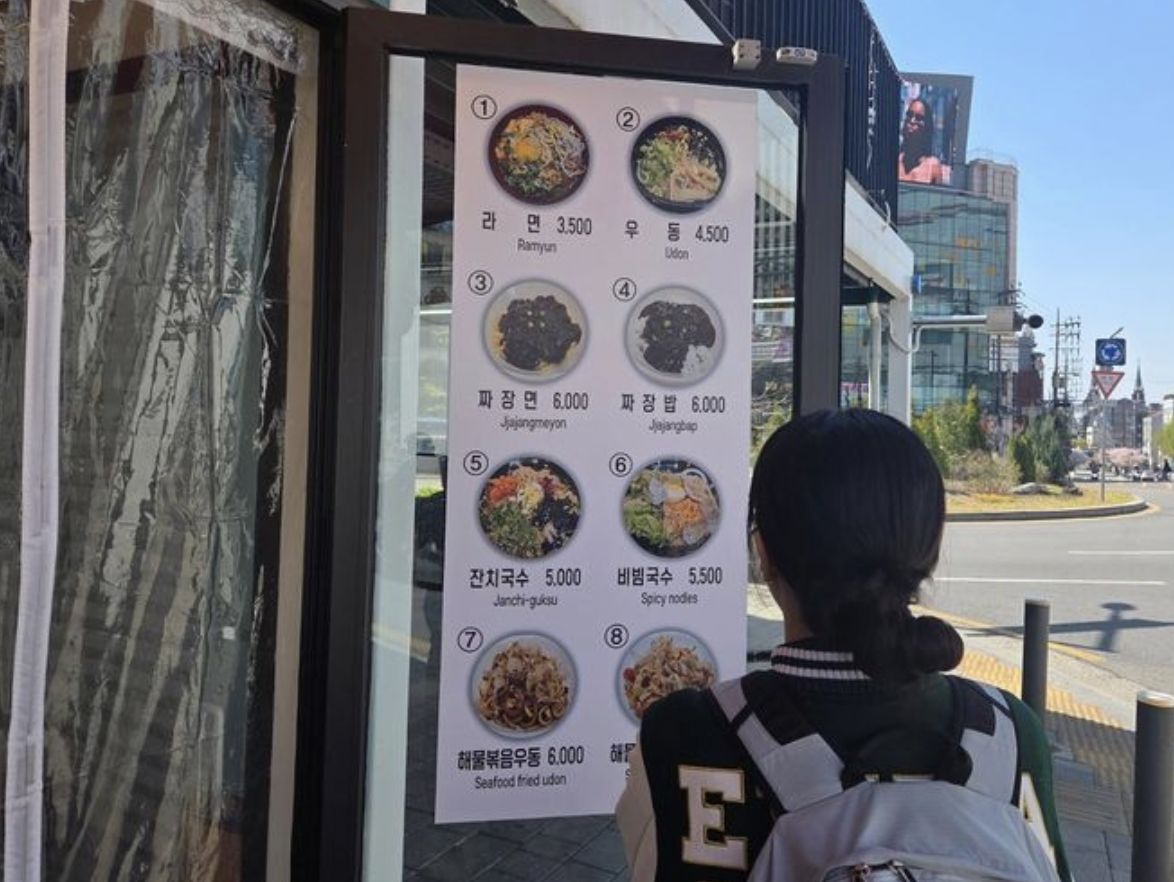 |
A university student views a menu outside a restaurant in Seodaemun district, Seoul, South Korea, on 7/4. Photo: Korea Times
According to Statistics Korea, the consumer price index has seen continuous increases, with food prices rising by 3.6% and transport by 5.2% in 2025. This surge pushes the average monthly food cost for a single person to about one million won.
The minimum wage in South Korea is approximately 2,06 million won a month. For a recent graduate working at a small business, this income is almost entirely consumed by the cost of living in Seoul, which ranges from 1,36-2 million won a month, with over half going towards rent. The disparity between income and essential expenses compels them to eliminate all personal hobby budgets.
Han Su-min, 26, who manages the "King of Beggars" chat group, often drinks instant coffee at work to avoid spending money. She noted that price pressures compel people to form groups and support each other in navigating these challenges.
Many choose to reuse old items to prevent new expenses. Moon, 24, stated she still wears clothes from her university days because apparel prices are high. Kim Min-ah, a 24-year-old student, limits social interactions. She drinks tap water at school instead of buying bottled water and eats kimbap from convenience stores. "Just stepping out of the house costs money, so I barely meet friends," Kim said.
Research student Jeong Ye-eun walks 40 minutes daily to reduce transportation costs. Meanwhile, Lee Ji-min, a job seeker, decided against visiting her family in Gimhae to save 100,000 won on a round-trip train ticket from Seoul.
To supplement their income, young South Koreans use government-supported applications. Kim Se-rin shared that she consistently walks 8,000 steps daily using the Seoul city "Wrist Doctor 9988" app to accumulate points. She converts these points into Seoul Pay to purchase essential groceries.
The saving trend has also led to the creation of "beggar maps." This platform compiles a list of restaurants where meals cost under 8,000 won per serving, or under 10,000 won in expensive areas like Gangnam and Yeouido. Thanks to community-contributed data, users can find fried pork cutlet restaurants for 5,000 won or knife-cut noodles for 4,000 won.
Choi Sung-soo, the platform's founder, reported that the app achieved 21,500 downloads within six days of its launch, with 1,31 million visits. This tool also brings a significant number of customers to small eateries. A restaurant owner near a university district mentioned that appearing on the map allows him to reach customers without incurring the 15% fees charged by food delivery applications.
Many sociologists view "jjantech" as a survival tool for the "Sampo generation," a term referring to young South Koreans who forgo dating, marriage, and childbirth due to economic pressure. When maintaining daily personal life requires assistance from "beggar maps," goals like starting a family or buying a home are entirely removed from young people's priority lists.
Professor Lee Eun-hee of Inha University's Department of Consumer Science stated that this trend will persist due to economic recession and increasing income inequality. Conversely, Professor Lee Byung-hoon, a sociologist at Chung-Ang University, noted that young people's self-identification with terms like "beggars" could have psychological repercussions for an entire generation.
Ngoc Ngan (Source: Korea Times)