As Daniel Nord and his wife in Helsinki prepared for their first child, they received an approximately 8 kg cardboard box after a prenatal check-up. The box contained clothes, blankets, and other essential items. This government support package aimed to ease their preparations for the baby's arrival.
"When we saw the tiny clothes, everything suddenly became more real, and we started imagining our child", Daniel said.
This box is part of Finland's maternity support package. The 2026 box includes 38 items: clothes, wool hats, sleeping bags, a bath thermometer, nail scissors, and a toothbrush. The products are neutral-colored, suitable for both boys and girls. A key feature is a perfectly fitting mattress inside, transforming the box into the baby's first bed. Finnish babies sleep in it during their initial months.
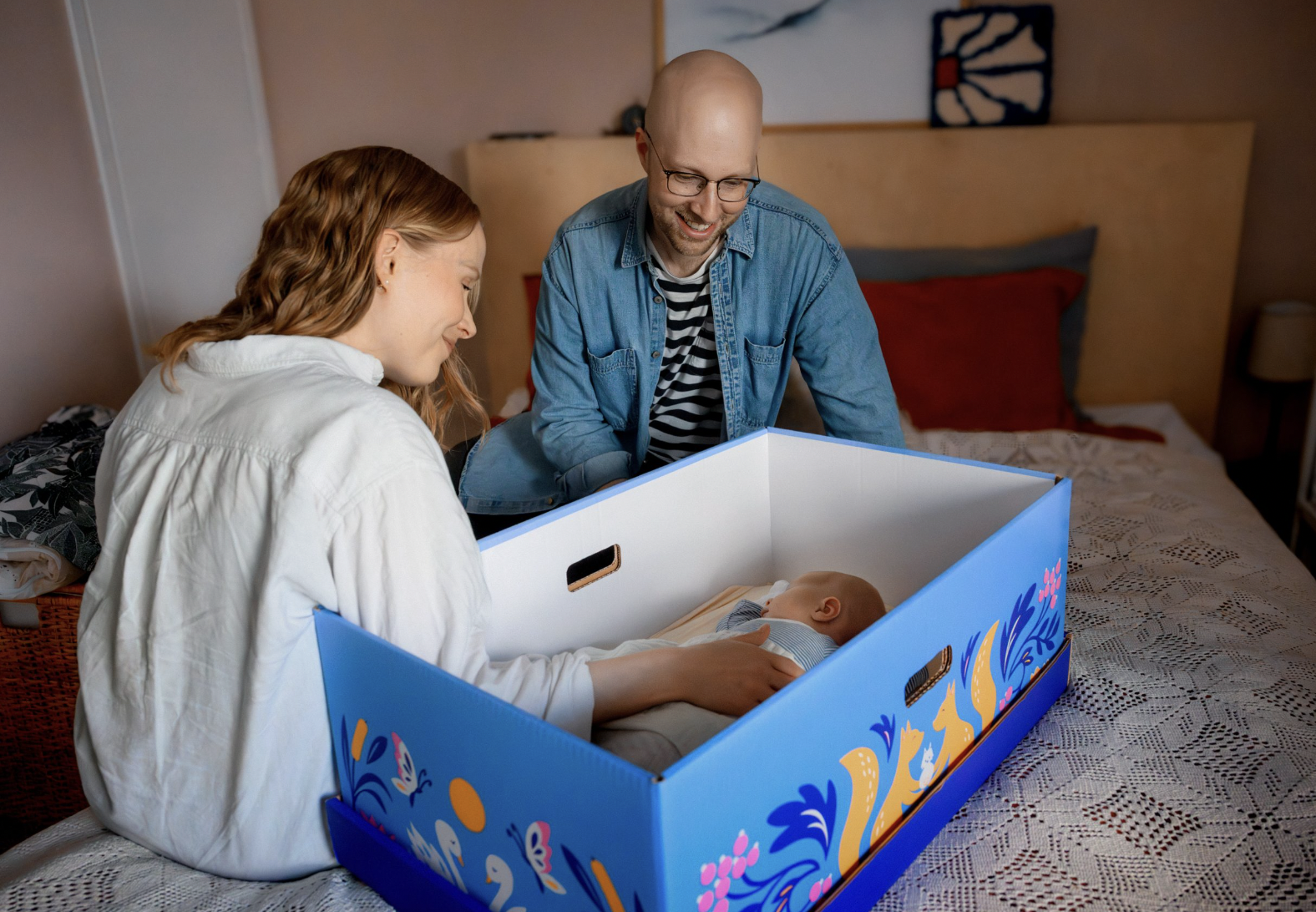 |
Daniel Nord and his wife care for their child in Helsinki, Finland. Photo: Nordic Labour Journal.
This practice originated in Finland in the late 1930s, a time of cramped housing and high infant mortality. In 1938, the government began providing clothes, fabric, and soap to low-income mothers. To receive this aid, expectant mothers had to attend medical examinations, which helped detect pregnancy risks early. In crowded homes, the cardboard box offered a separate, clean sleeping space for infants.
By 1949, the policy expanded to include all mothers, regardless of income. What began as a measure to support the poor transformed into a symbol of the belief that "every child has an equal start".
The box's contents also evolved over time. In the 1960s, sleeping bags were added to encourage outdoor sleeping for children, a common Nordic practice. Baby bottles were later removed to promote breastfeeding. By the 1970s, condoms and lubricants were included to support women's postpartum reproductive health.
Currently, families can choose between receiving the box or a cash grant. Approximately two-thirds of Finnish families still opt for the physical items, particularly first-time parents.
Anna, Daniel's wife, noted that the clothes in the box are of good quality and can be reused for subsequent children.
Finland remains the only Nordic country to maintain this nationwide baby box distribution model. According to Daniel, the policy highlights society's commitment to families with young children. The combination of healthcare services and essential baby supplies helps parents feel more secure as they embark on their parenting journey, he added.
Ngoc Ngan (Source: Nordic Labour Journal, Kela)