In mid-April, about 20 young people gathered in a conference room in Shanghai for a discussion on startup ideas. The event was organized by Karen Dai, founder of SoloNest, a platform supporting one-person startups.
The "one-person company" model, once popular in Silicon Valley, is now gaining traction across China. This wave is fueled by city governments pledging millions of USD to achieve technological self-sufficiency. "The one-person company is a product of the AI era," Dai stated.
According to her, independently running a business was previously challenging, but the current support capabilities of AI have lowered the barrier to entry.
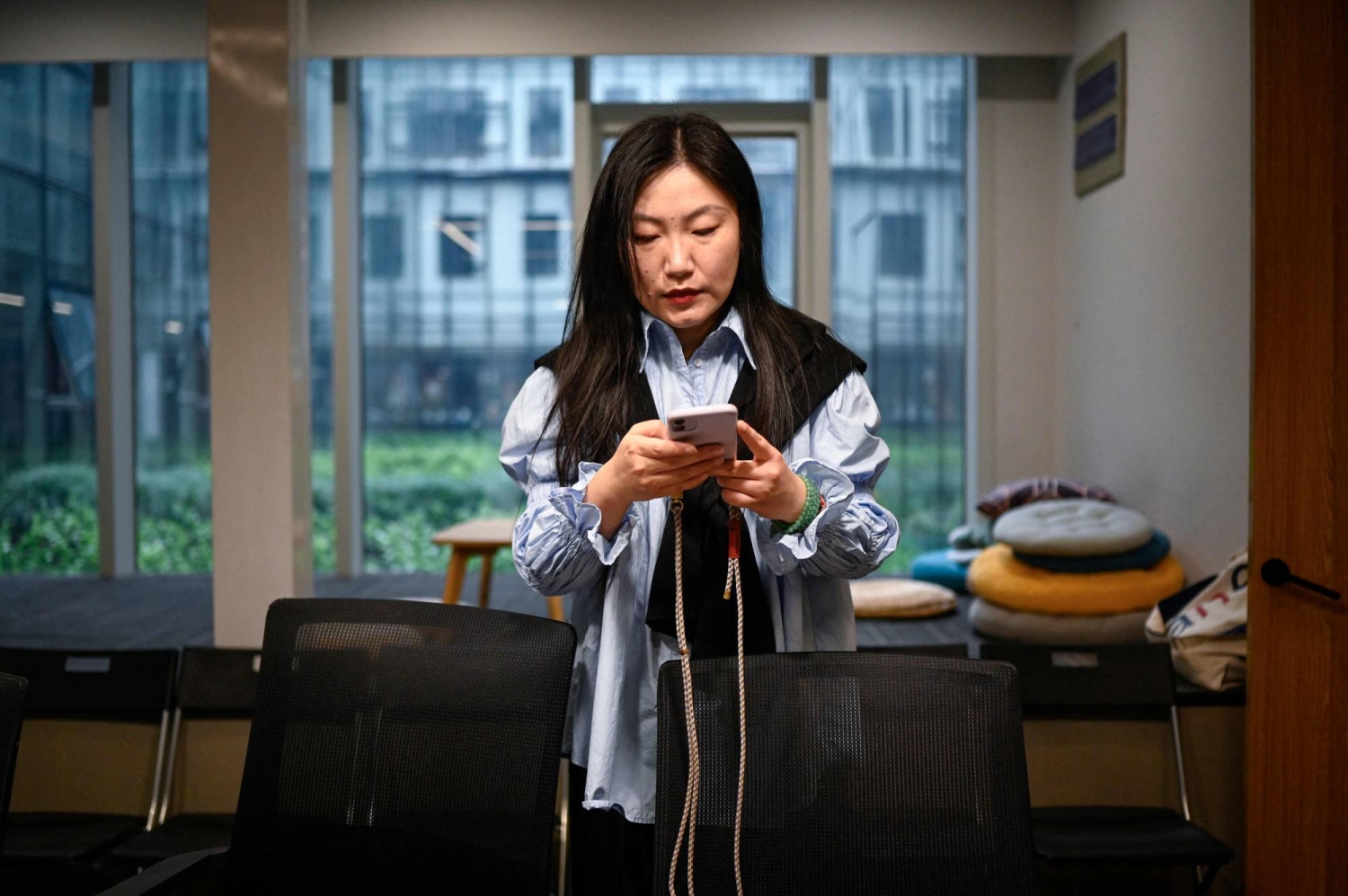 |
Karen Dai, founder of the one-person startup support platform SoloNest, prepared for a coffee talk in a conference room in Shanghai on 12/4. *Photo: AFP* |
For many years, Chinese social media has debated the "age 35 curse," a term referring to tech employees being laid off as they reach this age. "At 35, there seems to be an invisible line. Companies re-evaluate who is more suitable to stay," Dai explained.
To mitigate this risk, many are choosing self-employment. Wang Tianyi, 26, a former product manager at an Internet company, currently earns 5,800 USD monthly creating AI-powered advertising videos. "Thanks to technology, one-person companies have a significant advantage in efficiency," Wang said.
Wei Xin, 34, from Shanghai, recognized early that her document review job at a foreign consulting firm would be replaced by AI. She learned to use Google Gemini, created a digital version of herself, and transitioned to content creation. "If I don't embrace and use AI, I will soon become obsolete," noted Wei, who studied in the US.
Local governments in China are actively supporting this business model, often referred to as OPC (One-person company).
In 11/2025, Suzhou city pledged to train over 10,000 OPC talents by 2028 and invested about 100 million USD in robotics and healthcare sectors. Last month, Chengdu city also announced subsidies of about 2,800 USD for graduates establishing AI-powered one-person companies.
Kyle Chan, a research fellow at the Brookings Institute, views these measures as catalysts for small business growth. He believes that funding OPCs is a low-cost solution to address unemployment, especially given that one-sixth of young Chinese workers (16 to 24 years old) are currently jobless.
Kuo Zhang, President of Alibaba.com, indicated that 30-40% of the e-commerce platform's customers are now "independent entrepreneurs." The company recently launched Accio Work, a custom-designed AI assistant for small businesses. This tool, with 10 million monthly users, assists in managing customer service, tax compliance, marketing, and logistics.
However, the biggest challenge for these new businesses remains how to sell products and generate profit. Dai suggests that young people are investing in contingency plans. They are questioning whether AI can help them control their lives and pursue passions instead of struggling to find jobs at corporations.
Moreover, the startup landscape is not always rosy. According to data from the US National Institutes of Health (NIH), about 70% of independent founders fail within the first two years, almost double the rate for projects with co-founding teams (40%). Mental exhaustion from making all decisions independently, coupled with difficulty in attracting capital from investment funds, are the biggest barriers causing many one-person companies to fail early.
Latest data updated in 2026 from the US Bureau of Labor Statistics (BLS) and LendingTree shows that, on average, about 20-22% of small and micro-businesses fail in their first year. This rate increases to approximately 50% after five years and 65.3% after 10 years. Specifically for tech startups, the actual failure rate consistently hovers around 90%.
Bao Nhien (According to AFP, BI)