In late 2025, a sexual assault hearing at the Punjab and Haryana High Court in India was halted for an unusual reason: the judge could not read the medico-legal report. The court subsequently proposed incorporating handwriting skills into medical training and mandated the digitization of all prescriptions within two years. This incident ignited debate about the handwriting of medical professionals.
Data from the US National Institute of Medicine (IOM) reveals that careless handwriting contributes to over 7,000 deaths and causes 1,5 million medical incidents annually in the United States. The American Society of Health-System Pharmacists (ASHP) also confirmed that around 25% of medical errors originate from unreadable medical orders. A study published in the BMJ journal highlighted that for drugs with similar-sounding names, the risk of pharmacists misreading could reach 60% if doctors' handwritten prescriptions are unclear. To address this issue, pharmacies in the US make approximately 150 million confirmation calls to prescribers each year.
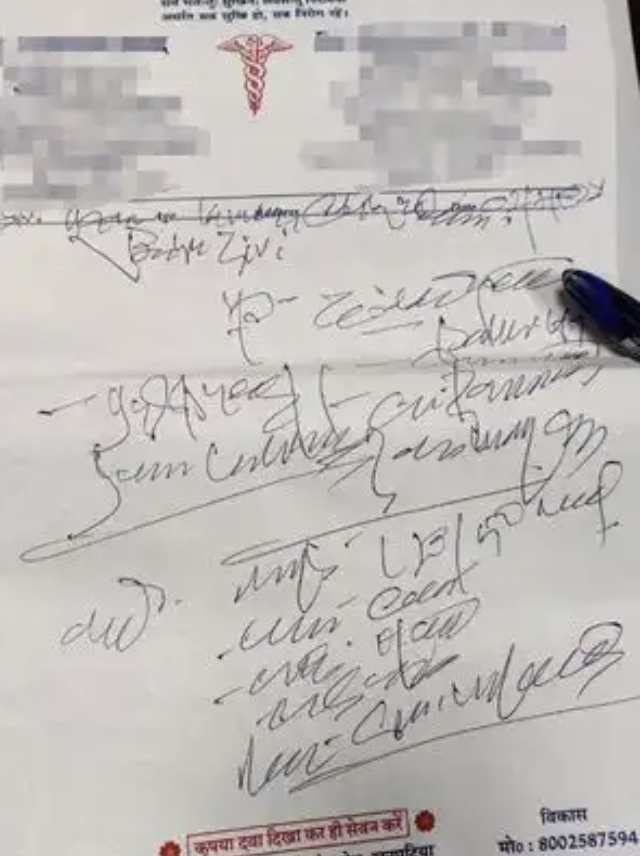 |
The controversial prescription in the Punjab High Court trial, India. *Photo: India Today*
Doctor Gobil Thapa of Tinsukia Hospital, Assam state, India, identified three primary reasons for this issue. First, medical students must record vast amounts of knowledge under time pressure, leading to a gradual loss of clarity in their writing. Second, once practicing, doctors often see up to 100 patients per shift, necessitating rapid writing. Finally, doctors often rely on the assumption that local pharmacists are familiar with their handwriting and will be able to decipher it. Doctor Thapa also noted that descriptions of medical conditions are generally written more legibly than drug names.
Doctor Dilip Bhanushali, President of the Indian Medical Association (IMA), stated that around 10% of current medical exams pose a challenge for examiners due to illegible handwriting. However, some professionals hold different views. Anesthesiologist Aishwarya Singh Solanki Thomas suggested that handwriting is a personal choice, as many individuals maintain clear handwriting even under high pressure. Conversely, an orthopedic doctor in Delhi indicated that ambiguous handwriting can sometimes be a way to conceal a lack of confidence or an inability to recall the exact names of active drug ingredients. Despite these varied opinions, experts generally agree that patient overload is the most significant barrier.
 |
Illustrative photo. *Istock*
In Mumbai and Delhi, pharmacists often recount having to rely on their experience and the prescribing habits of local doctors to decipher prescriptions. This reliance on guesswork carries inherent risks, leading to frequent calls for confirmation with the prescribers. Kunjal Gala, a handwriting coach in Mumbai, explained that handwriting is a complex activity involving over 30 muscle groups. When prescribing becomes highly repetitive, the brain processes information faster than the hand can write, causing handwriting to gradually deform by the end of the day.
To rectify this, Doctor Gobil Thapa proposed using pre-printed prescriptions or mandating that drug names be written in capital letters. Major hospitals in India, such as Apollo, LH Hiranandani, and Max, implemented digitization long ago. However, for smaller clinics, the cost of investing in equipment remains an obstacle. Currently, artificial intelligence tools from Google and applications like Prescription Reader are being developed to decipher doctors' handwritten notes. Nevertheless, experts emphasize that technology serves only as support; patients should still directly confirm with their doctor if they have any doubts about a prescription.
Ngoc Ngan (According to India Today, Time Magazine, BMJ)