During a recent conference on civil aviation safety at Tan Son Nhat, the Southern Airports Authority identified approximately 10 areas in Ho Chi Minh City where activities with potential risks to aircraft frequently occur.
Authorities have highlighted the following locations: Van Phuc City, Thao Dien, Thu Thiem urban area; Tham Luong; the area near Aeon Mall Tan Phu; Nguyen Van Cong street; the land area near Tan Binh Industrial Park; The Global City; Da Lake - Vietnam National University Ho Chi Minh City; and several public areas and wide roads near flight paths, such as Pham Van Dong.
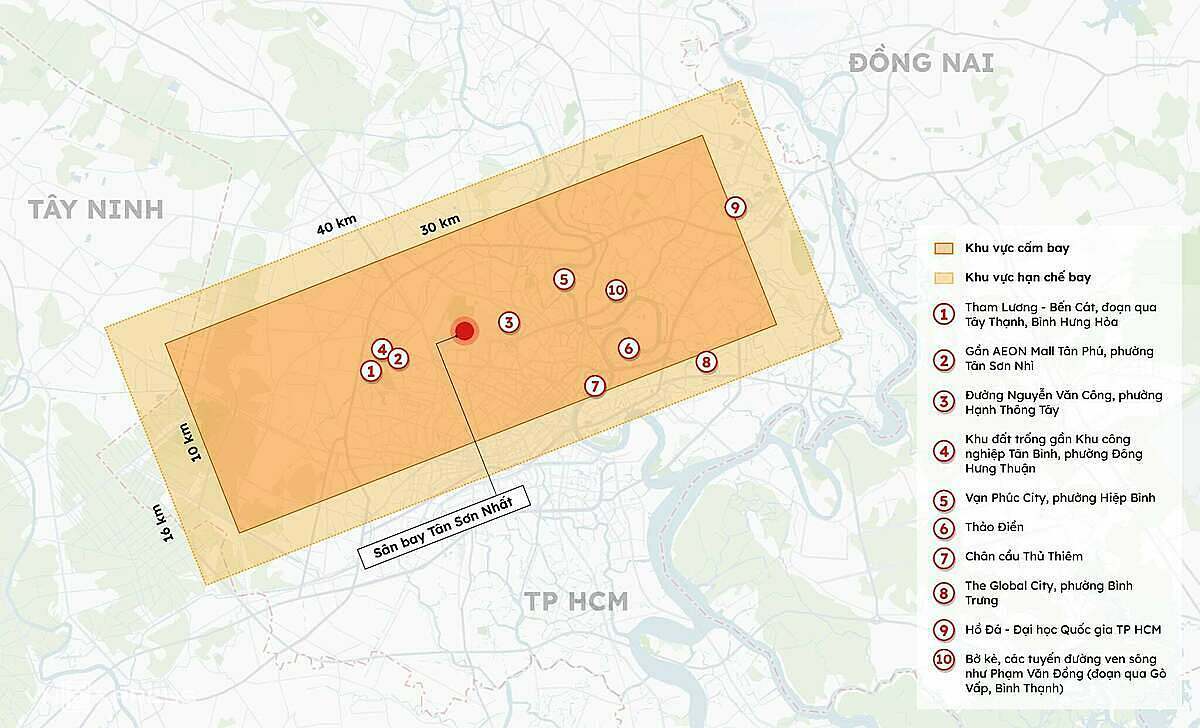 |
Locations identified by the Southern Airports Authority where kites, UAVs, and lasers frequently appear, potentially affecting aircraft at Tan Son Nhat. Graphics: Khanh Hoang |
These are places where UAVs, kites, balloons, laser beams, and other flying objects have been recorded or are likely to appear. This zoning helps local authorities, police, military, and related agencies focus on public awareness campaigns, inspections, and enforcement against actions that could threaten aviation safety.
According to the Southern Airports Authority, from 2024 to early September this year, 119 incidents involving UAVs, lasers, kites, and other objects were recorded around Tan Son Nhat.
Notably, on 11/8 and 13/8, incidents involving UAVs entering active airspace and kites with flashing lights disrupted airport operations, affecting over 100 flights.
Doan Van Minh, Deputy Head of Aviation Safety Monitoring Department, Southern Airports Authority, stated that the increasing diversity of risk sources makes ensuring flight safety more complex. In 2024, laser incidents and UAVs were prominent; this year, there has been a rise in cases involving kites, balloons, and fireworks.
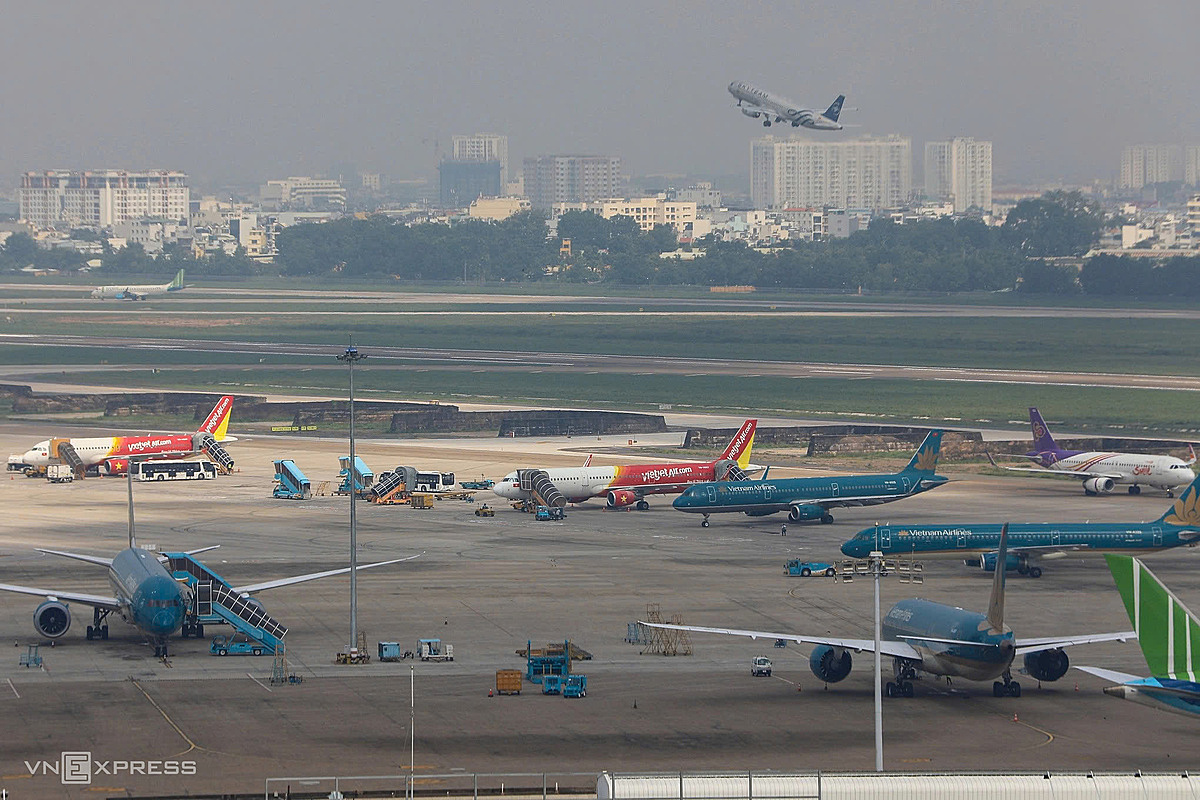 |
Aircraft at Tan Son Nhat International Airport. Photo: Quynh Tran |
From the beginning of the year until 4/9, units recorded 32 cases, including 13 laser-related incidents, 8 kite incidents, 4 balloon incidents, 3 UAV incidents, 3 other flying object incidents, and one firework incident.
Among the risk groups, UAVs are particularly dangerous, according to Minh, as they can actively change altitude, direction, and appear suddenly. In case of a collision, these devices can damage cockpit windows, wings, or other aircraft components. If sucked into an engine, they can affect aircraft operational capability, especially during takeoff and landing phases.
Even without a collision, UAVs appearing in no-fly zones can force aircraft to hold, alter takeoff and landing sequences, or even divert to other airports, causing disruptions to operational chains.
Kites and balloons also pose risks when appearing in restricted airspace due to their uncontrollable trajectories. Kites depend on wind direction, while balloons are nearly impossible to control once released.
Lasers or high-intensity light sources shone into the cockpit can cause glare, temporary vision impairment, affecting pilots' observation and concentration, especially when aircraft are at low altitudes for takeoff or landing.
According to the Southern Airports Authority, fireworks have recently become a factor to consider at large programs and events. When fired, fireworks create strong light, flashes, smoke, dust, and material fragments, which can distract the flight crew and obstruct external observation.
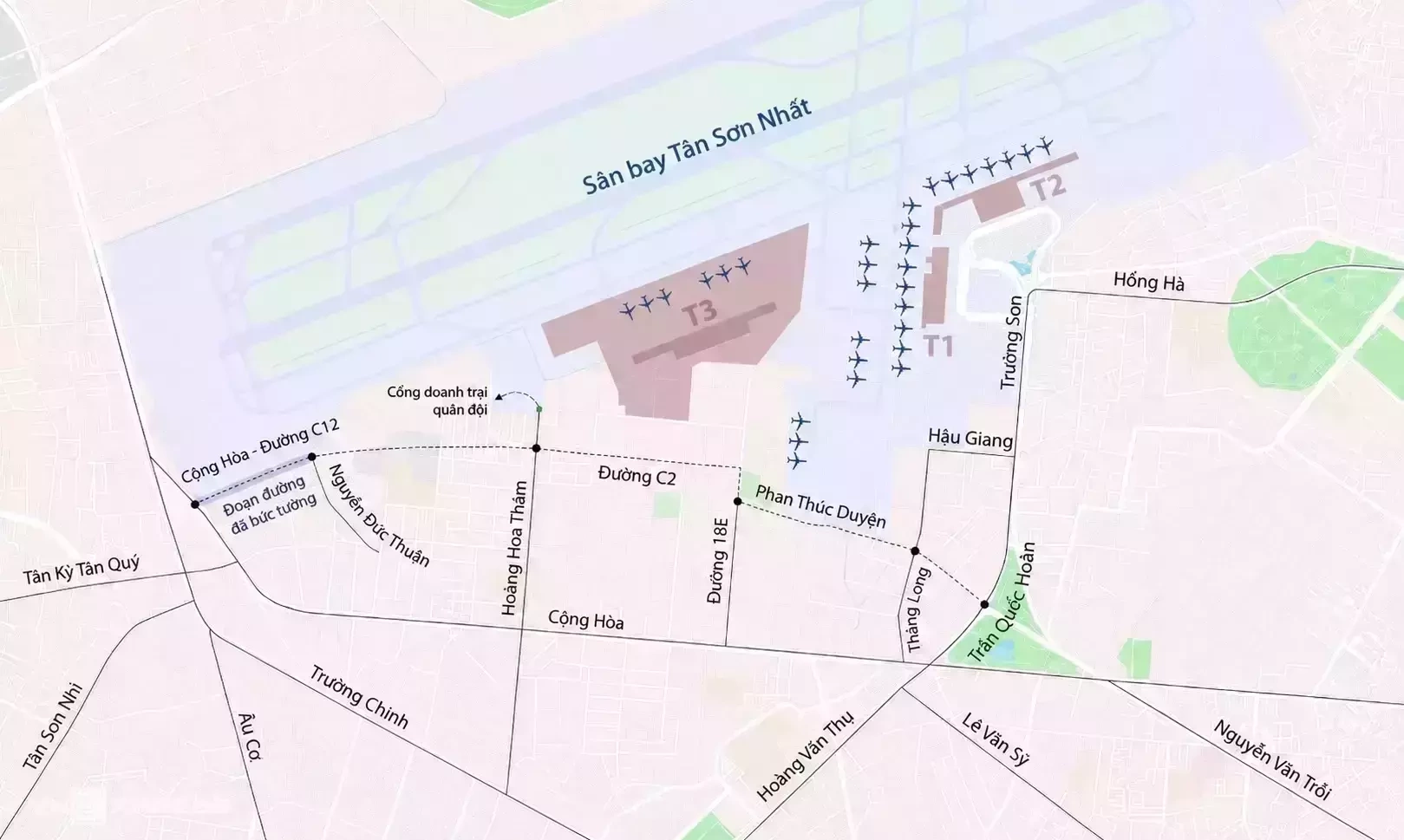 |
Tan Son Nhat International Airport with the locations of its three terminals. Graphics: Dang Hieu |
Lieutenant Colonel Vo Nhan Tiep, Deputy Commander of Air Defense Division 367, stated that the rapid development of unmanned aircraft necessitates new requirements for airspace management. UAVs are now easy to purchase, simple to use, and can be controlled from many residential areas, thus requiring proactive understanding of local areas and operational patterns for timely detection and handling.
He proposed improving coordination mechanisms among forces, clearly defining responsibilities and handling methods for various situations. Information on flight operations and high-risk areas also needs to be regularly shared to proactively identify risks.
Representatives from various units believe that prevention primarily requires helping residents clearly identify areas where UAVs, kites, and balloons are permitted or prohibited. No-fly and restricted-fly zone maps should be visualized down to each ward and commune; parks, vacant lots, and public points near flight paths need warning signs installed.
The Southern Airports Authority also recommended that Ho Chi Minh City intensify public awareness campaigns in areas with flight paths to curb residents from arbitrarily releasing kites, UAVs, and balloons.
For programs and events using lasers, high-power lights, or light effect devices, management agencies need to coordinate with the aviation industry before granting permits, assessing location, beam direction, power, operating time, and distance to the airport to mitigate risks to flight operations.
Giang Anh