


Speaking at an international press conference before the 14th Party Congress on the afternoon of 14/1, Professor Nguyen Xuan Thang, Director of the Ho Chi Minh National Academy of Politics and Chairman of the Central Theoretical Council, detailed the new points in the documents. He stated that the draft documents emphasize the requirement to "achieve" all set goals, linking development with improving people's lives and happiness. This is founded on political and social stability, macroeconomic stability, and a sustainable development environment.
According to Professor Thang, the draft documents were developed amidst rapid global shifts, intense strategic competition, and strong digital and green transformations, necessitating urgent innovation in development thinking. Building on 40 years of reform, Vietnam is entering a new development phase, aiming to become an upper-middle income, modern industrialized developing nation by 2030, and a high-income developed nation by 2045.
He noted that after the 13th Congress's term, which faced many shocks like Covid-19, natural disasters, floods, and supply chain disruptions, society expects the 14th Congress to issue strategic decisions strong enough to achieve the two 100-year goals. Consequently, the draft documents convey a message of unity and solidarity, aiming to realize the goal of building a Vietnam that is "peaceful, independent, democratic, prosperous, wealthy, civilized, and happy."
The draft documents "show many comprehensive new points, from their construction and presentation to their implementation mechanisms." A core focus is institutional breakthroughs for the nation's sustainable development, encompassing not only economics but also culture, society, human development, defense, security, foreign affairs, Party building, and the political system.
The draft continues to emphasize rapid, sustainable development, but differs from previous Congresses by elevating the environment to one of three crucial pillars, alongside the economy and society.
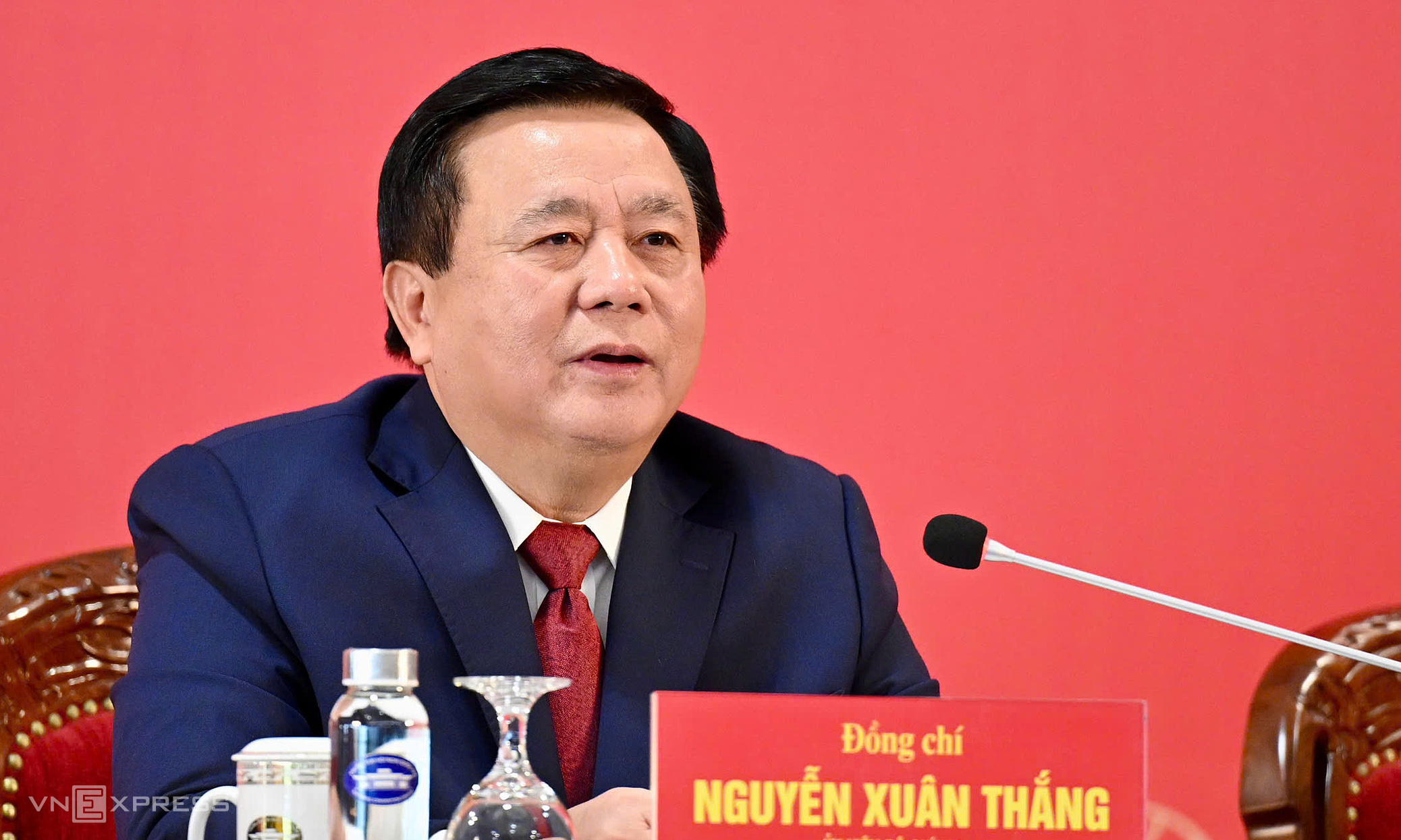 |
Professor Nguyen Xuan Thang addresses the press on the afternoon of 14/1. Photo: Giang Huy |
The most significant and noteworthy new point in the draft documents is the establishment of a new growth model for Vietnam, rather than merely stating "innovating the growth model" as before. As the world rapidly shifts towards a digital economy, a green economy, energy transition, and human resources becoming a core competitive factor, Vietnam needs to build a growth model based on higher productivity, quality, and added value.
He believes this is essential to leverage national advantages, create breakthroughs in economic productivity and competitiveness, and aim for sustainable double-digit growth. In 2025, Vietnam targeted 8% growth and actually achieved 8,02%.
Another new point in the draft documents is that for the first time, foreign affairs and international integration, along with defense and security, are identified as critical and regular tasks. The combination of "all-people national defense and people's security posture" with a "diplomatic posture" will create a firm foundation to consolidate the "people's heart posture."
Additionally, the draft clearly highlights science and technology, innovation; building a modern national education system; and developing human resources with many new elements.
The three strategic breakthroughs concerning institutions, human resources, and infrastructure are also concretized to align with new development requirements. Institutions must remove bottlenecks hindering development; shift administrative management thinking to national governance, development governance, and service to development; and build institutions for science and technology, digital transformation, innovation, labor productivity increases, and grassroots human resource development.
According to Professor Thang, modern infrastructure includes not only transportation but also energy infrastructure, digital infrastructure, technological infrastructure, climate change response infrastructure, and multimodal transport infrastructure. The preparation of these documents is closely linked to the requirement for immediate action. The document drafting process was carried out simultaneously with the development of action programs.
For the first time, three reports – the Political Report, the Socio-Economic Report, and the Report on Party building and enforcement of the Party Charter – are integrated into a single Political Report. Action programs are being developed concurrently with the draft documents to ensure clarity regarding individuals, units, tasks, resources, and implementation timelines, rather than waiting until after the Congress.
"The 14th Congress documents carry a very strong message, a very high level of action, and clear breakthroughs," Professor Nguyen Xuan Thang emphasized.


