


By the end of 2025, the ENSO (El Niño-Southern Oscillation) state, a major weather driver for many regions including Vietnam, was in a weak La Nina phase. This was characterized by cooler-than-average sea surface temperatures in the central and eastern equatorial Pacific.
According to Mai Van Khiem, Director of the National Center for Hydro-Meteorological Forecasting, La Nina is weakening rapidly, indicated by gradually warming sea temperatures and decreasing trade wind intensity. Therefore, 2026 is likely to be a typical ENSO transition year. From January to May, there is a 75-85% probability of shifting to a neutral ENSO state. By mid-year, neutral ENSO is expected to remain dominant, though sea surface temperatures show an upward trend.
From the second half of the year, the probability of El Nino emerging increases to about 55-65%. If it forms, it is likely to be a weak to moderate El Nino, similar to those observed in 1996, 2009, 2014, and 2018.
In 2018, the South China Sea experienced 9 storms and 5 tropical depressions, with three directly impacting Vietnam. That year also saw 24 cold spells, 18 heatwaves, and 26 periods of widespread heavy rain. Intense, continuous heavy rainfall occurred in July, August, and September across the Northern and North Central regions, and in October and November along the Central Coast.
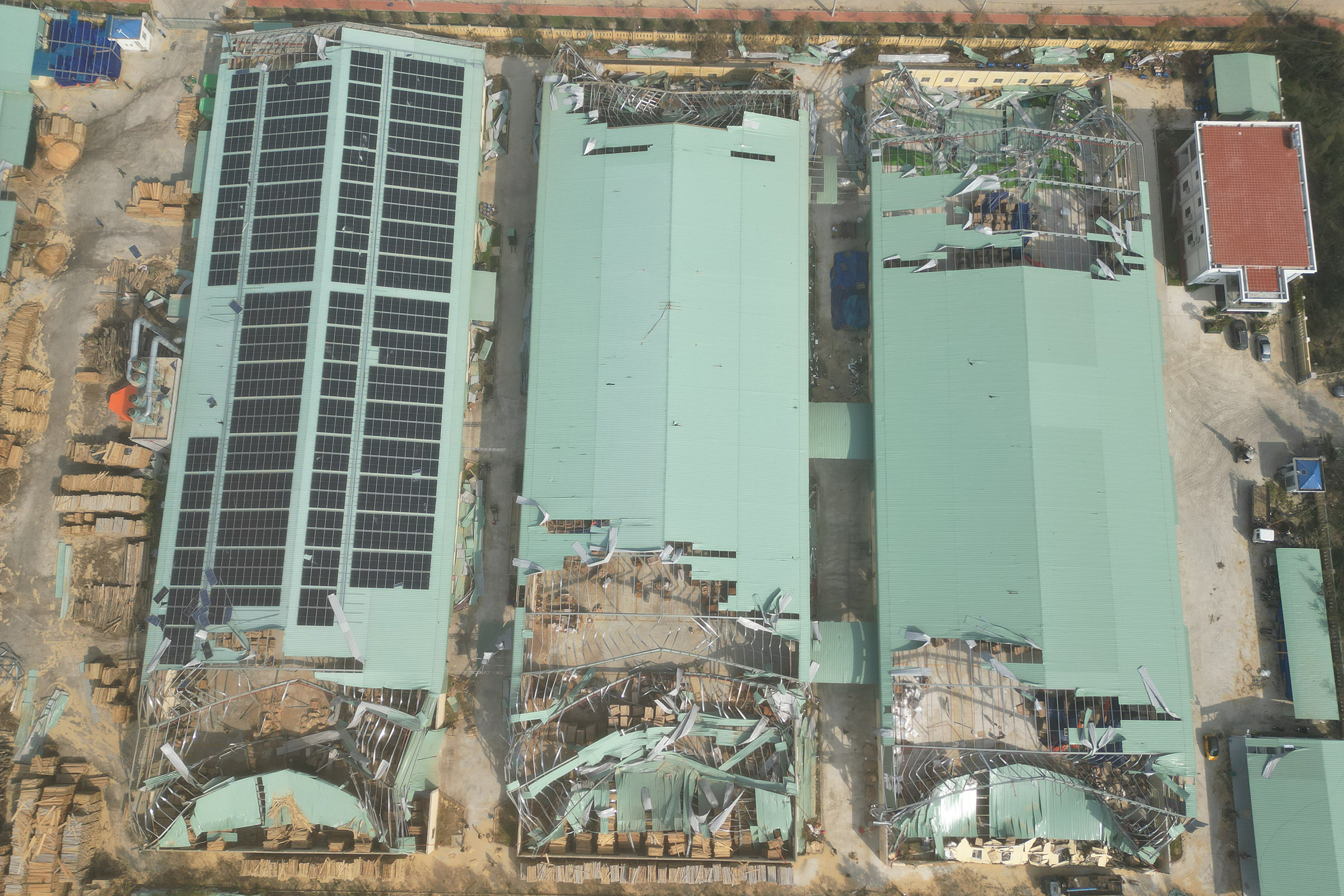 |
A factory in Gia Lai devastated after a storm in 2025. Photo: Duc Hoa |
Fewer storms, but more complex and unpredictable natural disasters
Mr. Mai Van Khiem cautioned that an early-year neutral ENSO phase does not guarantee less extreme weather. Historically, many years with neutral ENSO have experienced complex and difficult-to-predict natural disasters.
For the 2026 ENSO scenario, Mr. Khiem forecasts that Vietnam's 2026 rainy season will likely be uneven, heavily influenced by regional and intra-seasonal weather patterns such as the intertropical convergence zone, monsoons, and the Madden-Julian Oscillation (MJO). The risk of localized heavy rain, flash floods, and landslides remains high, particularly in the Northern mountainous and Central regions, especially during short but intense rainfall events.
While the number of storms and tropical depressions may be lower, their intensity and trajectories are expected to be unpredictable, particularly in the latter half of the season as ENSO transitions from neutral to a warm phase. Towards the end of the year, if El Nino develops, there could be an increased risk of drought, water scarcity, and saltwater intrusion, especially in the Central region and the Mekong Delta during the 2026-2027 dry season.
The Institute of Meteorology, Hydrology and Climate Change predicts that from January to March, nationwide temperatures will generally be near the multi-year average. However, the Northern region in January is expected to be 0,5-1 degree Celsius higher due to weaker cold air activity.
Total nationwide rainfall is projected to be near the multi-year average, with higher amounts in the Southern region and Central Highlands. In February, Quang Tri to Da Nang and eastern Quang Ngai could receive 35-70 mm of rain. March could see the South Central Coast and Central Highlands receive 50-100 mm, with some areas reaching 150 mm, which is 10-50 mm above average. The Southern region is forecast for 10-30 mm of rain in January-February (5-15 mm above average) and 30-70 mm in March (10-25 mm above average).
The Central Highlands and Southern region may experience more unseasonal rainy days during the dry season than in previous years. Heatwaves are likely to return in late February for the Southeastern region and from March for the Northwestern region.
 |
Flooding at My Dinh stadium in 2025. Photo: Van Ngoc |
The year 2025 was marked by exceptionally extreme natural disasters, with 21 storms and tropical depressions forming in the South China Sea. More than half of these directly impacted Vietnam, triggering a series of intense events from north to south. Dozens of rainfall records were broken, leading 20 rivers to surpass their historical flood peaks. These disasters resulted in 468 deaths and damages exceeding 100 trillion VND.
Gia Chinh


