


In Hanoi and Ho Chi Minh City, urban railway lines are expediting investment preparation and construction. Hanoi is building the underground section of line 3 (Nhon - Hanoi station), expected to be completed by the end of 2027. It is also beginning to implement line 2 (Nam Thang Long - Tran Hung Dao) and line 5 (Van Cao - Lang - Hoa Lac). Ho Chi Minh City has commenced construction on the Ben Thanh - Can Gio line and is preparing to implement line 2 (Ben Thanh - Tham Luong). Both cities aim to establish a mass transit network to reduce traffic congestion and environmental pollution.
For the Lao Cai - Hanoi - Hai Phong railway project, with a total investment exceeding 203.200 billion dong, the investor is currently preparing the feasibility study report for the main line construction. Construction of stations and connecting roads began on 19/12/2025. This railway line is expected to create a new transportation axis, connecting northern provinces with the Hai Phong seaport system and an economic corridor to Trung Quoc.
Meanwhile, the north-south high-speed railway project, with a total investment of about 1.7 million billion dong, is undergoing a feasibility study. Provinces and cities began construction on numerous resettlement areas in 8/2025. The Ministry of Construction also handed over pre-feasibility study documents to 15 localities to prepare for site clearance and allocated over 2,000 billion dong from the state budget for local site clearance. The north-south high-speed railway project is expected to commence construction by the end of 2026.
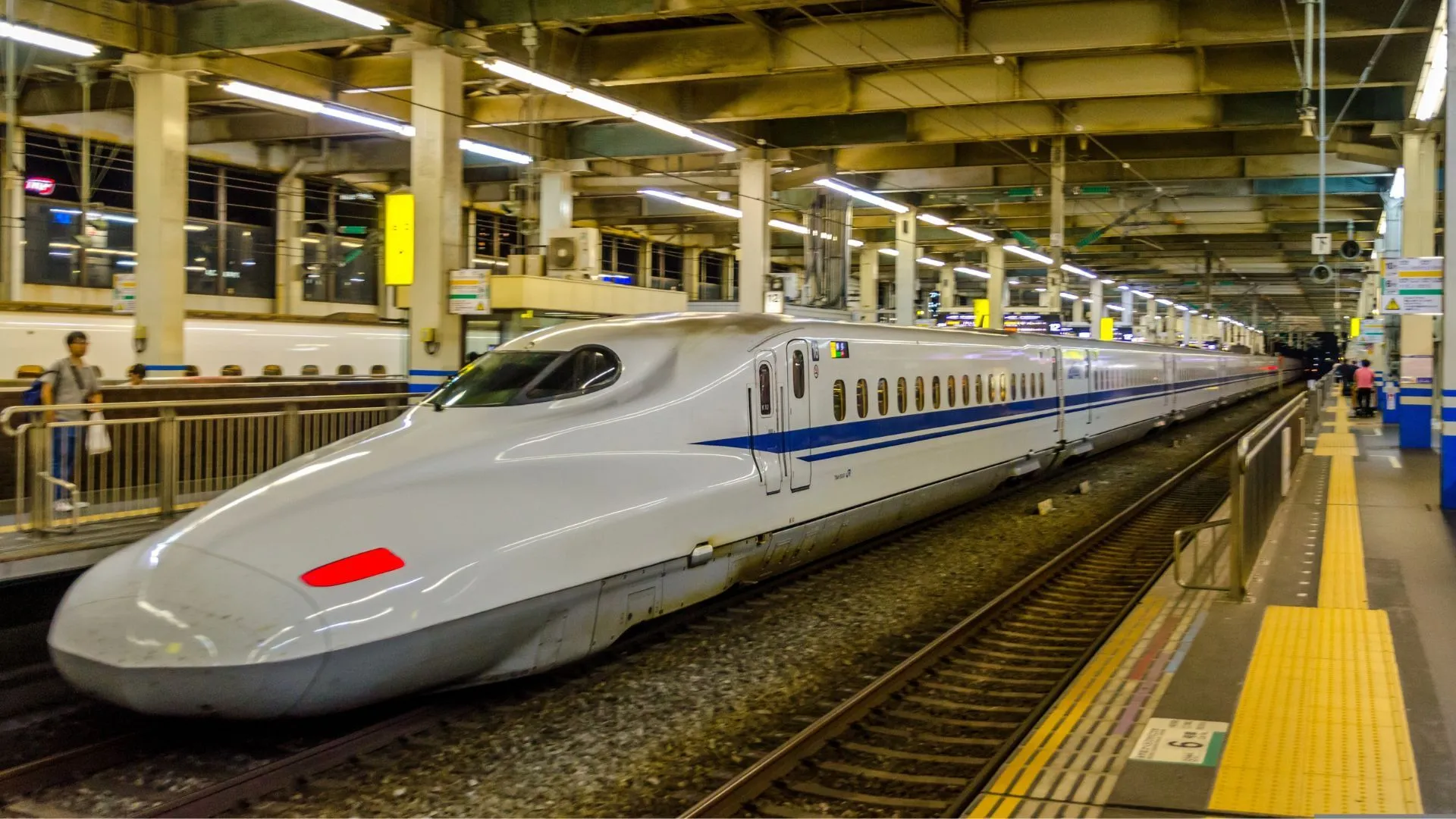 |
Shinkansen train in Japan. Photo: Shutterstock |
Shinkansen train in Japan. Photo: Shutterstock
The north-south high-speed railway is identified as a pivotal project among the large-scale railway initiatives being promoted. The Government has requested the early completion of important reports for submission to competent authorities. It also mandated clarification of investment methods, capital mobilization mechanisms, project management organization, and standardization of technical preparation steps.
Alongside the North-South axis, regional and logistics connection projects are also being accelerated to exploit transport corridors to seaports, industrial parks, logistics service centers, and border gates. In the urban railway segment, localities continue to adjust planning, supplement resources, and remove procedural obstacles to expand networks in major urban areas.
To implement multiple projects concurrently, the management agency is carrying out tasks related to organizational coordination, legal framework finalization, and technical standardization. After the National Assembly approved the investment policy for key railway projects, the Steering Committee for Key Works and National Important Projects in the Railway Sector was established on 15/3/2025.
Concurrently, the National Assembly amended the Railway Law and the Construction Law. The Government directed ministries and sectors to expedite the drafting and amendment of relevant decrees and circulars to address challenges in investment, management, operation, and resource mobilization for the projects.
The Ministry of Construction is also developing a system of specialized railway technical standards and regulations to serve as a basis for design, construction, and operation. Urban railways in Hanoi and Ho Chi Minh City have 311 standards under review and application. The Lao Cai - Hanoi - Hai Phong railway project is expected to apply 88 sets of Trung Quoc survey and design standards and 18 sets of standards for cost estimation and construction norms. The north-south high-speed railway project requires 219 railway and construction industry standards, 146 European and international standards, and 118 Trung Quoc standards for safety, operation, and technology.
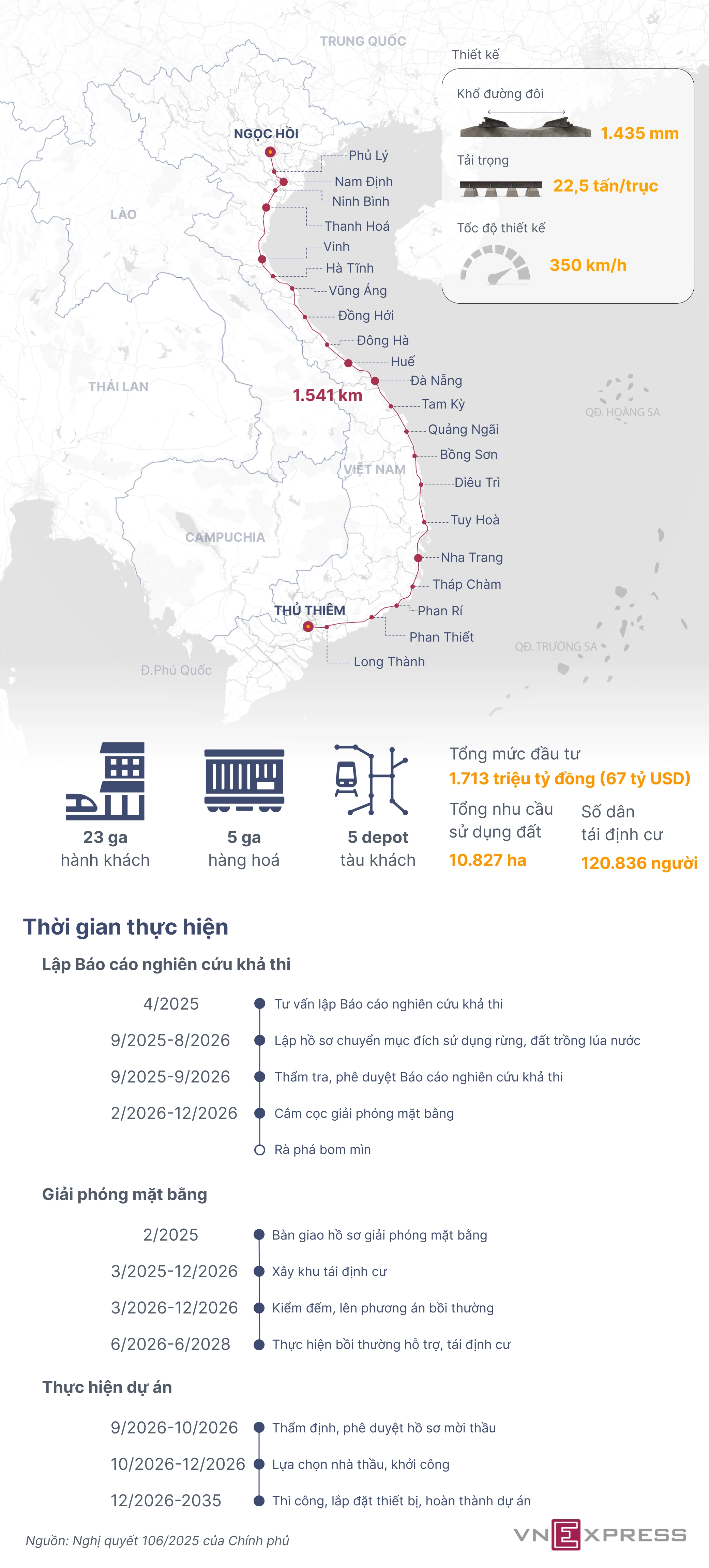 |
Milestones for the north-south high-speed railway project. Graphic: Hoang Khanh |
Milestones for the north-south high-speed railway project. Graphic: Hoang Khanh
Human resource preparation
Human resources are a key factor for implementing modern railway projects. The railway sector aims to train over 50,000 personnel by 2035, serving design, construction, management, operation, and maintenance.
According to the roadmap: 320 people will receive basic training in 2025; approximately 1,100 people will be trained during the 2026-2030 period; and about 41,000 people will be trained between 2030-2035, focusing on managing, operating, and exploiting modern railway systems.
Vietnam Railways Corporation excels in managing, operating, and maintaining the entire existing railway network. It also has a foundation for manufacturing many railway infrastructure components and mastering information and signal systems. The enterprise states its readiness to participate in large-scale railway projects, accepting technology and technical transfers from the initial design phase.
In 2025, the Railway College organized numerous theoretical and practical classes for railway technical staff. 175 railway infrastructure and signal information technical staff were sent for training in Lieuzhou, Kunming (Trung Quoc).
Despite institutional, technical, and human resource preparations, implementing large-scale railway projects faces challenges, particularly concerning capital, site clearance, technology, and implementation organization. Investment capital is considered the biggest challenge.
Large-scale railway projects, especially the north-south high-speed railway, demand substantial financial resources and long capital recovery periods. The line traverses many localities, including urban areas, leading to extensive site clearance requirements, high costs, and risks of delays if coordination between the central and local governments is insufficient.
Regarding technology and technical standards, the projects adopt modern, high-speed technologies, requiring a synchronized system of standards and regulations that align with international benchmarks. Domestic enterprises' capacity to master technology remains limited, potentially leading to reliance on foreign partners in the initial stages. The lack of experienced experts in designing, constructing, and operating modern railways may also affect project progress and quality.
To address these issues, experts propose that management agencies continue to refine the legal framework, especially specific mechanisms for capital, site clearance, and technology selection. They also suggest strengthening the State's coordinating role and enhancing the capacity of domestic enterprises to ensure that key railway projects are implemented on schedule, efficiently, and sustainably.
Doan Loan


