Three weeks before the holiday, Trang Nhung from Ha Noi finalized her family's travel itinerary to Hue and Da Nang. Searching for tickets on 7/4, she found prices had increased significantly, with many flights to the Central region already fully booked.
For the Hanoi - Hue route on 27-28/4, and the return on 5/5, round-trip tickets cost 4,2-4,5 million VND. During the peak period of 29/4-3/5, economy tickets were sold out, with only Skyboss class remaining at prices up to 9,7 million VND per person.
On the train ticket booking system, the Hanoi - Hue route on 28/4 had only a few sleeper tickets left, priced around 1,2 million VND, while many return services on 3/5 were fully booked. Nhung commented, "I anticipated that rising fuel prices would increase air and train fares this year, but I didn't expect them to sell out so quickly."
Data from airlines indicates that demand increased rapidly, concentrating on 29-30/4 and return dates of 3-4/5. On the Hanoi - TP HCM route, common one-way fares ranged from 3,4-5 million VND, depending on the flight time and airline.
Vietnam Airlines' flights from Hanoi to TP HCM on 27-29/4 had few economy seats remaining, with prices reaching the ceiling of 3,4 million VND per one way; most available tickets were in higher fare classes. Return services on 2-3/5 continued to maintain high prices.
Tourist routes from Hanoi and TP HCM to Da Nang, Nha Trang, Phu Quoc, and Da Lat also recorded higher than usual prices, commonly 2,5-4,5 million VND per one way. Many flights to Phu Quoc and Nha Trang had prices near the domestic economy fare ceiling.
The Hanoi - Nha Trang route for 29/4-2/5 with Vietnam Airlines cost approximately 7,4 million VND round trip; Vietjet Air offered prices around 7,2 million VND, not including checked baggage. Many flights from Nha Trang and Da Nang returning to Hanoi and TP HCM at the end of the holiday on 3/5 were sold out, with only premium tickets remaining.
Market realities show that flights on peak days, at convenient times, quickly sold out, while off-peak day or time flights still had tickets available at prices 1-2 million VND lower per one way.
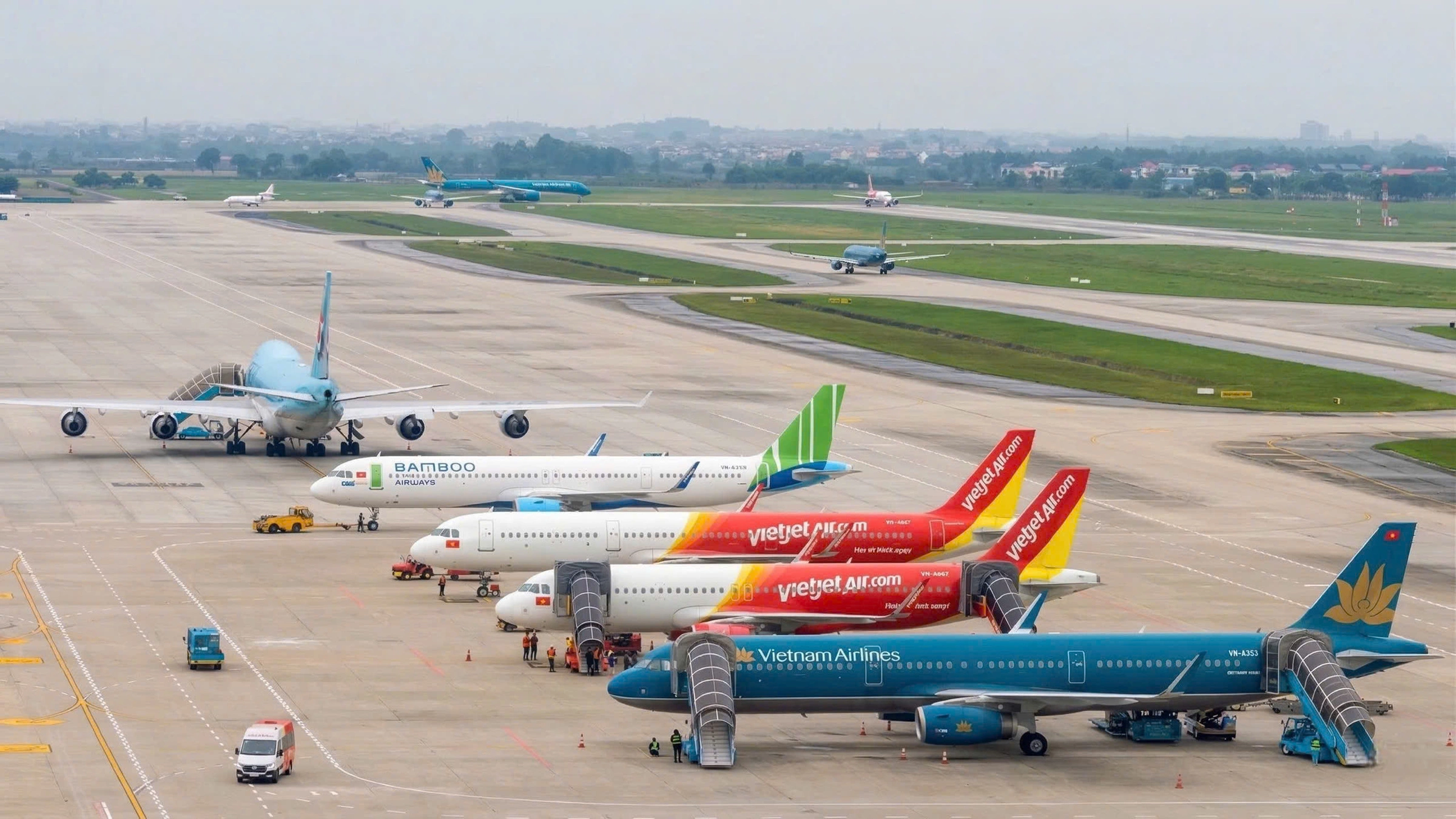 |
Aircraft parked at Noi Bai airport. *Photo: Phan Cong* |
Despite rising aviation fuel costs, airlines maintained their flight networks and added services to meet increased travel demand. Vietnam Airlines Group expects to provide nearly 1,12 million seats on domestic and international flights during the peak period, an increase of 15.5% compared to the same period in 2025.
For its domestic network alone, the airline operates more than 3,800 flights, offering over 730,000 seats, an increase of approximately 13% in flights and 16% in seats compared to the same period.
Vietjet Air also increased its flight schedule by approximately 500 flights, representing a 16% rise compared to the previous year, bringing its total seat capacity to 832,000, an increase of around 18%. The additional flights focus on high-demand routes such as Hanoi and TP HCM to Da Nang, Nha Trang, Hue, Quang Binh, Quy Nhon, and Phu Quoc.
In the railway sector, due to rising fuel prices since March, holiday ticket prices were adjusted to increase by 10-15% depending on the route and seat type. As of 7/4, Cong ty co phan Van tai Duong sat had sold 44,200 tickets.
During peak days, the Hanoi - TP HCM route saw two additional SE11/SE12 services, alongside five pairs of regularly operating passenger trains. Regional train pairs from Hanoi and TP HCM to Da Nang, Nha Trang, and Vinh are still operated daily, including the train connecting the central heritage region of Hue - Da Nang.
The railway also organized additional services for routes like TP HCM - Nha Trang, Phan Thiet, Hanoi - Dong Hoi, and Da Nang. The Hanoi - Lao Cai route maintains three pairs of trains daily; Hanoi - Hai Phong has four pairs of trains and will add six services on peak days.
According to some aviation experts, the surge in holiday ticket prices is a cyclical occurrence when demand is concentrated in a short period. In the long term, it is essential to expand airport infrastructure, optimize slot coordination, and increase fleet size to reduce pressure. For passengers, proactive planning and early booking remain effective solutions to avoid high prices every peak season.
Doan Loan