In late April, Ms. Hoa, 36 years old, residing in Hanoi, attempted to submit an integrated application for her newborn son's birth registration, permanent residency, and health insurance card via the National Public Service Portal. Believing the online process would be convenient due to linked data, she prepared her parents' documents and carefully checked all information before submission.
However, after multiple attempts, her application was repeatedly rejected. On one occasion, the system notified her of "missing documents" but did not specify which documents or information were incomplete. She tried calling the helpline but could not connect, eventually being advised by relatives to seek direct support at the commune office.
Having just completed her postpartum recovery period, Ms. Hoa left her son with his grandmother and went to the Public Administrative Service Center – the support point at her residential commune. After a holiday, many other citizens were also there to process online procedures. She continued to fill out the application on her phone, then used a computer at the support center, but still could not complete the submission.
Upon inquiring with an officer at the center, Ms. Hoa learned that while her husband's temporary residency had been successfully registered at the commune, the system only displayed his permanent address, not his temporary one. "The commune officer also mentioned that each rejected application has a clear reason noted, indicating what is missing or needs adjustment. But in my case, the reason was only visible to the officer, not to me as a citizen," she recounted.
Despite having been married for nearly 10 years and having two children, the information on the National Public Service Portal still listed Ms. Hoa and her husband as "single." According to her, this detail did not affect the birth registration process but highlighted that data between different systems was not fully synchronized.
Even when proceeding on a computer at the commune with staff assistance, the application stalled at the "attach documents" step without progressing. The commune officer was also perplexed, unable to resolve the issue due to a system error. Last week, Ms. Hoa tried again, and her application was successfully submitted, showing a "processing" status by 12/5.
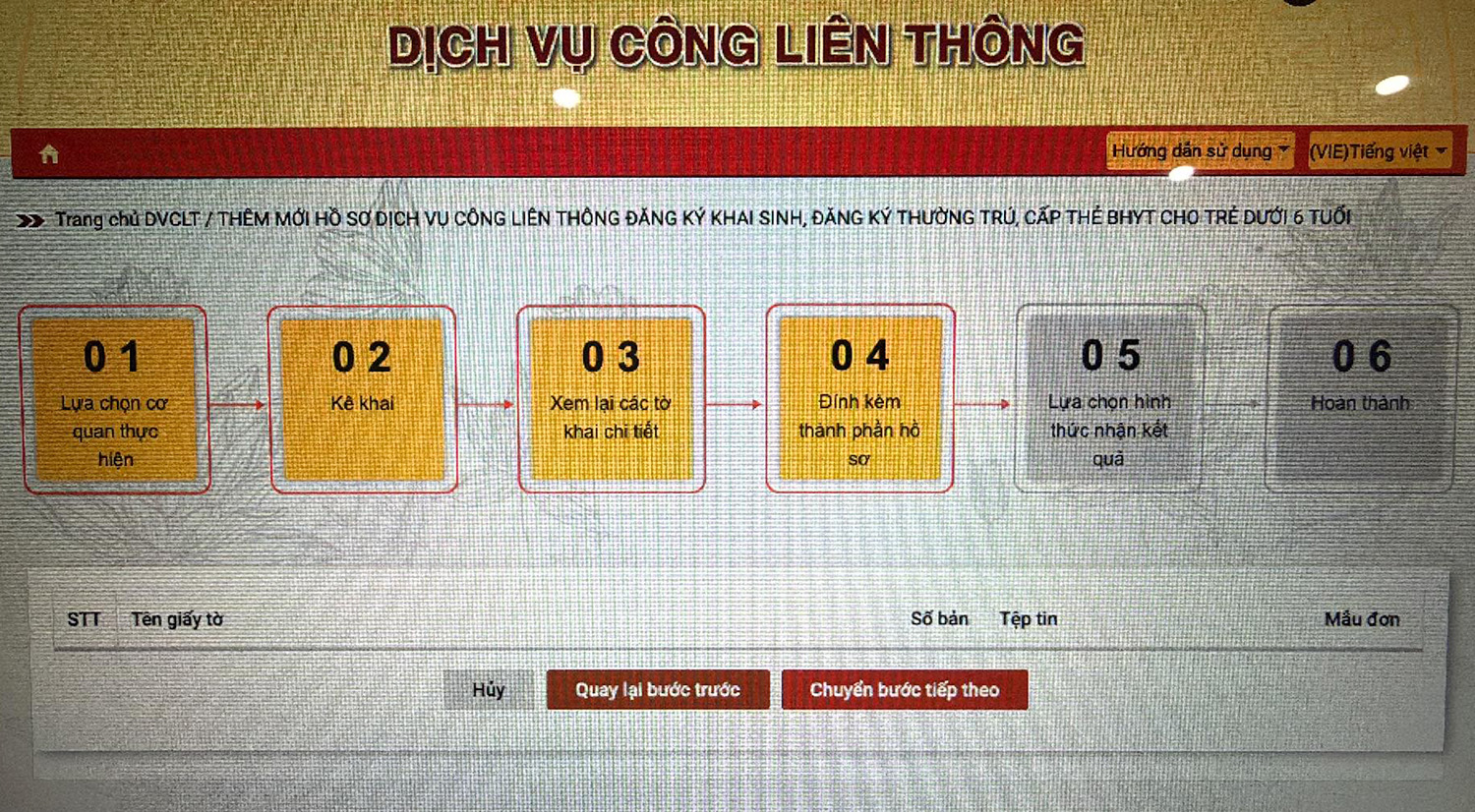 |
Ms. Hoa's online declaration process often stopped before she could attach required documents. Photo: NVCC |
Ms. Hoa is not alone; Ms. Thu, 37 years old, also in Hanoi, reported similar difficulties when submitting an integrated application for her child's birth registration, permanent residency, and health insurance card on the National Public Service Portal. After multiple unsuccessful attempts, her family had to visit the commune for direct guidance.
These issues emerged during a phase where online public services were consolidated under the National Public Service Portal as the single focal point, replacing previous provincial-level portals. This transition aimed to unify the platform but also created demands for data synchronization and maintaining direct support channels for citizens.
A rapid assessment of public service provision in the context of two-tier local government, conducted by the Ho Chi Minh National Academy of Politics and the Mekong Development Research Institute, indicated that commune-level authorities face challenges in digital transformation following mergers.
According to the study, only 22% of citizens had used the National Public Service Portal after the transition in 7/2025. Among those who had, 87% were satisfied with the service, but 27% encountered difficulties, and 34% were concerned about personal data security. Some areas reported slow system performance or unsynchronized data.
The research team recommended improving user experience by simplifying processes, reducing redundant data entry, and enhancing personal data protection.
The Ministry of Home Affairs' SIPAS 2025 report also showed that 87% of the 36,000 surveyed citizens expected high-quality online public services. The report emphasized that digital transformation should be citizen-centric, developing user-friendly platforms suitable for diverse demographic groups, while also combining online and in-person methods effectively.
Ms. Hoa believes that online public services would be more convenient if data were fully integrated and the system operated stably. When problems arise not caused by the citizen, the receiving agency should offer flexible support solutions to avoid prolonged application processing times.
Vo Hai - Hong Chieu
*Names of citizens have been changed upon request