On 29/9, Dao Phu Thuy Duong, Secretary of the Vinh Bao Commune Party Committee, stated that at depths of 1-2 meters, the soil changed to black and had a strange odor. Search teams believe these could be burial sites for murdered individuals and are continuing excavations for clarification. The identities of the 20 sets of remains found in this area have not yet been determined.
According to accounts from witnesses and martyrs' relatives, during 1950-1951, French colonialists established the Mai Son outpost, where they detained and tortured many revolutionary soldiers and local residents. Many were subsequently killed and mass-buried in the Ma Chia area, which was then nearly 6,000 square meters.
The remaining land at Ma Chia is currently about 250 square meters, rising 30-40 centimeters above the surrounding rice fields. A memorial stele here lists the names of 8 martyrs, alongside symbolic graves built by relatives for worship.
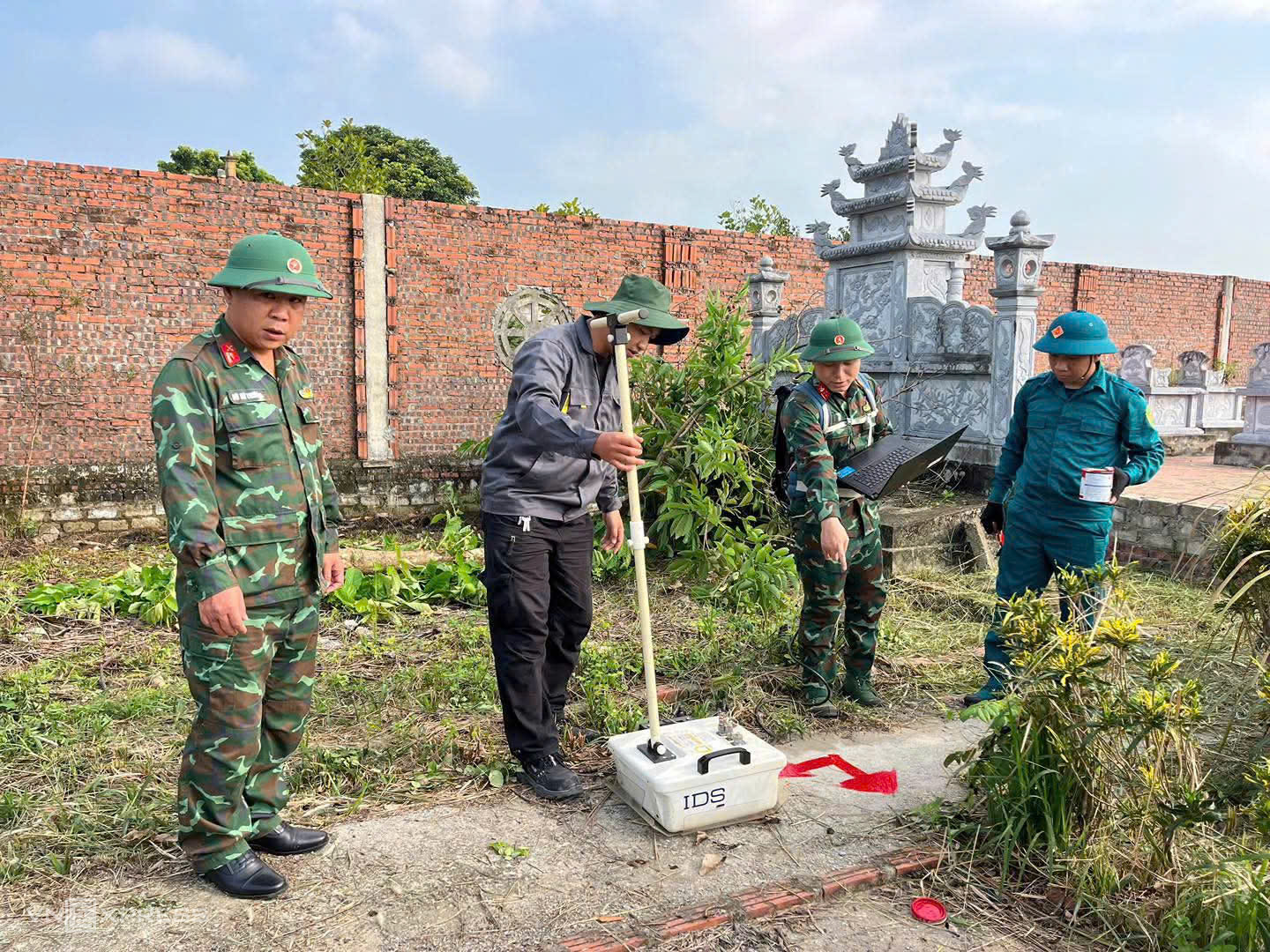 |
Search unit using ground-penetrating radar (GPR) to locate and identify mass graves of 8 martyrs from the anti-French resistance period in the Ma Chia area. Photo: Vu Truong |
Search unit using ground-penetrating radar (GPR) to locate and identify mass graves of 8 martyrs from the anti-French resistance period in the Ma Chia area. Photo: Vu Truong
Before the excavation, the Hai Phong City Military Command collaborated with Vinh Bao, Vinh Hai, and Vinh Am communes, martyrs' relatives, and historical witnesses to cross-reference documents, survey the site, and organize a workshop to establish search criteria. This activity is part of the "500 days and nights campaign" aimed at accelerating the search, collection, and identification of martyrs' remains.
The excavation is divided into two phases: first covering the entire remaining 250 square meters of Ma Chia land, then expanding to an additional 350-500 square meters in the surrounding area.
Le Tan