The Hanoi People's Committee is currently soliciting feedback on a draft resolution to pilot special mechanisms and policies for the investment and construction of seven key railway projects in the capital.
According to the draft, when the state acquires land for these projects, in addition to land compensation set at a maximum of two times the regulated rate, households whose residential land is acquired will be prioritized for temporary housing arrangements as per city regulations.
Strategic contractors are responsible for coordinating with local authorities and relevant agencies to encourage and persuade households and organizations within the project area to voluntarily hand over land concurrently with the process of inventorying, compensating, supporting, and relocating.
Beyond land clearance mechanisms, Hanoi plans to implement various specific policies related to contractor selection, investment procedures, capital mobilization, technology testing, and technology transfer. These measures aim to shorten the implementation time for the projects.
The seven projects proposed for these special mechanisms include two national railway lines and five urban railway lines. The two national railway projects are the realignment of the existing Hanoi - TP HCM railway line, specifically the Phu Xuyen - Ngoc Hoi section, and the Eastern Ring Road railway line, from Ngoc Hoi to Kim Son.
The five urban railway projects comprise: line one (Thuong Phuc - Railway Industrial Park - Ngoc Hoi - Hanoi Station - Yen Vien - Thu Lam Multi-purpose Urban Area - Noi Bai Airport); line two (Noi Bai Airport - Nam Thang Long - Tran Hung Dao - Thuong Dinh - Hung Vuong Stadium); line eight (Hoa Lac - Son Dong - Mai Dich - Ring Road 3 - Linh Nam - Thuan An - Gia Binh Airport); line 10 (Vo Chi Cong - Ring Road 2,5 - Vinh Tuy - Dong Anh); and line 14 (Thang Long Bridge - Hong Ha - Gia Lam - Nghia Tru).
As per the draft, the five urban railway lines commenced construction in June and are expected to be largely completed by 2030. The two national railway projects are scheduled to begin construction on National Day, 2/9, with an anticipated completion in 2027.
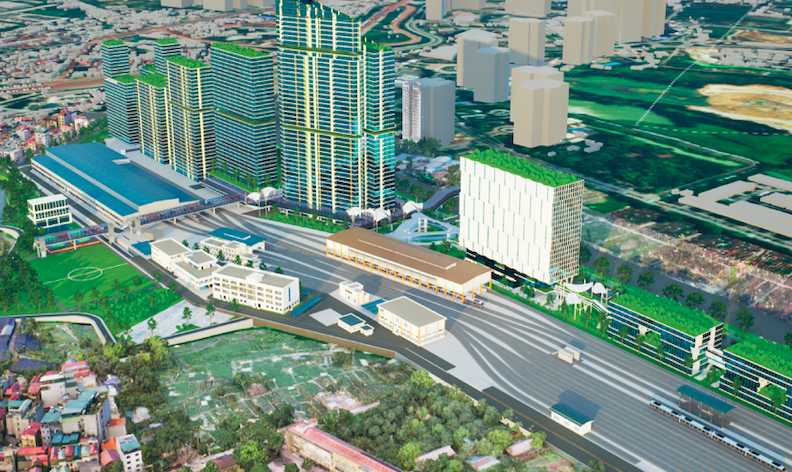 |
Perspective of Xuan Dinh Depot, urban railway line 2.1. *Source: Hanoi People's Committee* |
Strategic contractors must offer a minimum 10-15% price reduction.
To accelerate these projects, Hanoi proposes a "strategic contractor" mechanism. According to the draft, a strategic contractor is a potential domestic contractor committed to undertaking the capital's important railway projects and designated by the City Party Committee to sign contracts.
This contractor must guarantee project progress and quality, while also having a plan for technology reception and transfer. The project cost must be reduced by a minimum of 15% compared to the approved bid package price for local railway projects and 10% for national railway projects.
This reduction applies to bid packages executed under turnkey contracts and various EPC, EC, and EP contract types. These contract forms involve the contractor managing multiple project stages, from design and equipment supply to construction, depending on the specific contract type.
Hanoi also suggests streamlining certain pre-implementation procedures. For local railway projects and those developed under the Transit-Oriented Development (TOD) model, planning and construction commencement procedures can be carried out simultaneously with investment decision procedures. Project owners and strategic contractors must fulfill all commencement conditions within 12 months from the start date.
Another mechanism designed to enhance domestic mastery of railway technology proposes that strategic contractors be allowed to conduct controlled trials for operational mastery, technology localization; research, production, and assembly of Tunnel Boring Machines (TBMs) and train sets; and the development of production lines for tunnel lining construction, along with solutions and technologies suitable for each project.
According to the Hanoi Metropolitan Railway Management Board, which advised on the draft's development, the city is currently implementing multiple urban railway projects and national railway projects assigned by the central government. However, the implementation process faces challenges related to investment procedures, contractor selection, surveying, design, cost management, land clearance, capital mobilization, and coordination among agencies and localities.
The city believes that these special mechanisms will help shorten investment preparation time, mobilize and utilize resources more effectively, thereby accelerating project progress.
Under the capital's 100-year vision master plan, Hanoi's urban railway network is projected to span approximately 979 km. Including national and inter-regional railways, the entire system will be nearly 1.200 km long. Currently, Hanoi operates the Cat Linh - Ha Dong line and the elevated section of Nhon - Cau Giay, part of the Nhon - Hanoi Station line. The city plans to invest in approximately 500 km of urban railway by 2035 and complete the remaining 479 km during the 2036-2045 period.
Vo Hai