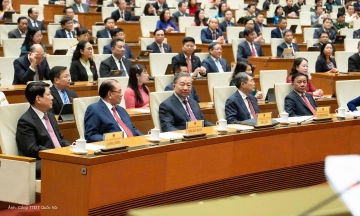
Associate Professor Dr. Luu Quoc Thai of Ho Chi Minh City University of Law presented this assessment at the national scientific workshop "Land Law 2024 and requirements for amendments and additions in the new context", held on 17/6.
 |
Associate Professor Dr. Luu Quoc Thai at the national scientific workshop "Land Law 2024 and requirements for amendments and additions in the new context", 17/6. Photo: Quoc Toan |
Associate Professor Dr. Luu Quoc Thai, a senior lecturer at the Faculty of Commercial Law, stated that the root cause of the issues stems from the state simultaneously performing two roles: representing the land owner and acting as the regulatory body. The blend of the owner's economic rights with public authority prevents land relations from fully operating according to market principles.
He believes that by both providing land use rights and determining land prices and related financial obligations, the state easily falls into the situation of "playing both sides", reducing market objectivity.
Dr. Nguyen Hoang Thuy Trang of the Faculty of Commercial Law pointed out that the current mechanism creates conflicts of interest in most of the state's land valuation activities.
According to her, when determining land use fees, land rent, and related financial obligations, the state is the budget revenue collector; thus, higher land prices result in greater revenue. Conversely, when land is expropriated, the state is the compensation payer; therefore, lower land prices reduce budget expenditures.
Meanwhile, the state both determines the land price used as a basis for compensation and resolves complaints and disputes arising from this price.
"This mechanism can create significant financial pressure on citizens and businesses when land prices used to calculate financial obligations increase sharply", Ms. Trang said.
She cited Ho Chi Minh City's new land price table under Resolution 87/2025, which shows significant increases in many locations. Residential land on Dong Khoi street is valued at 687,2 million VND per square meter, more than 4 times higher than the old price table, causing difficulties for many cases when changing land use purposes or completing legal procedures.
Conversely, if the land price table and adjustment factors do not promptly reflect actual market fluctuations, those whose land is expropriated may receive compensation significantly lower than market transaction prices.
Analyzing the land valuation mechanism under Resolution 254/2025, Dr. Pham Van Vo of the Faculty of Commercial Law explained that many cases previously required specific land valuation through consulting firms and appraisal councils. Now, they apply the land price table multiplied by an adjustment K-factor.
According to him, this approach simplifies procedures, shortens processing time, and reduces costs. However, the value of each land parcel depends on its location, shape, development potential, and many other factors, while the land price table and K-factor are established by area or road, making it difficult to fully reflect these differences.
"A land parcel with a 5 m wide frontage and another with only a 2 m wide frontage on the same road certainly do not have the same value, but the land price table still applies the same price", he said.
 |
Real estate in central Ho Chi Minh City, 7/2025. Photo: Quynh Tran |
Dr. Vo noted that both the land price table and the K-factor are relatively stable, whereas market prices fluctuate constantly. The lengthy process of development, appraisal, and approval often results in outdated prices compared to reality.
He cited the draft adjustment K-factor for Ho Chi Minh City's land prices, where land prices determined by the price table and K-factor on some central roads are only about 955 million VND per square meter, significantly lower than actual transaction prices of 1,5-2 billion VND per square meter. This disparity could lead to those whose land is expropriated receiving compensation below the asset's true value.
According to Dr. Vo, a prolonged discrepancy between compensation prices and market prices can increase complaints and disputes, and affect the progress of site clearance.
Experts believe that a fundamental solution is not merely technical adjustments to valuation but controlling conflicts of interest within the land pricing mechanism.
Associate Professor Dr. Luu Quoc Thai stated that in commodity-monetary relations, the state should first be seen as the owner of land use rights, while citizens and businesses are clients. Relations between the parties must be based on principles of equality, transparency, and respect for market value.
He proposed expanding negotiation mechanisms for land expropriation, increasing market factors in land valuation, and gradually limiting situations where state agencies both determine prices and directly benefit from or are affected by the valuation results.
Dr. Nguyen Tri Cuong of the University of Economics and Law (Vietnam National University, Ho Chi Minh City) stated that many countries have separated land management agencies from valuation systems to mitigate conflicts of interest. Land valuation involves: independent appraisal organizations, transparent transaction databases, and social oversight mechanisms.
Citing South Korea's experience, he noted that the country has established a public land price system based on regularly updated actual transaction data. Standard land prices are determined by independent experts, but for compensation or calculating financial obligations for specific projects, authorities still consider the unique characteristics of each land parcel instead of rigidly applying an administrative price.
Le Tuyet