The Department of Dyke Management and Disaster Prevention reported that at 7 h today, the water level of the Tich river at Kim Quan station (Ha Noi) reached 8,57 m, exceeding alert level three by 0,17 m. The Bui river at Yen Duyet registered 7,43 m, surpassing alert level three by 0,43 m.
In Ninh Binh, the Hoang Long river at Ben De station rose to 4,4 m, 0,4 m above alert level three. The Day river at Phu Ly reached 4,48 m, exceeding alert level three by 0,48 m. In Thanh Hoa, the Buoi river remained high, reaching 16,99 m at Thach Quang and 12,88 m at Kim Tan, surpassing alert level three by 0,99 m and 0,88 m respectively. The Yen river at Chuoi station rose to 4,15 m, 0,65 m above alert level three, and the Len river at Cu Thon reached 4,46 m, exceeding it by 0,96 m.
The Boi river at Hung Thi station (Phu Tho) was at 10,83 m, 0,03 m above alert level one. Previously, the flood on this river peaked at 14,93 m at 9 h on 16/9, 1,93 m above alert level three, before receding.
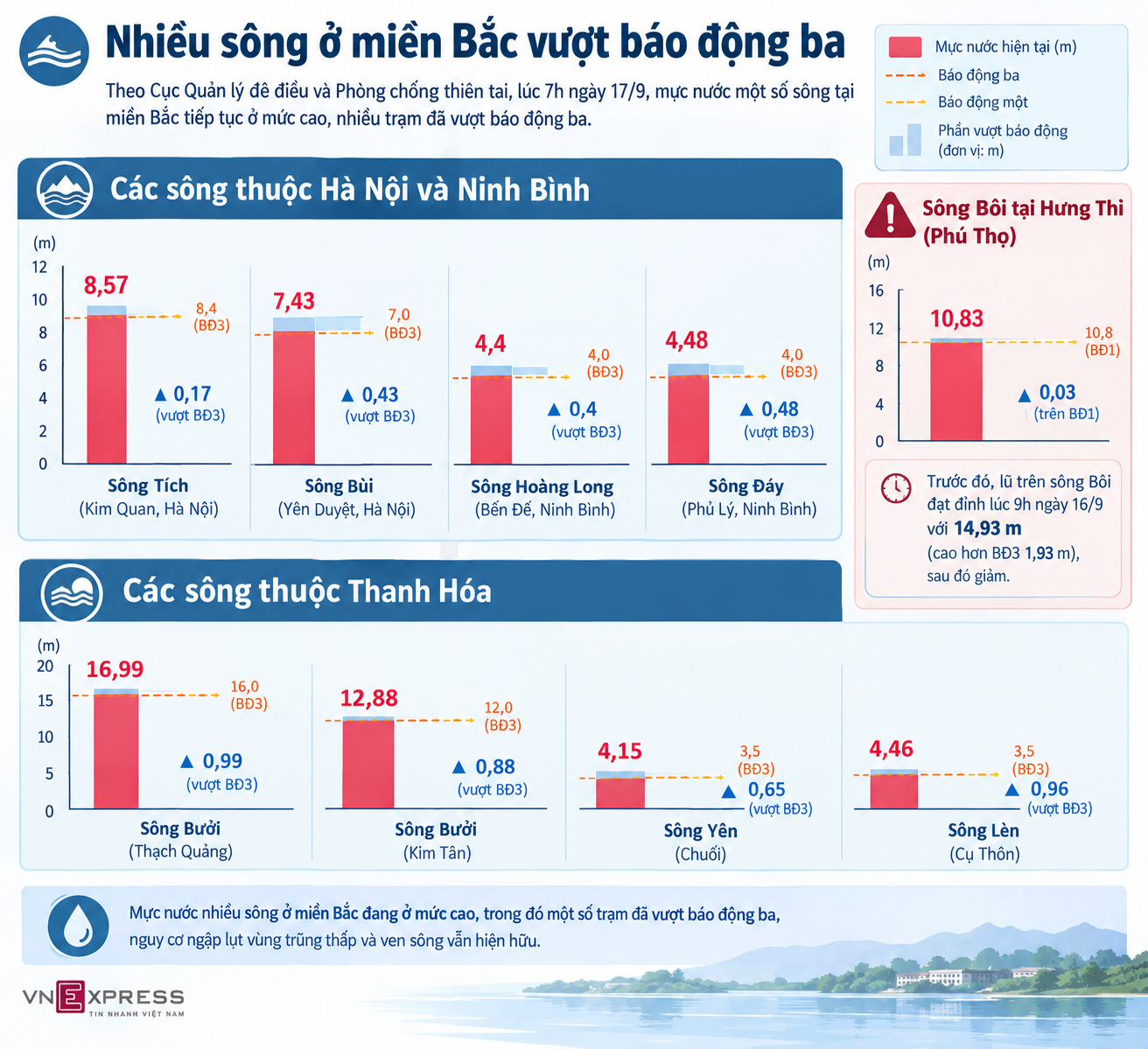 |
Water levels in many rivers exceed alert level three. Graphics supported by AI.
Forecasts indicate that over the next 12 hours, floodwaters on the Hoang Long river will recede slowly but remain above alert level three. Meanwhile, water levels in the Tich, Bui, Day, Buoi, and Yen rivers are expected to continue rising and stay above alert level three.
The high flood levels follow several days of heavy rainfall, influenced by a post-tropical depression and a cold front. Meteorological agencies recorded widespread rainfall of 200-400 mm across northern Vietnam, Thanh Hoa, and Nghe An from 19 h on 13/9 to 7 h on 17/9, with some localized areas receiving over 500 mm. Several locations experienced very heavy rain, including Ta Si Lang (Lao Cai) with 583 mm, Van Mai and Lung Van (Phu Tho) with 504 mm and 498 mm respectively, Cho Chay (Ha Noi) with 471 mm, and Cam Lien 2 and Thanh Tan 1 (Thanh Hoa) with 585 mm and 568 mm respectively.
From the night of 16/9 to the morning of 17/9, rain concentrated in the midland and delta regions of northern Vietnam, Thanh Hoa, Nghe An, and the South Central Coast, with common rainfall levels of 40-80 mm. Dam Day and Hoai Duc (Ha Noi) received 164 mm and 138 mm respectively; Gia Vien (Ninh Binh) received 166 mm; and Chuoi and Cam Lien 2 (Thanh Hoa) received 184 mm and 182 mm respectively.
The National Center for Hydro-Meteorological Forecasting predicts that today, Ninh Binh, Thanh Hoa, Nghe An, and southern Phu Tho will continue to experience 40-80 mm of rain, with localized amounts exceeding 130 mm. In the late afternoon and evening, areas from Hue to Lam Dong and the Southern region will see 10-30 mm of rain, with localized amounts over 60 mm.
Starting from 18/9, heavy rainfall in northern Vietnam, Thanh Hoa, and Nghe An is expected to gradually decrease.
 |
Forces reinforce the Bui dike in Xuan Mai commune, Ha Noi on 17/9. Photo: Gia Chinh
The flooding has submerged 2,291 homes in Phu Tho, Ha Noi, Ninh Binh, Thanh Hoa, and Nghe An. Of these, 921 homes are in Ninh Binh, 749 in Nghe An, 334 in Thanh Hoa, 146 in Ha Noi, and 141 in Phu Tho. Additionally, 1,621 households are cut off due to flooded roads, and 372 households in Xuan Mai (Ha Noi) have flooded access routes.
Approximately 10,000 hectares of rice, crops, and other plants have been damaged, including 5,843 hectares in Ninh Binh, 2,157 hectares in Thanh Hoa, and 1,287 hectares in Nghe An.
The floods also caused three homes to collapse, damaged 21 others, and triggered 92 landslides in Lao Cai, Phu Tho, Thanh Hoa, and Nghe An. Eight of these landslides occurred on national highways. Local authorities are addressing and mitigating these issues to ensure traffic flow.
In Ninh Binh, the river-facing slope of the left Day dike experienced an 18 m landslide, with a height of 0,5-1,8 m. Authorities initiated temporary repairs by driving bamboo stakes, filling sandbags, and laying tarpaulins to prevent erosion.
In Ha Noi, about 1,400 m of the Bui river dike and embankments in Xuan Mai and Kieu Phu communes were overtopped. Functional forces are reinforcing and preventing further overflow.
At reservoir systems, the inflow to Hoa Binh reservoir at 7 h on 17/9 was 2,877 m3/s, with a reservoir water level of 112,16 m. Son La reservoir received 624 m3/s of water and discharged 814 m3/s. Thac Ba reservoir had an inflow of 460 m3/s and discharged 142 m3/s. Hydropower reservoirs in northern and North Central Vietnam continue to operate and regulate water levels based on current conditions.