The Central Steering Committee for Science, Technology, Innovation, and Digital Transformation announced on 30/12 the conclusions of General Secretary To Lam from the Committee's conference summarizing 2025 work and outlining tasks for 2026.
According to the conclusions, General Secretary To Lam endorsed the motto for 2026 as "breakthrough action, widespread results." While 2025 served as a "kick-off and warm-up" phase, 2026 must transition to accelerated progress. The decisive factors for this acceleration are implementation capacity, disciplined action, and tangible outputs.
"Every ministry, sector, and locality must shift from a plan-driven approach to a goal- and product-oriented approach; from reporting progress to reporting effectiveness; from merely undertaking tasks to seeing them through to completion," the General Secretary stated, also requiring that performance results be linked to accountability for leaders.
The Party leader assigned agencies to clearly identify core tasks and allocate resources accordingly. This includes operationalizing the national digital master architecture framework and the national data architecture framework, completing infrastructure, building platforms and databases, developing strategic technologies, and fostering high-tech human resources. The Central Steering Committee will coordinate, monitor, urge, and inspect the implementation of these tasks across the entire system.
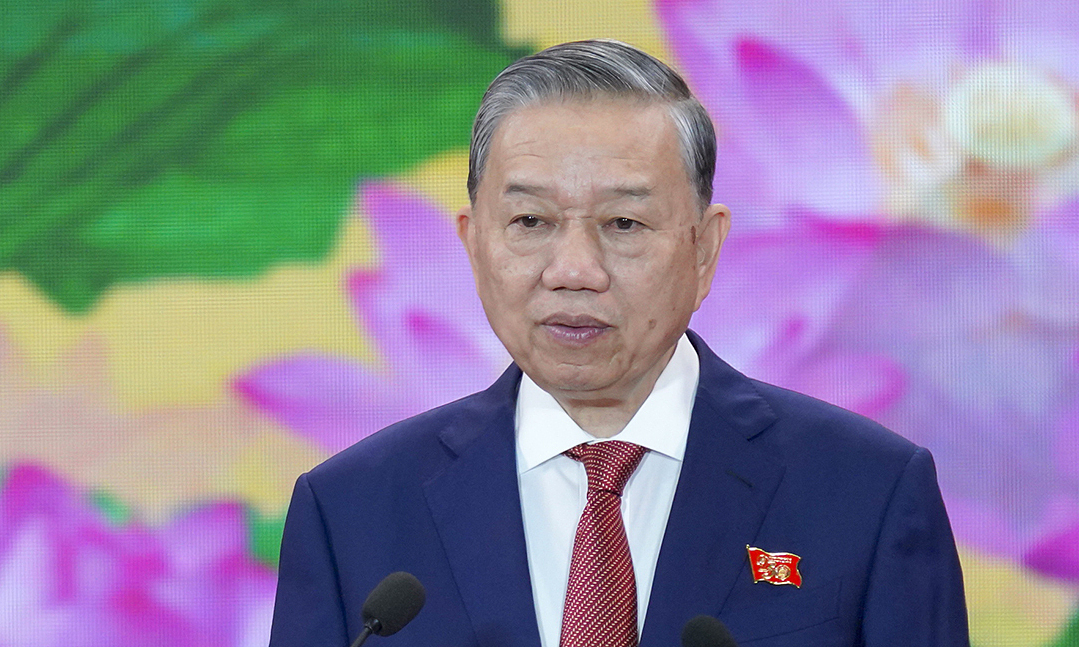 |
General Secretary To Lam. Photo: Nguyen Dong |
The General Secretary demanded that "three major questions must be answered." First, how ministries, sectors, localities, and businesses will establish their databases. By Q1/2026, a complete list of databases must be finalized and regularly updated, ensuring the data is accurate, sufficient, clean, and live.
Second, for strategic technologies, it is crucial to identify which ministries and sectors are responsible for deployment and which will coordinate. Clear objectives for 2026 and by 2031, along with a specific implementation roadmap, are also required.
Third, the nationwide improvement in digital transformation and innovation must be quantified by clear indicators. This includes determining the number of high-quality bachelors and engineers to be trained for strategic technologies, and specifying the responsibilities of the Ministry of Education and Training, the Ministry of Science and Technology, scientific academies, and the Union of Science and Technology Associations. "All these details need to be clearly defined with an implementation roadmap," the General Secretary urged.
Emphasizing that 2026 holds particular significance as the initial year for implementing the Resolution of the 14th National Party Congress, the General Secretary noted that early in the term, the Central Committee will issue strategic resolutions on transforming the nation's development model based on science, technology, along with solutions to mobilize resources for two-digit growth. This underscores the foundational role of science, technology, innovation, and digital transformation, which are no longer options but mandatory requirements for fast and sustainable national development.
The General Secretary called on agencies to focus on developing specific applications and products that serve socio-economic development and meet the needs of people and businesses. All policies, platforms, services, and utilities must measure results by the satisfaction of people and businesses, focusing on substance and avoiding formalism to deliver practical effectiveness. Additionally, resources should be directed towards strategic technologies and product commercialization, promoting science and technology and innovation through state - academia - enterprise collaboration.
The State is designated to play a facilitating role, removing barriers, and acting as the "first customer" to commission science, technology, innovation, and digital transformation products, services, and solutions. This will create an initial market for new research outcomes, inventions, and technological applications.
"Large businesses need to think big, undertake major initiatives, lead and pave the way, creating development space for other businesses to join the value chain; small and medium-sized businesses should focus on tasks suitable to their capabilities to enhance their position and contribute to national development," the General Secretary said.
Vu Tuan