


Under the revised National Master Plan, Vietnam will reorganize into 34 provinces and cities and six key economic regions. Hanoi is positioned as the center of the Red River Delta Region, connecting with six provinces and cities: Thai Nguyen, Bac Ninh, Hai Phong, Quang Ninh, Hung Yen, and Ninh Binh. Concurrently, it serves as the nucleus of the Hanoi Capital Region, linking with five provinces: Phu Tho, Thai Nguyen, Bac Ninh, Hung Yen, and Ninh Binh.
In the 100-year vision Master Plan for the Capital, Hanoi is identified as the central driving force, tasked with coordinating, leading, and disseminating development. Cities in surrounding provinces and municipalities will function as satellite urban areas, collaborating to support, share resources, and stimulate growth for both the region and the entire nation.
Hanoi's development area is expanding through sub-regional linkages. With Thai Nguyen and Bac Ninh, the plan aims to create a high-tech industrial-service urban chain along the North-South economic corridor, Ring Road 3, National Highway 1B, National Highway 3, and National Highway 18. Connections with Hung Yen, Hai Phong, and Quang Ninh will be established via the Lao Cai-Hanoi-Hai Phong-Quang Ninh economic corridor and Expressway 5B, Ring Road 4, fostering a dynamic axis for border gate economy, marine economy, and logistics.
Linkages with Ninh Binh will follow the North-South axis, Phap Van-Cau Gie-Ninh Binh Expressway, Northwest Expressway, and Ring Road 5, establishing a corridor for supporting industries, cultural and spiritual tourism, and high-quality healthcare. For Phu Tho, connections via the Noi Bai-Lao Cai corridor will facilitate the development of ecological tourism, mechanical engineering, and supporting industries.
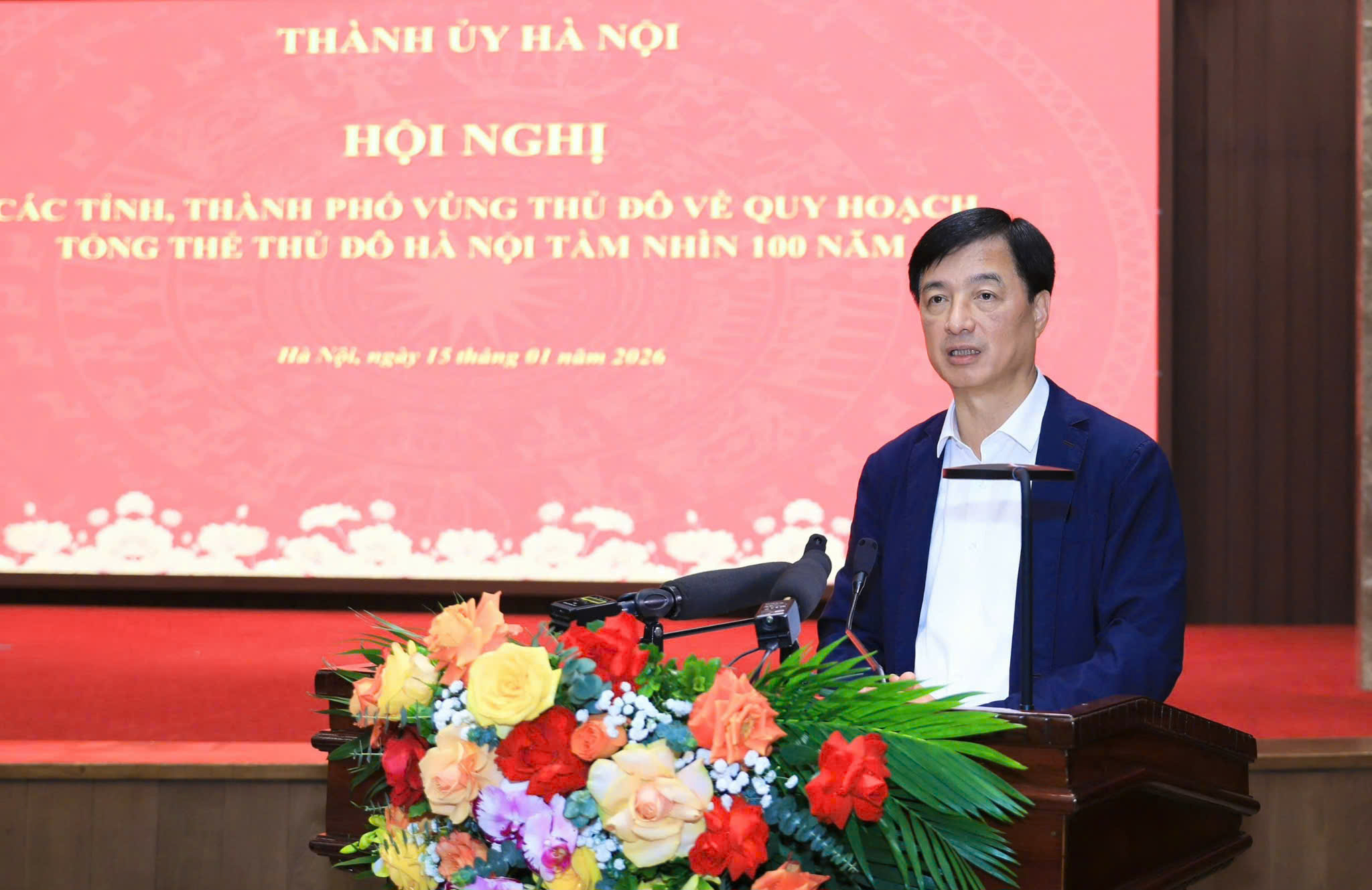 |
Secretary of the Hanoi Party Committee Nguyen Duy Ngoc concludes the conference. Photo: Quang Thai |
During the conference discussion, Nguyen Huu Nghia, Secretary of the Hung Yen Provincial Party Committee, stated that comprehensive connectivity with Hanoi is a guiding principle in the province's 2021-2030 planning, which includes plans for six bridges over the Red River. He proposed adding Trieu Duong bridge to connect Hung Yen's provincial road 427 with Thuong Tin, Hanoi. Additionally, he requested a clear alignment for Dong Ninh bridge, linking provincial road 429 (in the Van Diem area) with Hung Yen's heritage road, to ensure consistency with Hanoi's Ring Road 4 and 5 plans.
The Secretary of the Hung Yen Provincial Party Committee also advocated for the Capital's master plan to address underground space and urban rail systems. Hung Yen has planned five urban railway lines, primarily oriented towards Hanoi. Therefore, he proposed that Hanoi's metro lines, particularly line 8, be designed for synchronous connection with Hung Yen's lines to facilitate travel, aid in population dispersal, and alleviate pressure on the inner city. Furthermore, the plan should prioritize efficient utilization of waterway transport, especially along the Red River.
Pham Dai Duong, Secretary of the Phu Tho Provincial Party Committee, highlighted that Phu Tho shares approximately 290 km of border with Hanoi and is traversed by two major rivers: the Red River and the Da River. He proposed that Hanoi enhance inter-regional coordination to address issues such as environment, transport, population distribution, and industrial development. The province is also adjusting its industrial park attraction strategy to lessen the burden on inner Hanoi, while capitalizing on the development momentum of Hoa Lac High-Tech Park to extend to adjacent areas, including urban development, high-tech industry, and backup data centers.
Phu Tho's leadership proposed that Hanoi share detailed plans for the Red River banks, enabling Phu Tho to extend the riverside landscape up to Viet Tri, ensuring a consistent 70 km stretch. The province also suggested collaborating on a tourism route along the Red River and Da River, connecting from Lao Cai through Phu Tho to Hanoi. Additionally, they proposed a synchronized investment mechanism for border areas like Ba Vi to ensure consistency in regional spatial development.
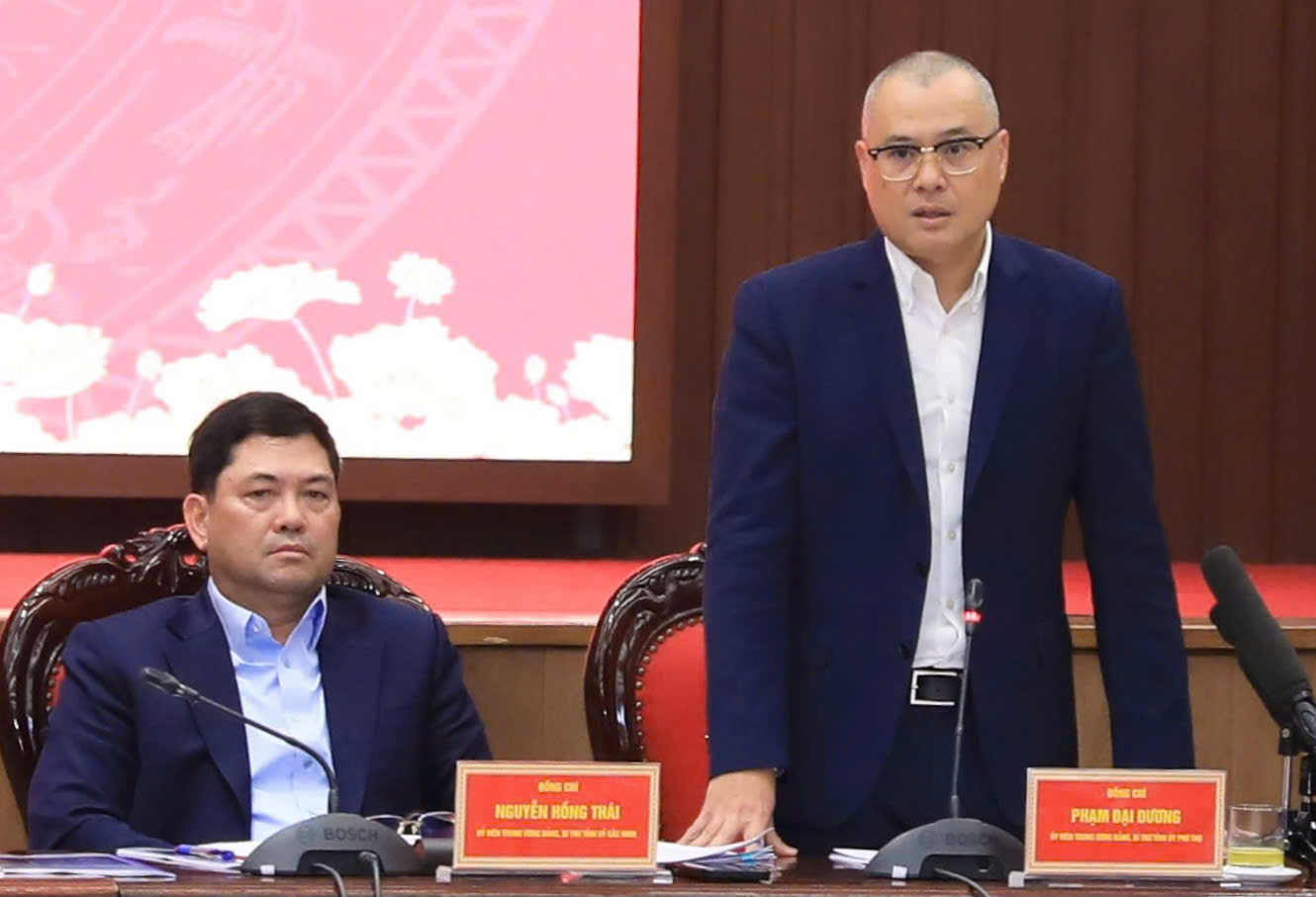 |
Secretary of the Phu Tho Provincial Party Committee Pham Dai Duong offered comments at the conference. Photo: Quang Thai |
Tran Duc Thang, Minister of Agriculture and Environment, expressed agreement with the draft Capital Master Plan, noting that many of its contents directly relate to the Ministry's functions, particularly in planning, land use, water and mineral resource management, and environmental protection.
The Minister proposed enhancing coordination among the Central government, Hanoi, and local authorities in implementing key environmental initiatives. In the first Quarter of 2026, the Ministry will collaborate on a pilot project to rehabilitate the Bac Hung Hai river system, focusing on dredging and improving water flow to progressively address pollution. While the Central government will allocate funds for dredging, local authorities must proactively invest in synchronized development along the route to achieve green, clean, and sustainable objectives.
Concluding the conference, Nguyen Duy Ngoc, Secretary of the Hanoi Party Committee, stated that Hanoi is actively seeking input from key Party and State leaders, as well as central committees, ministries, and sectors, for the 100-year vision Master Plan for the Capital. Concurrently, it is developing a resolution to supersede Politburo Resolution 15-NQ/TU and amending the Capital Law to support the development goals of the Capital, the region, and the entire nation in the new phase.
The Hanoi Secretary praised the insightful and visionary comments received at the conference, which proposed numerous solutions for the development of both the Capital and the wider region. He emphasized that regional linkage is a shared responsibility among all localities, not solely Hanoi's. He urged central committees, ministries, and local authorities to continue offering feedback to refine the draft institutional frameworks and development plans for the Capital.
The Secretary of the Party Committee stressed that regional linkage necessitates common standards across various sectors, including urban railways, waterway and road transport, subway systems, and addressing environmental issues in rivers. He stated, "Regional development mechanisms can only be robust when common development issues are identified. Localities must define the quality and development trajectory of Hanoi's satellite urban areas, while also establishing a vision for connecting with the central hub of the Hanoi Capital Region."
Vo Hai


