The Department of Construction recently assigned relevant units to review, design, and implement pilot projects at three elevated railway pillars on Nguyen Trai street, in front of the Royal City building; the Le Van Luong - To Huu underpass; the Le Van Luong - Lang Ha overpass; and three bus shelters in central streets.
For the three elevated railway pillars on Nguyen Trai street, which stand about 5.3 meters from the ground to the bottom of the bridge deck, the proposed plan involves installing steel trellis frameworks around the pillars without drilling into the structure. The trellis will be spaced appropriately from the concrete surface to allow plant growth and facilitate pillar inspection.
Plants will be cultivated at the base of the pillars, guided to climb the trellises, and distributed across all pillar surfaces. Units will select climbing plant species that grow along trellises, avoiding those that self-cling directly to concrete. The greening scope will not extend to the pillar tops, bridge girders, or technical equipment, and sufficient space must be maintained for inspection and maintenance.
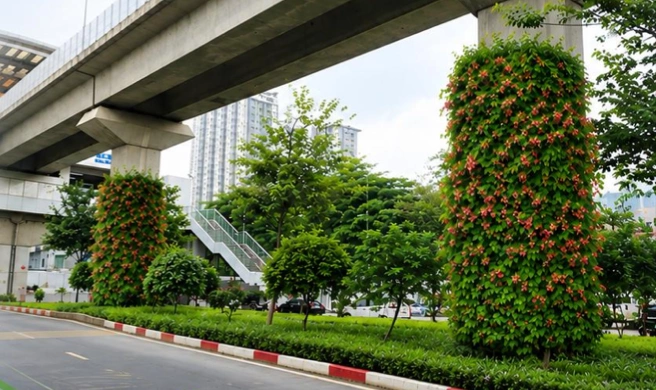 |
Perspective view of climbing plants around the railway bridge pillars of the Cat Linh - Ha Dong line, in the Nguyen Trai street area (in front of Royal City building). |
At the Le Van Luong - Lang Ha overpass, the targeted greening area is the bridge abutment wall, covering approximately 200 square meters for climbing trellises. The trellis system is designed in sections to complement the structure's architecture. These bridge abutment walls are of moderate height, constructed from concrete panels, and have existing planting strips below. The construction unit will improve the soil, plant the vegetation, and install steel trellises to guide the climbing plants. These conditions make installation, care, and monitoring of the plants more straightforward compared to elevated railway pillars or underpass walls.
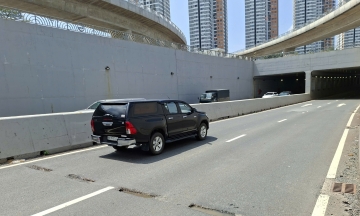
For the Le Van Luong - To Huu underpass, the wall base is adjacent to the roadway and drainage system, lacking safe space for traditional planters. The proposed solution is to arrange potted plants in clusters along the upper edge of the underpass wall, beneath the railing, extending for about 300 meters. These plants will be cultivated to hang down the inner underpass wall. Initially, the hanging length will be controlled to two to three meters and regularly trimmed to ensure no obstruction to traffic, road signs, lighting systems, or technical equipment.
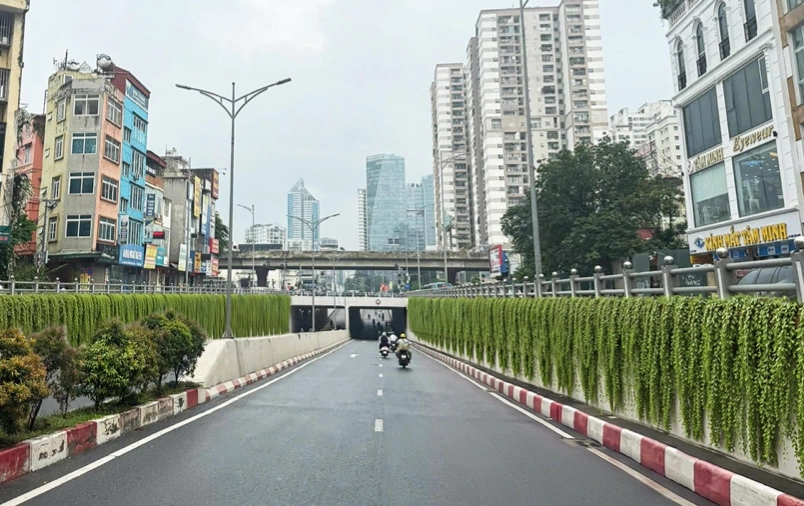 |
Perspective view of greening the Le Van Luong underpass wall. |
At three bus shelters, including the University of Pharmacy stop on Le Thanh Tong street and the stop near Xanh Pon Hospital on Tran Phu street, the plan involves placing planters behind or on either side of the structures, ensuring pedestrian access remains unobstructed. These locations feature wide sidewalks and ample sunlight for climbing plants, but lack surrounding planting strips. Light frameworks or cables will guide the plants up the back wall and a section of the shelter roof.
Plant support structures are prioritized for independent installation. If connected to a bus shelter, the installation location must receive approval from the facility management unit. Plants and trellises must not obscure stop names, route information, advertisements, cameras, lighting, or obstruct vehicle visibility.
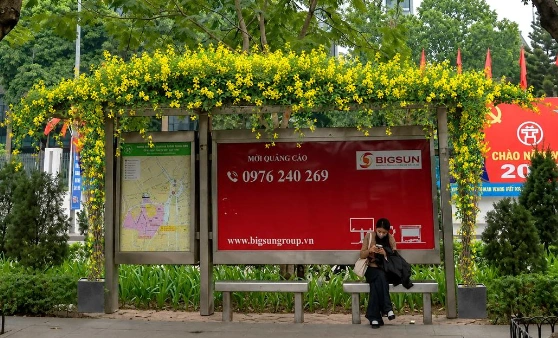 |
Perspective view of climbing plants at a bus shelter. |
The pilot program to green transport infrastructure is being implemented following Hanoi's recent issuance of a project for managing and developing its system of green spaces, parks, flower gardens, and water bodies. One key solution outlined in this project is to incorporate greenery into transport infrastructure, architectural structures, and streetscapes. The city currently has hundreds of urban railway pillars along the two Cat Linh - Ha Dong and Nhon - Hanoi Station lines, alongside the elevated Ring Road 2 and Ring Road 3 systems, numerous overpasses, and hundreds of bus shelters. However, most of these structures currently lack planted trees or flowers to enhance their aesthetics.
Among the five operational underpasses – Kim Lien, Thanh Xuan, Trung Hoa, Le Van Luong, and Kim Dong - Giai Phong – the Trung Hoa underpass has already been adorned with Indian borage plants cascading down its walls, creating green walls at the section connecting Tran Duy Hung road to Thang Long avenue.
Vo Hai