


The Hanoi People's Committee recently issued a plan to address informal markets and spontaneous business points. This initiative follows directives from the City Party Committee and City People's Council to resolve urban order issues. The plan aims to completely clear all existing informal markets, prevent new ones from emerging, and contribute to building a brighter, greener, cleaner, safer, and friendlier capital city.
A city review classified informal markets and spontaneous business points into four groups for phased clearance. Group 1 includes markets encroaching on roadways and sidewalks, which are critical areas seriously impacting traffic safety and urban order. These markets must be cleared by 30/1/2026.
Group 2 comprises informal markets with fewer than 50 business households, slated for clearance by 30/6/2026. Group 3 includes markets with 50 to 100 business households, to be cleared by 30/12/2026. Group 4 consists of long-standing and complex informal markets with over 100 business households, which are scheduled for clearance by 30/6/2027.
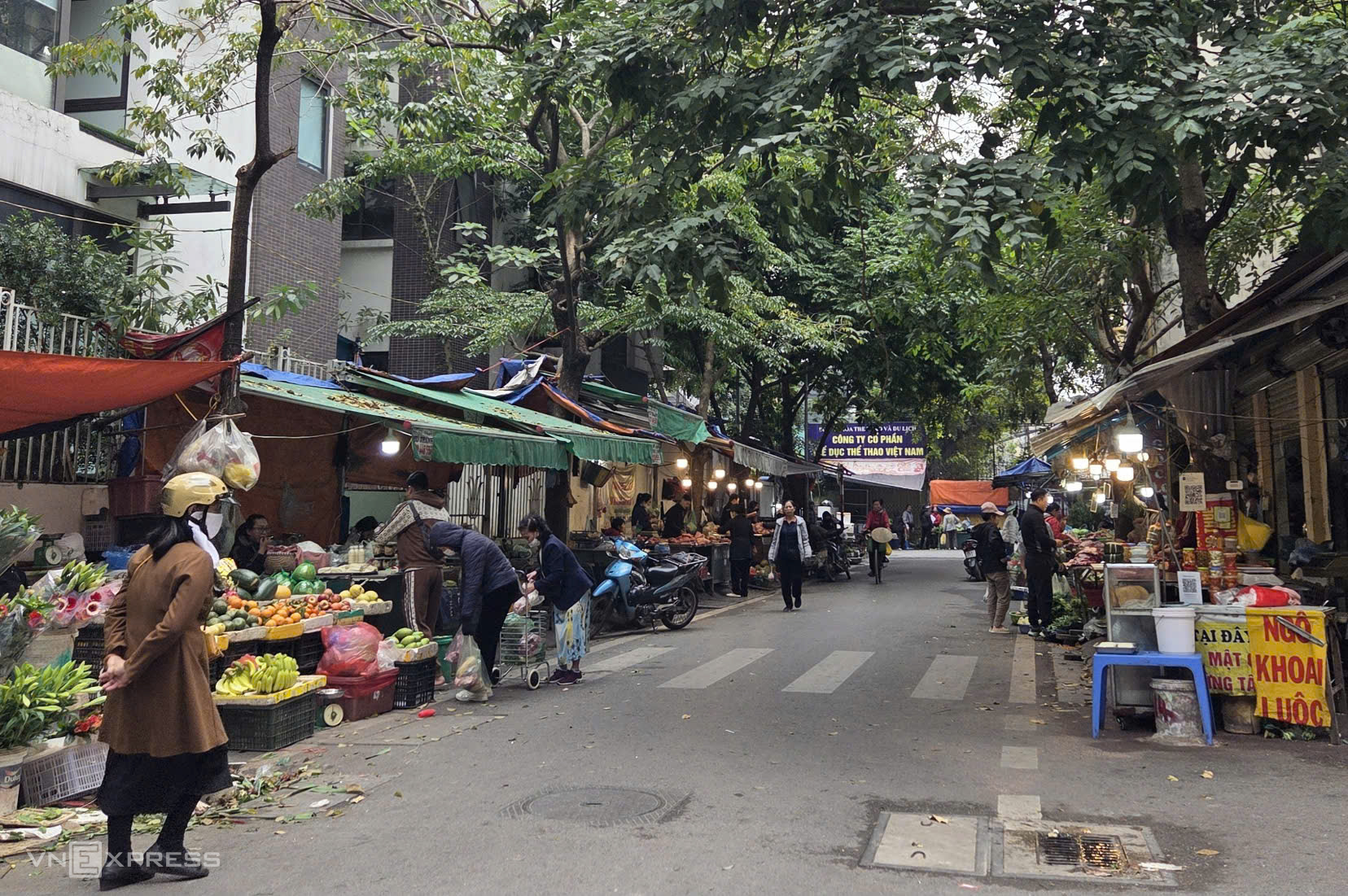 |
"Informal market" at the end of alley 40, Nguy Nhu Kon Tum street, Thanh Xuan ward, on the morning of 5/1. Photo: Vo Hai
To safeguard residents' livelihoods, the city requires communes and wards to review the operational status of formal markets, assessing occupancy rates and infrastructure. This will inform plans to relocate small traders from informal markets to available spaces in formal markets. Concurrently, Hanoi will invest in constructing new markets and renovating existing ones, prioritizing areas currently underserved, as part of the market development and management plan for giai doan 2026-2030.
Local authorities are fully responsible for clearing informal markets in their areas, adhering to the "6 clear principles." They will mobilize forces to conduct outreach, engage in dialogue, and sign commitments with business households. Additionally, they will encourage residents to adopt the habit of shopping at formal markets.
Following clearance, local areas will maintain regular patrols and inspections, deploying stationed forces. They will also implement measures such as marking lines, posting prohibition signs, and utilizing technology to prevent the recurrence of informal markets.
Hanoi has repeatedly aimed to eliminate informal markets since the 2000s, integrating this objective into various urban order campaigns. Despite these efforts, hundreds of informal markets persist in many wards and communes, occupying roadways and sidewalks. These markets obstruct traffic, contribute to environmental pollution, and detract from urban aesthetics, necessitating the city's current comprehensive and long-term clearance roadmap.
>>> List of 231 informal markets to be eliminated
Vo Hai


