Tran Tuan, owner of a major seafood export business in the Mekong Delta, expressed his delight at the inauguration and technical opening of the Can Tho - Ca Mau expressway. Its operation will create a seamless "backbone" transport axis connecting Ho Chi Minh City, Trung Luong, My Thuan, Can Tho, and Ca Mau.
"After more than 15 years of waiting, the expressway axis from Ho Chi Minh City has finally extended to Ca Mau," he stated. He believes the route will ensure smooth connectivity between the nation's largest hub for rice, fish, shrimp, and fruit with Ho Chi Minh City and the Southeast region, an area known for vibrant trade.
Tuan’s company operates a seafood processing plant in Can Tho, located near the Can Tho - Ca Mau expressway interchange. Each month, the company exports approximately 300-350 containers of goods, with more than half being shrimp products, primarily sourced from Ca Mau.
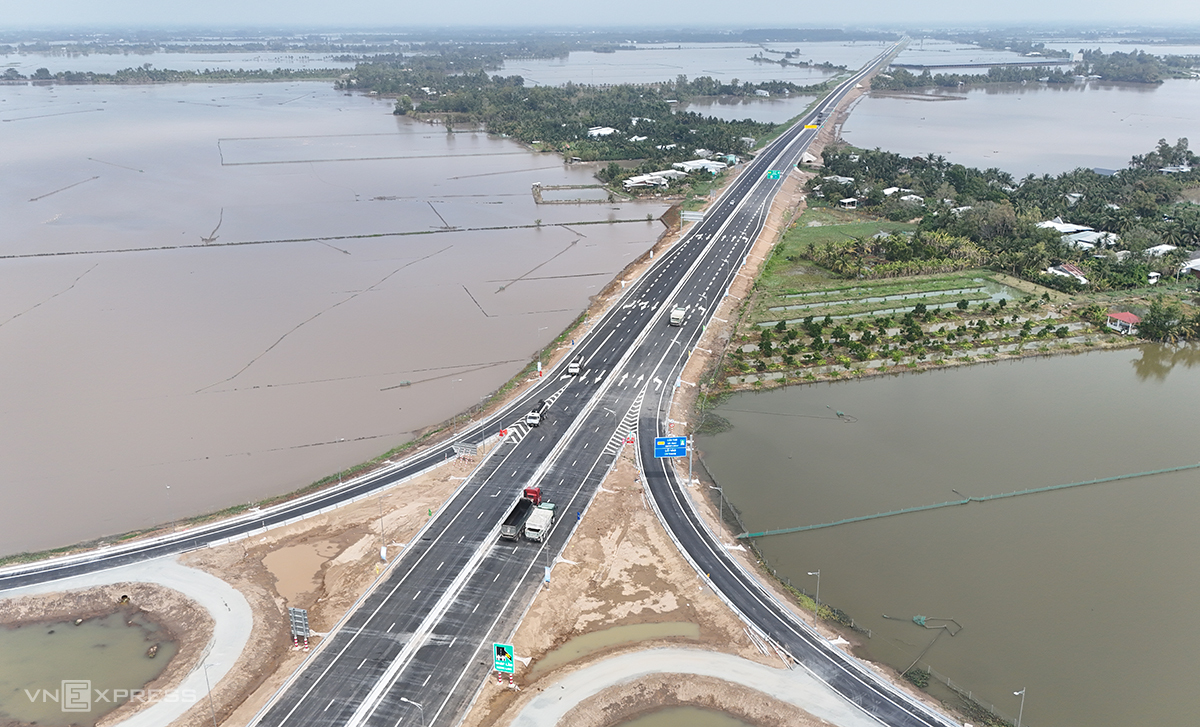 |
The Can Tho - Ca Mau expressway on its inauguration and technical opening day, 19/12. Photo: An Binh |
"Using the expressway, shrimp from Ca Mau reaches the factory in just about one hour," Tuan said, a significant reduction from the 2-2.5 hours it previously took via National Highway 1 or the Quan Lo - Phung Hiep route. After processing, goods continue on the expressway to ports in Ho Chi Minh City and Vung Tau, cutting transport time by nearly half. While costs have not yet seen substantial reductions, Tuan noted that the time advantage has noticeably enhanced his company's competitiveness.
Sharing this enthusiasm, Nguyen Van Son, owner of a transport company with more than 30 container vehicles specializing in transporting agricultural products from the Mekong Delta to Ho Chi Minh City, reported that with the seamless north-south expressway in the Mekong Delta, transit time from Ca Mau to Ho Chi Minh City is now 4-5 hours, down from 7-8 hours. Fuel costs, he added, have decreased by about 30%.
"Goods arrive faster and fresher," Son remarked, suggesting that farmers can sell their produce at better prices, and transport businesses gain more work. "The expressway connecting Ho Chi Minh City to Ca Mau is a decades-long dream for transport workers in the Mekong Delta," he said.
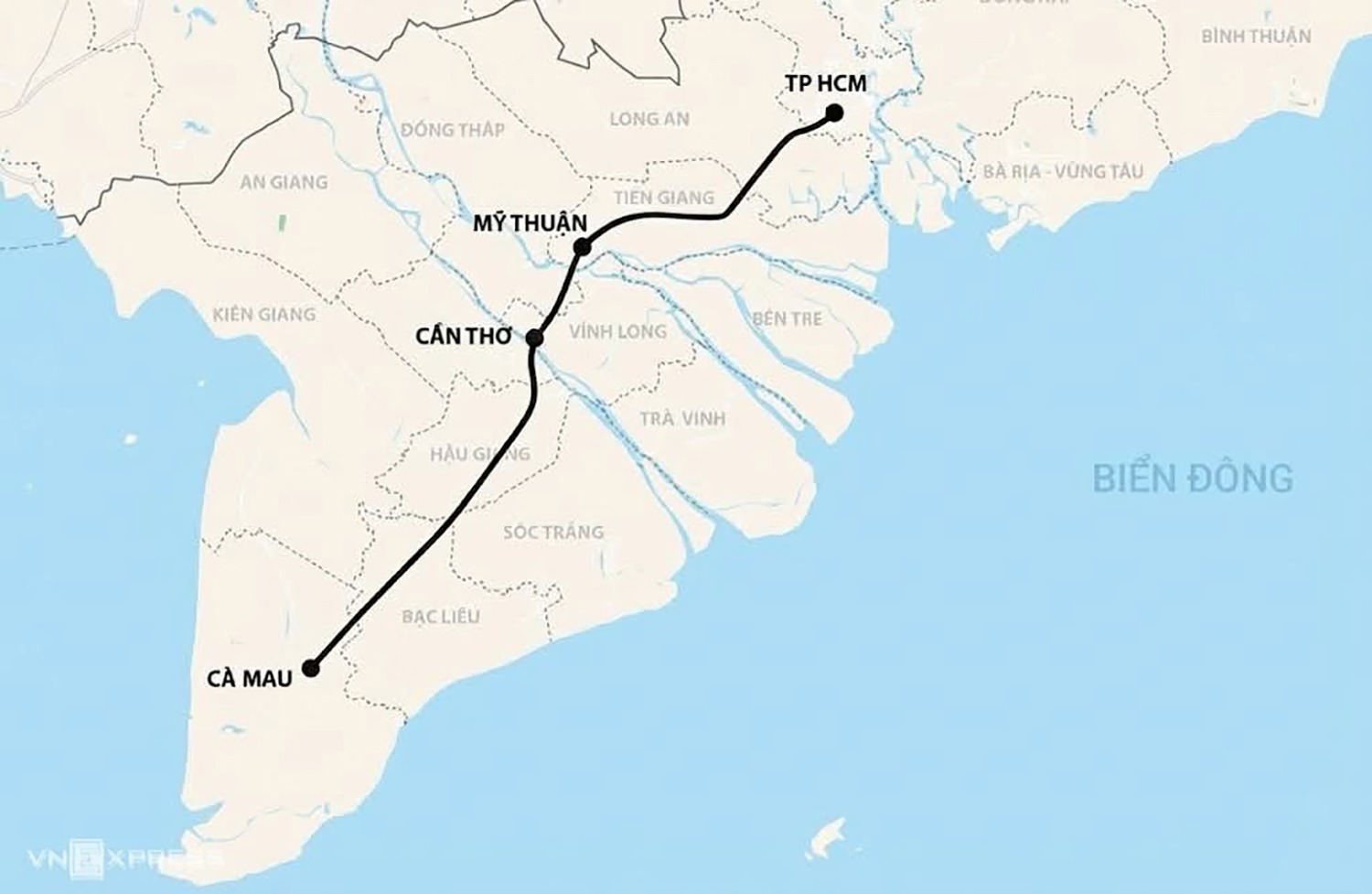 |
The completed route creates a seamless expressway connection from Ca Mau to Ho Chi Minh City. Graphic: Hoang Chuong |
From a macro perspective, Pham Ngoc Thach, Deputy Head of the Legal Department at the Viet Nam Chamber of Commerce and Industry (VCCI), believes that the completion of expressways such as Can Tho - Ca Mau, Chau Doc - Can Tho - Soc Trang, and An Huu - Cao Lanh will shorten goods transport time from the Mekong Delta to Ho Chi Minh City and the Cai Mep - Thi Vai port cluster, reducing logistics costs by 30-40%.
"Modern, synchronously connected transport infrastructure will attract foreign direct investment into the Mekong Delta, particularly in logistics and agricultural and aquatic product processing," Thach commented.
Lu Quang Ngoi, Chairman of the People's Committee of Ca Mau province, emphasized the Can Tho - Ca Mau expressway's crucial importance for the locality and the entire Mekong Delta region.
According to Ngoi, residents, businesses, and the Ca Mau government have long awaited this expressway to facilitate production, transport, and travel. "The road opens up new development conditions for Ca Mau, especially in agriculture, aquaculture, and tourism," he stated.
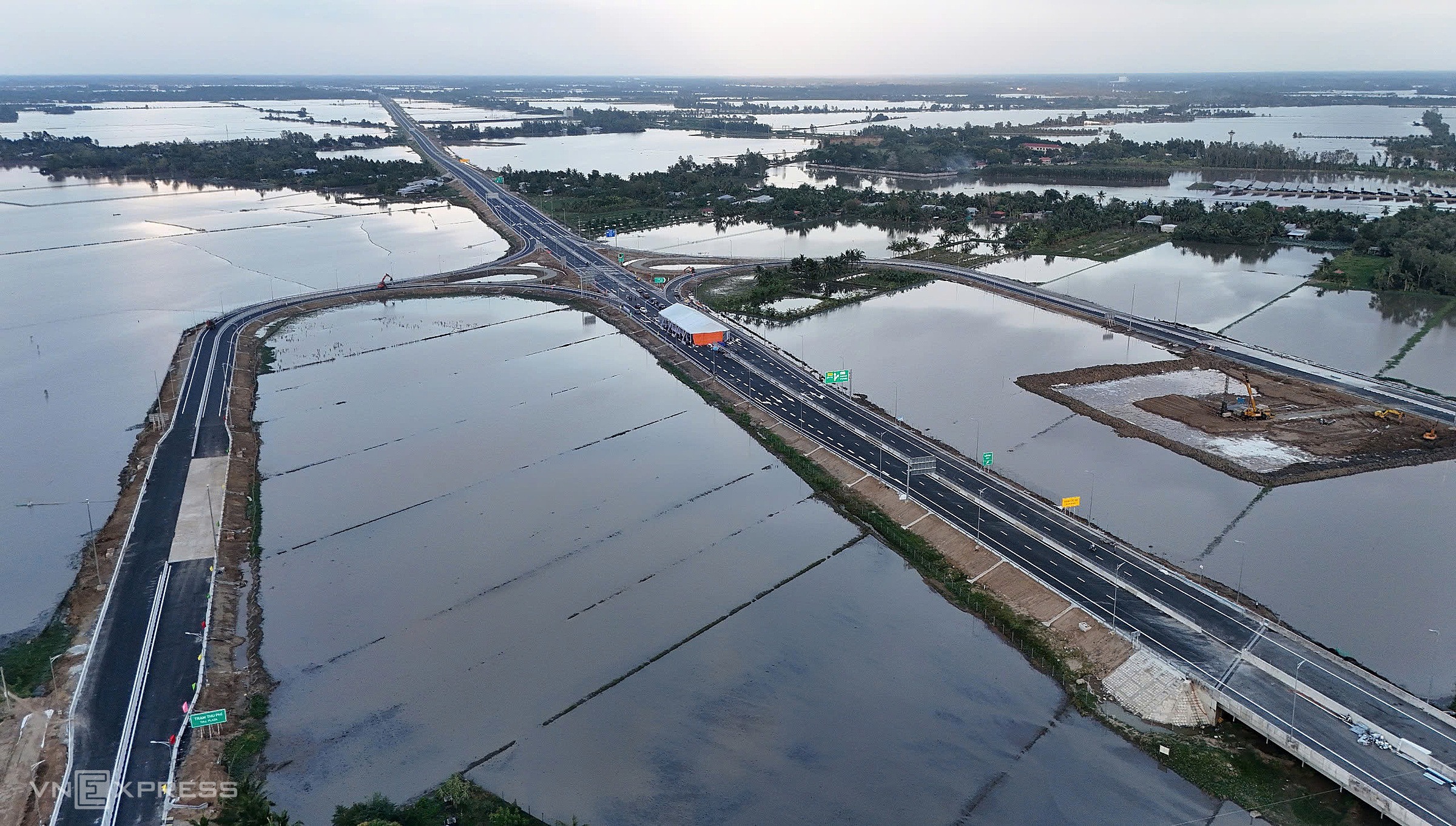 |
The Can Tho - Hau Giang expressway section technically opened on 20/12. Photo: Huy Phong |
Tran Van Thi, Director of My Thuan Project Management Board (the investor), explained that the Can Tho - Ca Mau expressway, nearly 111 km long, features a straight design primarily traversing agricultural fields, which helped save costs compared to other options. However, the project faced challenges due to extensive site clearance, material shortages, weak geological conditions, adverse weather, and fluctuating prices.
The project received close guidance from the Government and relevant ministries. Prime Minister Pham Minh Chinh made multiple visits to the construction site and chaired meetings to resolve issues concerning site clearance and materials. At times, more than 3,000 engineers and workers, along with 1,500 machines, operated in "three shifts, four crews" to accelerate progress.
After nearly three years of construction, the Can Tho - Ca Mau expressway, featuring four lanes and a 17 m cross-section, with a total investment of more than 27,500 billion VND, is largely complete. The first phase includes two sections: Can Tho - Hau Giang, 37,65 km long, costing more than 10,300 billion VND; and Hau Giang - Ca Mau, more than 73 km long, costing over 17,150 billion VND.
According to the plan, the Can Tho - Hau Giang section will commence operation from 22/12, and the Hau Giang - Ca Mau section from 31/12. Once operational, this expressway will reduce travel time from Ho Chi Minh City to Ca Mau to approximately 3.5-4 hours, half the time compared to National Highway 1, while also significantly easing traffic on the existing main transport artery.
An Binh