


On the morning of january 14, Do Ba Quan, general director of Tri Nam Digital Transport Service Joint Stock Company, the investor and operator of the system, announced that electric bikes are expected to be operational before the Lunar New Year. These new bikes combine pedals with an electric motor and use replaceable batteries available at network stations.
According to the investor, when the battery is low, the bike will issue a warning signal, prompting users to return it to a battery-swap station. If a replacement is not made in time, the bike can still be used as a regular bicycle, ensuring an uninterrupted journey.
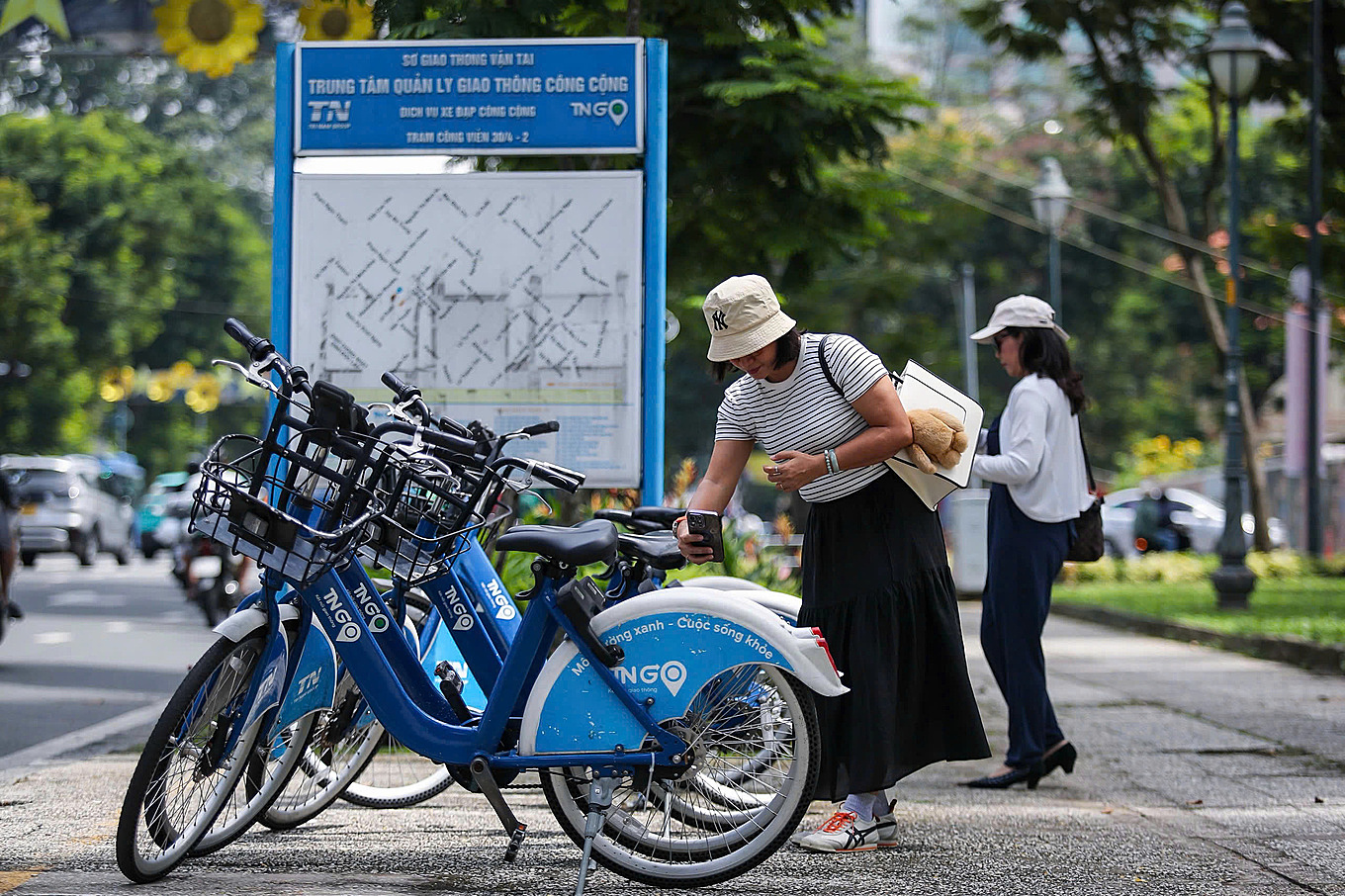 |
Customers scan a QR code to rent a traditional public bicycle in Ho Chi Minh City, 10/2025. Photo: Ha Giang
Electric bike rental is projected to cost 20,000 VND for 30 minutes, 35,000 VND for 60 minutes, and 65,000 VND for 120 minutes. Users can scan the QR code on the bike via the TNGO or Zalo applications to register, unlock, and use the service, similar to the existing public bicycle model.
Ho Chi Minh City's public bicycle service launched in late 2021 with 43 stations and nearly 400 bikes, later expanding to 52 stations and over 500 bikes. These are primarily located in central areas, near transport hubs, commercial centers, and tourist attractions. Traditional bicycle rental costs 5,000 VND for 30 minutes and 10,000 VND for one hour.
Statistics show the system recorded nearly 320,000 uses in 2022, dropping to over 164,000 in 2023 and approximately 80,400 in 2024. The investor views this decline as anticipated, as the service transitioned from an experimental phase to serving users with genuine needs. Traditional bicycles, however, limit those who need to travel quickly or over long distances, making the addition of electric bikes crucial for increased flexibility and competitiveness against motorbikes.
A representative from the Ho Chi Minh City Public Transport Management Center stated that integrating electric bikes into the system diversifies travel options. This aligns with the city's green transport development goals and will enhance connectivity between buses and metro lines in the future.
Complementing this model, Ho Chi Minh City recently launched a dedicated bicycle lane on Mai Chi Tho boulevard. This initiative is seen as the first step in establishing a network of separate lanes, encouraging residents to use bicycles in conjunction with public transport.
Beyond Ho Chi Minh City, Tri Nam Company also deployed 500 electric bikes within Hanoi's public bicycle network in 12/2025. This includes 130 stations within Ring Road 1, with plans for expansion into Ring Road 2 and Ring Road 3.
By Giang Anh


