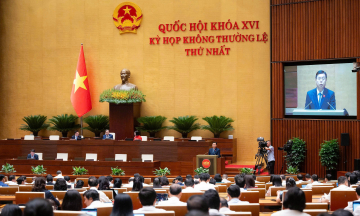
On the afternoon of 5/8, the National Assembly held a group discussion on the draft Law amending and supplementing a number of articles of the Law on Vietnamese Workers Working Abroad under Contract.
The draft law aims to improve the quality of workers sent abroad, prioritizing professions where Vietnam will need human resources in the future, and effectively utilizing these human resources upon their return. However, many delegates believe that the new regulations are merely principles and lack sufficient mechanisms for implementation.
Delegate Nguyen Ngoc Son, a full-time member of the Committee for Science, Technology and Environment, stated that the policy needs to shift from the goal of "how many people to send" to "how to send people and what to gain in return".
According to his figures, nearly 900,000 Vietnamese workers are currently employed abroad, sending home over 6 billion USD annually. However, income varies significantly based on skill level and market. Vietnamese workers in Japan and Taiwan earn approximately 1,300 USD per month, those in South Korea about 1,600 USD, while in Germany and Denmark, earnings can reach 4,000 USD.
"For the same worker, by simply upgrading their skills and changing markets, the value generated increases two to three times without needing to increase the number of workers going abroad", Son said.
He believes this represents a growth potential based on worker capabilities, rather than continuously increasing the number of people going abroad. This approach also helps reduce the exodus of young workers from the domestic market, especially as many localities expand industrial parks but face labor shortages.
To implement this shift, delegates propose that the law clearly define priority professions, markets, and human resource training policies that meet international standards.
 |
Delegate Nguyen Ngoc Son, a full-time member of the Committee for Science, Technology and Environment. Photo: Ngoc Thanh
Delegate Tran Lan Phuong, Vice President of the Vietnam Women's Union, suggested that workers sent abroad should focus on those who have received training, possess professional and technical qualifications, especially in fields prioritized by the state for development.
She proposed empowering the Government to specify criteria for selecting professions and markets, and to establish mechanisms to support businesses in identifying markets and training workers in fields such as semiconductors, electronics, and digital technology. "If only principles are stipulated, implementation will be very difficult in practice", Phuong stated.
In addition to improving the quality of workers before they go abroad, delegates proposed that the draft law include mechanisms for receiving and utilizing them after they complete their contracts.
According to delegates, this could become a channel for human resource training, acquiring skills and technology for Vietnam. Many returning workers have gained foreign language proficiency, experience, professional skills, and a professional work ethic. However, Vietnam lacks comprehensive mechanisms to track, recognize their competencies, and connect them with domestic businesses.
Delegate Pham Thu Xanh, Director of Hai Phong Obstetrics and Pediatrics Hospital, proposed that the draft law include policies for receiving, utilizing, and developing this human resource, preventing the waste of skills acquired abroad.
Delegates also recommended that the law stipulate the responsibility for recording the professional skills of returning workers in a national database; and assign provincial People's Committees to connect them with businesses, especially foreign-invested enterprises in their localities.
For workers from impoverished households and ethnic minorities, Son suggested specific mechanisms to support vocational training and foreign language education. He believes that the ability to connect them with employment after their return will determine whether the nearly 900,000 workers abroad become a valuable human resource or are wasted upon their return.
Son Ha