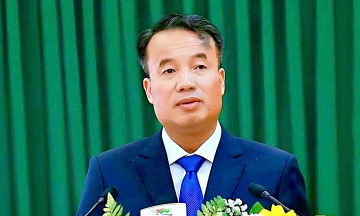
During the morning hearing on 20/9 at the National Assembly's Committee for Culture and Society, Minister of Education and Training Hoang Minh Son spent significant time addressing recent textbook shortages.
The minister acknowledged that several factors contributed to the issue. In late 2025, the ministry approved the selection of a single textbook series and directed Vietnam Education Publishing House, along with localities, to plan its production and supply. While using one textbook series offered an advantage this year, some localities implemented free textbook policies. This led parents to wait and not purchase books immediately before the academic year, creating unforeseen demand fluctuations.
These factors, combined with inaccurate demand forecasting by localities and the publisher, resulted in localized surpluses and shortages. The number of surplus printed copies was not large enough to absorb unexpected demand. "We are seriously learning from this experience, will monitor more closely and rigorously, and develop accurate textbook forecasting plans. This will not happen in the next academic year", Hoang Minh Son pledged.
By the afternoon of 19/9, the number of textbooks not yet delivered to students had decreased to about 900,000 copies, representing 0,25% of the total 240 million copies planned for supply. Publishers and suppliers are actively working to ensure all students receive their books. Moving forward, the minister stated that appropriate surplus quantities of textbooks would be printed, allowing students and parents to purchase them immediately if needed. The ministry also plans to establish a close coordination mechanism with provincial departments of education and training to supply textbooks directly through schools, reducing intermediaries and ensuring proactivity for subsequent academic years.
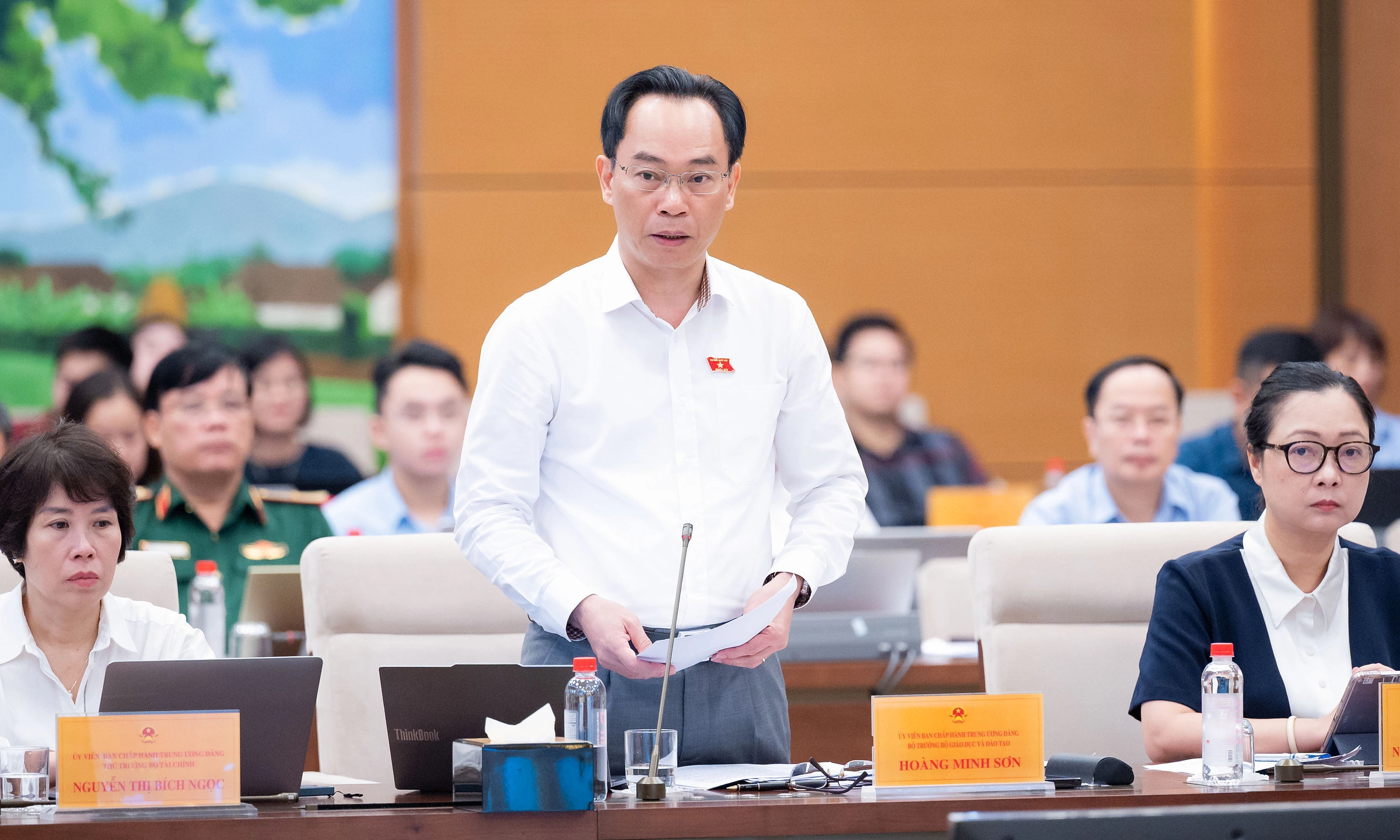 |
Minister of Education and Training Hoang Minh Son speaking at the hearing on 20/9. Photo: National Assembly Portal |
Taking strong action against examination malpractice
Addressing concerns about examination malpractice, Representative Dinh Ngoc Quy, a full-time member of the Committee for Culture and Society, noted that since 2020, the high school graduation examination regulations have been amended 4 times. These revisions aimed to both facilitate and ensure strictness. However, serious cases of malpractice and violations have occurred in some localities, impacting public trust in the examination's integrity and objectivity.
The representative requested the minister outline the future direction for organizing this examination and solutions to enhance objectivity, transparency, and prevent violations. Minister Hoang Minh Son explained that the model for organizing the high school graduation examination and university admissions has undergone continuous innovation. Currently, the high school graduation examination is organized in a streamlined, cost-effective manner, significantly reducing pressure. Concurrently, university admissions have provided unprecedented convenience for students, with the entire process from application registration, fee payment, to enrollment registration all conducted online via computer systems.
However, the minister acknowledged that the negative violations occurring in some localities are regrettable. Regarding the cause, the minister cited the Prime Minister's conclusion, stating that it primarily stems from a lack of legal compliance, and therefore, the solution must be through legal means. "Individuals who violate regulations and the responsibilities of related parties must be strictly handled to ensure the rule of law in examinations and across the entire education sector", the minister emphasized.
The second cause stems from localized factors during examination organization. The ministry advocates for increased decentralization and delegation of power to localities. Localities are responsible for organizing examinations within their areas, while the ministry manages state affairs, develops admission regulations, and provides examination questions. Although procedures are strictly regulated, some localities, driven by their own motives, still engage in fraudulent activities. Minister Hoang Minh Son stated that the ministry would continue to improve examination question development by slightly reducing the difficulty level while still accurately assessing students' abilities and knowledge.
Developing a roadmap to eliminate IELTS bonus points
Regarding the proposal to eliminate IELTS bonus points and outstanding student awards in university admissions, Minister Son stated that this suggestion is based on clear data analysis. When a university or major requires English proficiency for admission, the ministry directs that English must be included in the admission combination and criteria. This prevents situations where admissions are based on other subjects (such as Mathematics, Chemistry, Biology) and then bonus points are added for candidates with English certificates.
Adding English points for majors that do not require foreign language specialization creates disadvantages and unfairness for other candidates, effectively double-counting a knowledge competency. The minister cited the reality that some majors have very high benchmark scores (up to 28 points) but still allow bonus points of up to 1,5. This results in thousands of candidates with very high examination scores (26,5 to 28 points) failing to gain admission simply because they could not afford expensive certifications. The minister recognized this as an urgent issue related to fairness that requires immediate adjustment.
Although the consideration of international certificates (such as IELTS) falls under universities' autonomy, when inconsistencies arise, the ministry has established a roadmap for restrictions, such as capping bonus points at 10% since last year.
Son Ha