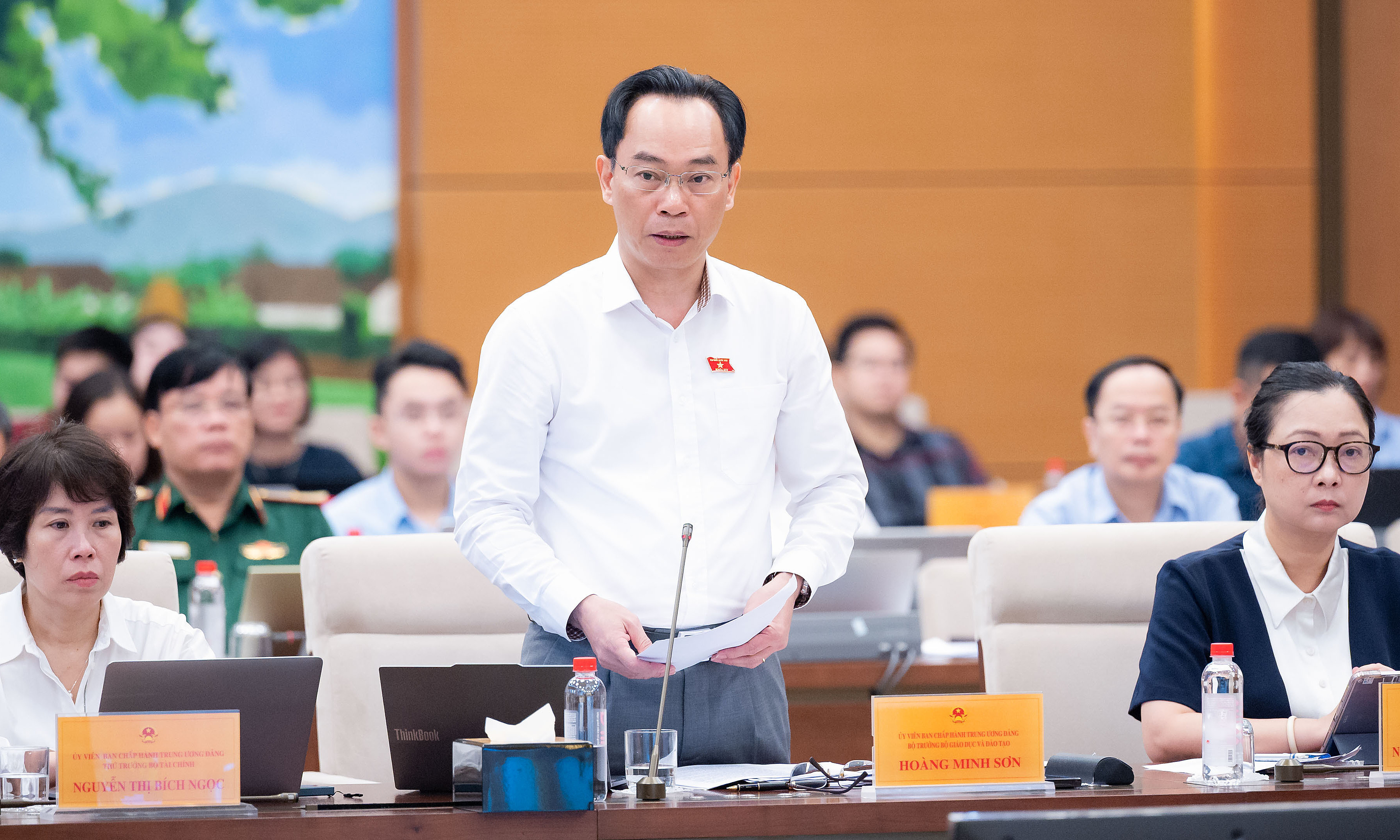
Speaking at a hearing before the Culture and Society Committee on the morning of 20/9, Minister of Education and Training Hoang Minh Son stated that the current organizational model has undergone many stages of innovation, successfully reducing pressure on students. However, some negative incidents still occur in certain areas.
The Ministry has analyzed the causes and proposed solutions to maintain exam stability, enhance quality control, and apply data analytics technology to limit fraud. In the next phase, Minister Son confirmed that measures will be implemented to gradually tighten admission regulations, focusing on a genuine assessment of students' capacities, ensuring fairness in candidate selection, and improving the quality of human resources. Admission criteria and methods will be adjusted to reduce negative practices and restrict the use of certificates that could create inequity.
Regarding comprehensive education, the Ministry defines its focus beyond mere knowledge to include ethics, culture, physical fitness, arts, and life skills. Efforts to prevent, detect, and address violence, abuse, and social ills are being implemented synchronously, with coordination from various ministries and sectors, especially the Ministry of Public Security and local authorities.
 |
Minister of Education and Training Hoang Minh Son. Photo: National Assembly e-portal
The Minister also noted the increasing impact of the online environment and artificial intelligence (AI) on education. The Ministry is progressively refining legal documents to integrate AI into education while controlling its potential negative impacts. Son believes that the basic educational framework has been completed with the promulgation of relevant legal documents. The significant challenge ahead lies in implementation, addressing emerging bottlenecks, resolving inconsistencies between documents, and ensuring that policies deliver tangible results. The ultimate goal is to develop student capabilities and enhance human resource quality to serve national development.
The Ministry of Education and Training expects that from 2027, only priority points for region and demographic will remain, and universities will not be permitted to grant additional points for achievements or certificates. Currently, bonus points for certificates like IELTS are capped at 1.5 out of 30. The Ministry explains that awarding points for international certificates can create inequality, as access to these certificates depends on the economic conditions, living area, and financial capacity of students' families.
An additional 43,000 teacher positions are needed.
The Minister stated that, based on staffing norms, the education sector faces a shortage of about 104,000 teachers. However, after reorganizing the school network and reviewing student enrollment figures, the need for additional staff in the 2026-2027 period has decreased to about 43,260 positions.
In addition, there are currently about 44,000 permanent teacher positions allocated nationwide that are yet to be filled, alongside 48,370 contract teachers working in public educational institutions. According to the Minister, the current teacher shortage should be viewed from multiple perspectives: the deficit compared to established norms, localized surpluses and shortages between different regions and units, and the employment of contract teachers in public schools.
The coordination of teachers among units, localities, and schools is being urgently implemented, which will further optimize staffing during the reorganization process.
Regarding higher education, the Minister noted that scholarship policies, credit programs, and the National Scholarship Fund have established the legal framework to support students in fundamental sciences, key engineering, and strategic technology fields. These policies have begun to show initial impacts in recent university admissions, contributing to an increase in both the quantity and quality of students entering these disciplines.
Speaking earlier, National Assembly Vice Chairwoman Nguyen Thi Thanh observed that the hearing was held at a crucial time, following the National Assembly's promulgation of many new and groundbreaking policies on education and training.
To promptly implement these new policies, the Government, the Ministry of Education and Training, and other ministries and sectors are undertaking a substantial amount of work, focusing on developing and issuing detailed regulations. Based on initial results, the current requirement is a strong shift from institutional refinement to practical implementation. She emphasized that the measure of success is not merely the number of documents issued or tasks deployed, but more importantly, whether teachers have better conditions to teach, students receive a better education, and the quality of education undergoes more substantial changes.
The National Assembly Vice Chairwoman urged delegates and Ministry leaders to identify causes, responsibilities, and solutions to create real and clear improvements. She requested the Minister of Education and Training to provide the main explanations, and also asked the Ministry of Home Affairs, the Ministry of Finance, and other ministries and sectors to clarify matters within their management scope, responsibilities, and coordination in implementation.
Regarding the reorganization of the administrative apparatus and school network at the commune and ward levels, the National Assembly Vice Chairwoman urged agencies to update the situation accurately, not relying solely on local reports. The key issue is evaluating the effectiveness of the model where one principal manages four to five schools after mergers, while locations, teachers, and students remain at their respective school sites.
Son Ha