Vietnam's education sector is undergoing significant reforms, aiming to cultivate a new generation of citizens equipped with intellect, compassion, and resilience to thrive globally. The Minister of Education and Training, Nguyen Kim Son, outlined these ambitious changes in an interview, emphasizing a shift towards "real learning, real quality" across all levels of education.
The National Assembly dedicated a full day to discussing amendments to three education-related laws and one resolution: the Education Law, the Higher Education Law, the Vocational Education Law, and a resolution implementing Politburo Resolution 71 on breakthrough educational development. These legislative efforts are expected to create a robust framework for the sector's transformation.
Minister Son highlighted that "real learning, real quality" must begin with the core principles of every school: quality and honesty in teaching and learning. The Ministry is resolute in rejecting the achievement-driven mentality and combating all forms of superficial teaching and learning to restore education to its true essence. The school environment must foster respect, compassion, and honesty, from how teachers listen to students and students respect teachers, to how schools maintain transparency in evaluation.
When genuine quality becomes a cultural value, individuals will feel shame for dishonesty, rather than viewing it as normal. An environment that champions honest learning and honest examinations will undoubtedly bring about change. Teachers will teach with dedication and responsibility, and students will learn for true understanding and practical application, rather than simply coping. Simultaneously, the teaching staff must lead this shift towards real learning. Teachers must be exemplary in character, honest, and fair; a moral lesson cannot be convincing if the teacher lacks integrity. The Ministry is focusing on training teachers to innovate their methods, moving towards developing competencies rather than one-way transmission of knowledge. Additionally, every teacher must continuously learn, hone skills, and be ready to embrace new approaches, from active learning methods to technology and artificial intelligence. When teachers are dedicated and professional, they will inspire students towards real learning and honest examinations. The most crucial starting point is building an honest teaching and learning environment that prioritizes genuine quality. This forms the foundation for all solutions to be effective, creating positive changes visible in every classroom and every school.
 |
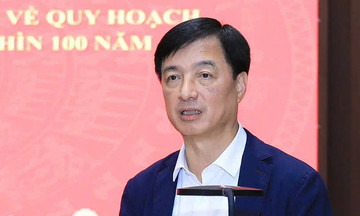
Minister of Education and Training Nguyen Kim Son. Photo: Hoang Phong |
To implement Resolution 71, the Government recently submitted the National Target Program on Education for 2026-2032 to the National Assembly Standing Committee. This program addresses critical bottlenecks such as teacher shortages, temporary classrooms, and inequalities in learning conditions. With a large capital scale, the Ministry prioritizes investments in the most disadvantaged areas, where both teachers and students face severe deprivation. The immediate focus is on eliminating temporary and borrowed classrooms in remote and exceptionally difficult areas. The current figure of over 6,400 borrowed classrooms is a significant concern, and the Ministry is determined to eradicate them soon. Once schools are solidly built, students will have a stable learning environment, and teachers will feel secure staying in their schools. In border regions, every school established and every lesson taught also serves to strengthen national sovereignty from its roots.
The issue of teacher shortages will be addressed with a range of synchronized solutions. The Government has approved nearly 66,000 new permanent positions for the 2022-2026 period, and the Ministry requires localities to recruit sufficient staff, especially for subjects with severe shortages like foreign languages, information technology, music, and fine arts. The Ministry also coordinates with teacher training colleges to educate according to demand, ensuring a supply of quality teachers. However, recruiting staff must be accompanied by retention, which means remuneration and working conditions are crucial. The initial investment will focus on filling the largest gaps: new schools where classrooms are lacking, and teachers where staff are needed. When this is achieved, the immediate benefits will include more reasonable class sizes, the elimination of third shift classes, and students in disadvantaged areas having learning conditions nearly on par with those in lowland regions.
Alongside resource allocation, institutional improvement is a key requirement. The sector is amending the Education Law and preparing a standardized set of textbooks compiled by the State. The revised law is expected to profoundly impact educational quality by expanding compulsory education to a higher level, making lower secondary education (grade 6-9) mandatory, and universalizing preschool education for children 3-5 years old. This means the State is committed to ensuring every Vietnamese child completes lower secondary school and receives preschool education, laying a foundation for long-term improvement in public intellect and human resource quality.
The draft law also introduces new content, such as the application of artificial intelligence (AI) in education. The Ministry aims to create a legal basis for digital age teaching and learning, encouraging schools to adopt modern technology and new methods to enhance educational effectiveness. In terms of management, the revised law also plans to remove the mandatory School Council requirement for public educational institutions to streamline the administrative apparatus. All these adjustments, though seemingly macro-level, ultimately aim to help schools operate more efficiently and focus on improving teaching and learning quality. Regarding textbooks, the amended law stipulates a common set of textbooks nationwide to ensure uniformity in teaching and learning. Even with a common set, the Ministry encourages flexibility and creativity in teachers' instructional methods.
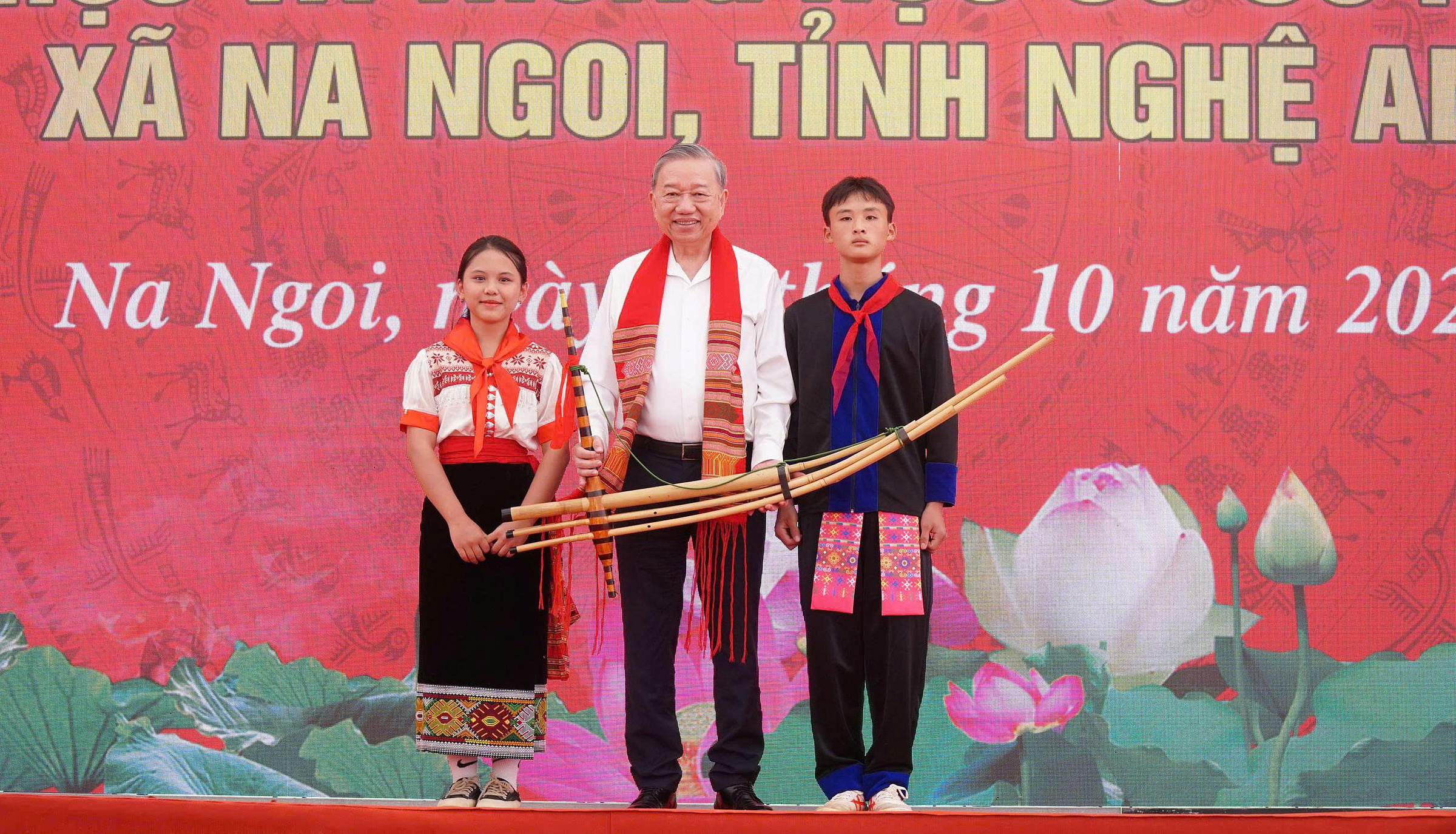 |
General Secretary To Lam receives a souvenir from students in Na Ngoi commune. Photo: Ho Lai |
The challenge of inadequate and overcrowded classrooms persists in both mountainous regions and large urban centers. The Minister envisions a synchronized national education infrastructure strategy to address this. The Ministry's perspective is to build a uniform network of schools nationwide, ensuring that children everywhere can learn in fundamentally adequate conditions. The Ministry will advise on developing national standards for schools, such as the ratio of classrooms to population, to prevent rapid urbanization without corresponding school development. For large urban areas, the focus is on increasing schools to keep pace with population growth and allocating land for education in urban planning. Hanoi's construction of 43 new schools this year is a significant step in reducing pressure.
In rural and mountainous areas, the priority is to solidify and modernize school facilities, including not only classrooms but also specialized rooms, libraries, restrooms, and physical education areas. The National Target Program will prioritize funding for disadvantaged areas to narrow regional disparities. Additionally, infrastructure for teachers, such as public housing, is crucial to ensure teachers feel secure "sticking to their villages". The entire sector is also promoting information technology infrastructure, striving for all schools to have high-speed internet and digital learning equipment by 2030. A synchronized, modern, and equitable infrastructure system is essential to elevate educational quality and ensure no student is left behind.
Amidst salary reforms and amendments to the Education Law, the Minister has repeatedly emphasized that "teachers deserve better treatment, not handouts." He firmly believes that teachers must be compensated fairly for their efforts and mission, rather than receiving benefits as charity or subsidies. Politburo Resolution 71 also affirms the need for special, superior preferential policies for the teaching staff. In the upcoming salary reform, the most important objective is to correctly implement the policy that "teachers' salaries are ranked highest within the administrative and public service salary system."
Currently, the Ministry of Education and Training has submitted a draft decree on new salaries to the Government. Accordingly, all teachers will receive an additional special salary coefficient: preschool teachers are expected to see a 25% increase in their current salary, while general education teachers and lecturers will receive a 15% increase. This is not undue favoritism but a deserved reward for the silent sacrifices of teachers. Existing allowances will be maintained, leading to a real increase in teachers' income and a marked improvement in their lives.
However, teacher remuneration extends beyond salaries and allowances. The Ministry is implementing a comprehensive set of policies to provide security and motivation for the staff. For the first time, the sector will have a Law on Teachers, a legal document fully outlining the legal status, rights, obligations, and policies to protect the honor and social standing of teachers. The Ministry has finalized decrees and circulars guiding the implementation of the law, ensuring these policies will take effect from 1/1/2026.
The Ministry is also reforming recruitment processes, focusing on assessing actual pedagogical competence to select dedicated and talented individuals. Additionally, practical support policies include professional development, regular health check-ups, provision of public housing or rental assistance for teachers in disadvantaged areas, and mechanisms to attract skilled individuals to hard-to-recruit fields. The Minister believes that all these efforts, combined with a democratic and respectful working environment, represent the strongest commitment to the teaching staff, enabling teachers to work with peace of mind and be further motivated to contribute. He hopes every teacher feels society's appreciation, and that the teaching profession will regain its "noble" status in both remuneration and spiritual life, ending the struggle of teachers worrying about daily necessities or feeling disheartened on their journey of "nurturing individuals".
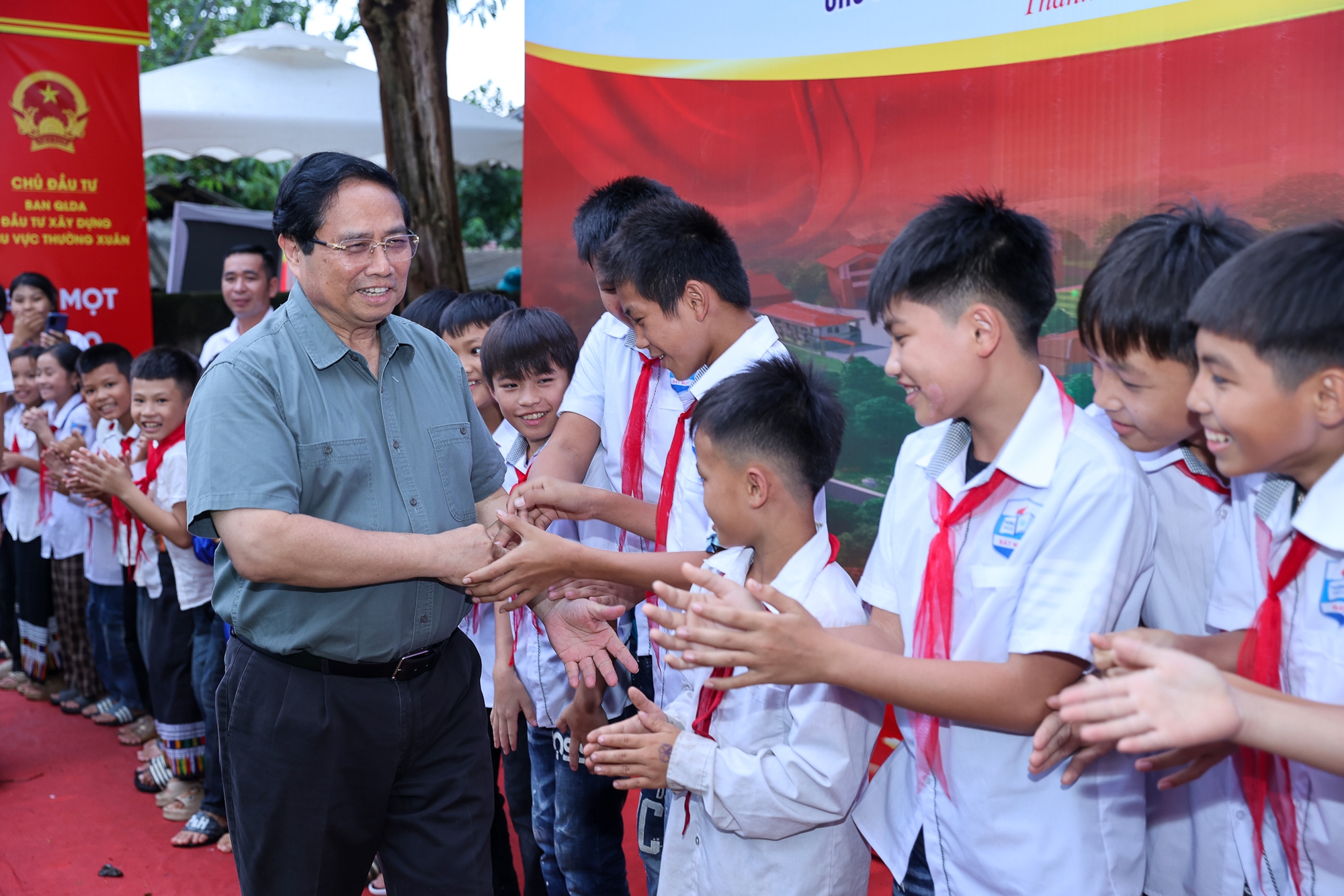 |
Prime Minister Pham Minh Chinh and students at the groundbreaking ceremony for an inter-level boarding school for primary and lower secondary education in Bat Mot commune, approximately 120 km from Thanh Hoa provincial center. Photo: Nhat Bac/VGP |
With the synchronized implementation of institutional reforms, curriculum changes, textbooks, infrastructure, and personnel policies, the Minister envisions a profoundly different quality of education for Vietnamese students in the next 5-10 years. Students will no longer learn in temporary classrooms or in classes of 50-60 students, as the goal is to have enough schools and classrooms for two sessions a day. Children in highland areas will have solidly built schools, books, and equipment comparable to those of urban students. In urban areas, class sizes will be more reasonable, allowing teachers more time to focus on individual students.
The new general education curriculum will stabilize, making learning lighter yet more effective. State-compiled, free textbooks will ensure all students have standard learning materials. Students will develop more skills, gain more experiences, and engage less in rote learning or cramming. The application of technology and AI will transform learning, making it more personalized and flexible; students in remote areas can learn with talented teachers from afar, and urban students can connect internationally. The most evident change will be a generation of more confident, well-rounded, and happier students. The learner-centered philosophy will permeate every school. When teachers are further motivated, they will inspire students, making every school day truly enjoyable.
The Minister believes that the current efforts, spanning institutions, curriculum, infrastructure, and personnel, will lay the foundation for a new generation of citizens who are intellectual, compassionate, resilient, and ready to engage with the world.
Lan Ha