In a presentation submitted to the National Assembly Forum on Oversight Activities 2026 on 30/7, the Ministry of Industry and Trade stated that the energy sector faces immense pressure to meet double-digit economic growth targets for many years to come.
According to the ministry, the global transition to green energy and electrification is progressing rapidly. Many countries are returning to nuclear power development to ensure energy security and reduce emissions. Concurrently, international capital for traditional energy projects is shrinking, necessitating a more proactive and flexible approach from Vietnam.
Domestically, traditional primary energy resources are dwindling, while international climate commitments demand a gradual reduction in fossil fuels and increased development of new energy sources. This reality also highlights significant gaps in mechanisms and policies, such as a competitive electricity market, direct power purchase agreements, two-part electricity tariffs, rooftop solar power, and mechanisms to attract private investment in the transmission grid.
Consequently, the Ministry of Industry and Trade has proposed that the 16th National Assembly include the implementation of the adjusted Power Development Plan VIII and the National Energy Plan in its supreme oversight program. This oversight should focus on the progress of large power generation projects, the transmission grid system for capacity evacuation, and stringent penalties for organizations and investors whose delays impact energy security.
The ministry also requested that the National Assembly supervise the development of new energy sources, the fulfillment of international commitments regarding energy transition, and an evaluation of the effectiveness of the fuel conversion roadmap at coal-fired thermal power plants.
For the oil and gas sector, the Ministry of Industry and Trade proposed intensifying exploration and surveying to increase reserves in potential areas and deep waters. It also suggested improving recovery rates at small, marginal fields and prioritizing the development of liquefied natural gas (LNG) and petrochemical industrial infrastructure towards deep processing.
Regarding the coal sector, the ministry believes it is necessary to enhance the application of science and technology to maximize domestic extraction output, diversify import sources, upgrade transshipment storage systems, and research advanced mining technologies in the Red River Delta coal basin.
For the 2026-2027 period, the Ministry of Industry and Trade recommended that the National Assembly prioritize considering and approving the amended Electricity Law and the amended Oil and Gas Law in 2026. These legislative frameworks will provide the basis for operating a two-part electricity tariff mechanism and resolving obstacles for wind and solar power projects, based on principles of harmonized benefits and shared risks.
In the 2028-2030 period, the ministry will focus on developing integrated national energy industrial centers, periodically evaluating the implementation of strategic targets, and preparing high-quality human resources for energy storage technologies and new energy sources.
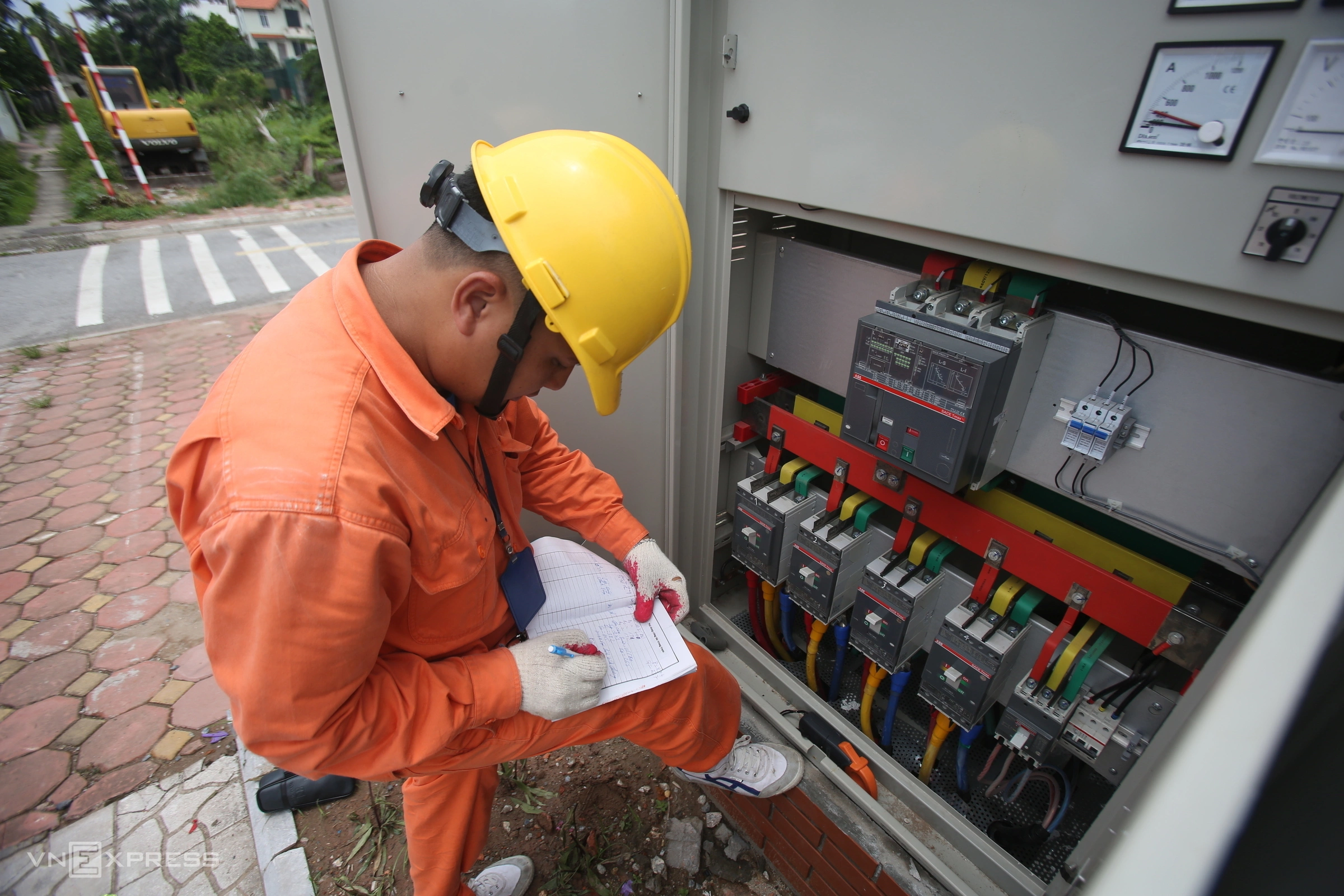 |
An electricity sector worker in Hanoi. Photo: Ngoc Thanh |
The adjusted Power Development Plan VIII, approved by the Prime Minister in 4/2025, aims to ensure sufficient electricity for an average Gross Domestic Product (GDP) growth of approximately 10% per year during the 2026-2030 period and about 7,5% for the 2031-2050 period. Under the plan, total electricity generation and import are projected to reach 560,4-624,6 billion kWh by 2030, increasing to 1.360,1-1.511,1 billion kWh by 2050.
The plan also sets targets for renewable energy (excluding hydropower) to account for 28-36% of total capacity by 2030 and 74-75% by 2050. Solar power capacity is expected to reach 46.459-73.416 MW by the end of this decade. Additionally, the plan strives for 50% of public offices and 50% of households to use self-produced, self-consumed rooftop solar power by 2030.
Regarding nuclear power, the adjusted Power Development Plan VIII aims to bring two nuclear power plants, Ninh Thuan 1 and Ninh Thuan 2, into operation during the 2030-2035 period, with a total capacity of 4.000-6.400 MW. By 2050, the system may require an additional 8.000 MW of nuclear power to ensure energy security.
By definition, supreme oversight is the National Assembly's activity of monitoring, reviewing, and evaluating compliance with the Constitution, laws, and resolutions of the National Assembly by agencies, organizations, and individuals within its oversight scope. The annual oversight program is decided by the National Assembly based on a submission from the National Assembly Standing Committee, after discussion and approval by delegates.
Son Ha