On 2/4, the Politburo issued a conclusion outlining the legislative orientation for the 16th National Assembly term. The conclusion sets a goal to establish a democratic, fair, synchronous, unified, transparent, and feasible legal system by 2030, paving the way for development. By 2045, the legal system is expected to achieve high quality, modernity, and alignment with both national realities and international practices.
Alongside the request to research a comprehensive amendment of the 2013 Constitution, the Politburo emphasized the task of synchronously completing institutions and laws. This is crucial for rapid, sustainable development, building a socialist rule-of-law state, and effectively operating a three-tier government model.
Legislative work is mandated to foster breakthroughs in science, technology, innovation, and digital transformation. It must also establish a new growth model, restructure the economy, and accelerate industrialization and modernization, with science, technology, and digital transformation as the primary drivers.
The Politburo also directed the improvement of laws to develop Vietnamese culture and people, build a modern education system, effectively manage resources, protect the environment, adapt to climate change, build regular, elite, and modern armed forces, and enhance foreign affairs and international integration.
Party committees, party organizations, and agencies across the political system are required to promptly and fully institutionalize the Party's guidelines and policies. The focus is on completing the core content of the 14th Party Congress Resolution and other strategic resolutions within the current year.
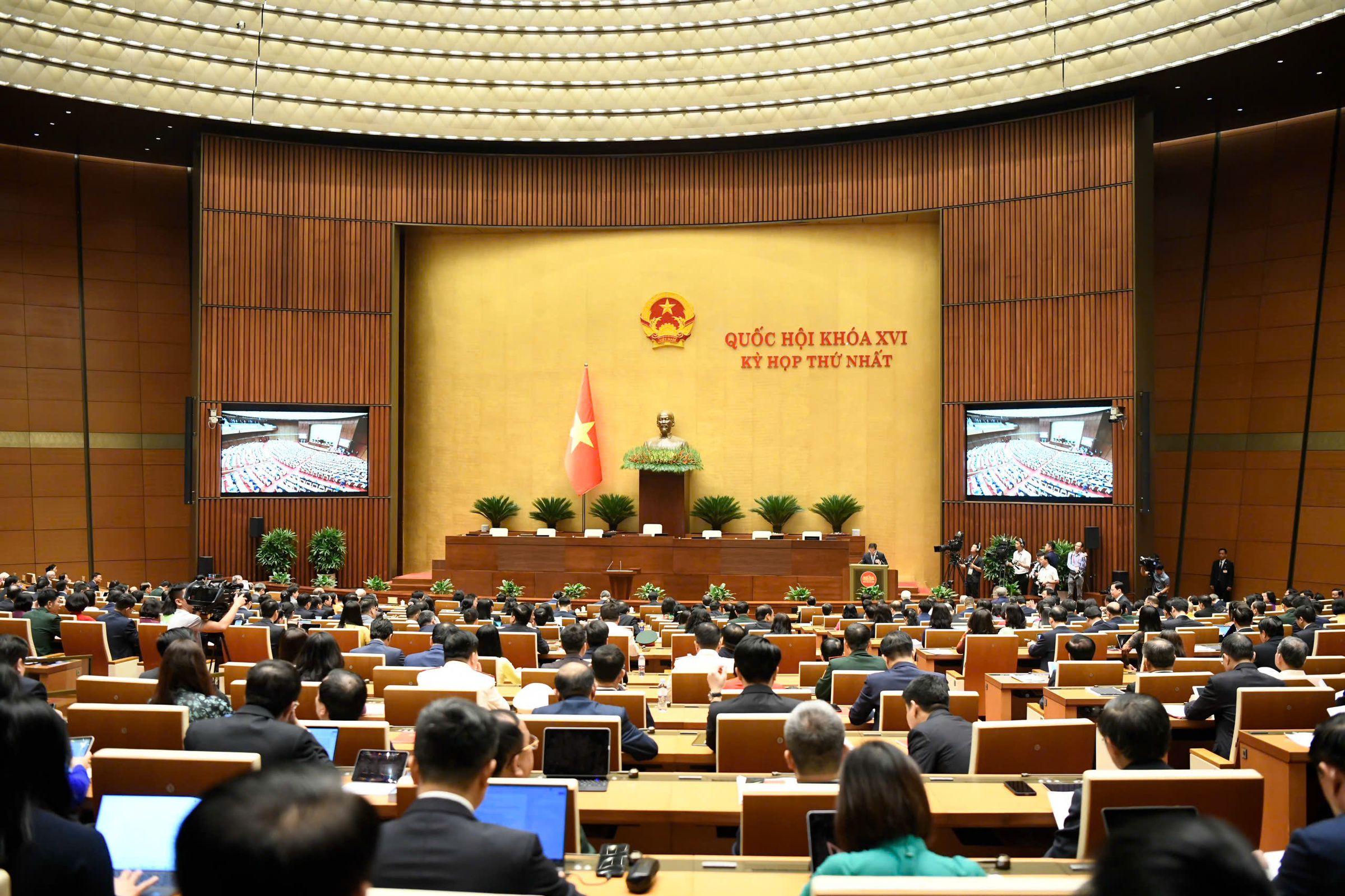 |
The opening session of the 16th National Assembly, morning of 6/4. Photo: Hoang Phong |
The Politburo urged the swift removal of legal bottlenecks to unleash resources and promote double-digit economic growth. Concurrently, it called for establishing a legal framework for emerging fields such as the digital economy, artificial intelligence, digital transformation, green transition, and renewable energy.
The conclusion explicitly states that the legislative mindset must shift from management to service and development creation. It unequivocally calls for abandoning the notion of banning what cannot be managed, eliminating the "ask-give" mechanism, and reducing and simplifying administrative procedures and business conditions. State management is required to transition from pre-inspection to post-inspection, accepting controlled risks.
Since 1945, Vietnam has promulgated 5 constitutions in 1946, 1959, 1980, 1992, and 2013. In 6/2025, the National Assembly passed a resolution to amend and supplement several articles of the 2013 Constitution. This was done to streamline the administrative apparatus and establish a two-tier local government model.
Earlier, during a National Assembly group discussion in 5/2025, General Secretary To Lam outlined the orientation to research a fundamental amendment of the Constitution in the new term. This would be based on a comprehensive assessment after 40 years of Doi Moi (renovation). In 12/2025, while chairing a meeting of the Central Steering Committee for Legal and Institutional Improvement, General Secretary To Lam reiterated the need to review the implementation of the 2013 Constitution. This review would serve as a basis for proposing suitable amendments, aligned with the Party's major reviews.
Vu Tuan