In a document sent to relevant units, the Ho Chi Minh City People's Committee approved Hoanh Son Group Joint Stock Company to research and prepare a project proposal after the preliminary plan was reviewed and advised by the Department of Finance.
According to the proposal, the Tam Tan road will be 13.2 km long and 40 meters wide. It will start at the An Ha bridge interchange approach on national route 22, run parallel to the Thay Cai canal, and connect to Ho Chi Minh City ring road 4. The An Ha bridge interchange is designed as a multi-level trumpet interchange, featuring overpass ramps to separate traffic flows and reduce conflicts.
The company proposes implementing the project under a public-private partnership (PPP) and build-transfer (BT) contract. The preliminary total investment capital is estimated at approximately 11,100 billion VND, with an expected implementation period of 48 months if approved.
 |
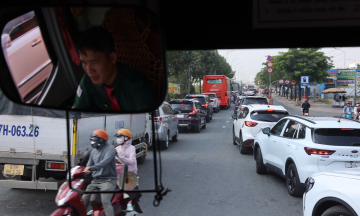
Traffic congestion on national route 22 in northwest Ho Chi Minh City, 2025. Photo: Giang Anh. |
During the appraisal process, relevant departments, agencies, and localities agreed on the project's necessity. The Department of Construction assessed that national route 22 experiences frequent congestion, particularly in front of the Tan Phu Trung Industrial Park, significantly impacting traffic and logistics. Investing in the Tam Tan route will establish an external transportation axis for the Northwest Urban Area, reduce pressure on existing routes, and stimulate industrial development along the corridor.
The Ho Chi Minh City Urban Development Board stated that the Tam Tan road is a key axis of the Northwest Urban Area according to the master plan. Upon completion, the route will attract housing and social infrastructure projects, enhancing regional transport connectivity.
The Ho Chi Minh City People's Committee noted that assigning the preparation of the project proposal does not imply investor designation. The selection process will adhere to regulations. The city tasked relevant departments and agencies with guiding the company during the research phase, ensuring synchronous implementation conditions.
Beyond the Tam Tan road project, northwest Ho Chi Minh City is preparing to implement several other major transport infrastructure projects. These include upgrading national route 22 under a build-operate-transfer (BOT) contract, spanning nearly 8 km, 60 meters wide, with a total capital exceeding 10,400 billion VND. Additionally, a section of Ring Road 4, over 15 km long, is expected to commence construction for compensation, support, resettlement, and access road development, with a total capital exceeding 7,000 billion VND.
These projects are expected to create a synchronized transport network, enhance inter-regional connectivity, and reduce pressure on Ho Chi Minh City's northwest gateway.
Giang Anh