On the afternoon of 29/4, General Secretary, President To Lam and a Central Committee delegation worked with the Quang Tri Provincial Party Standing Committee. The meeting reviewed the implementation of the 14th National Party Congress Resolution, the first Provincial Party Congress Resolution, other Central Committee resolutions, and key provincial tasks for the coming period.
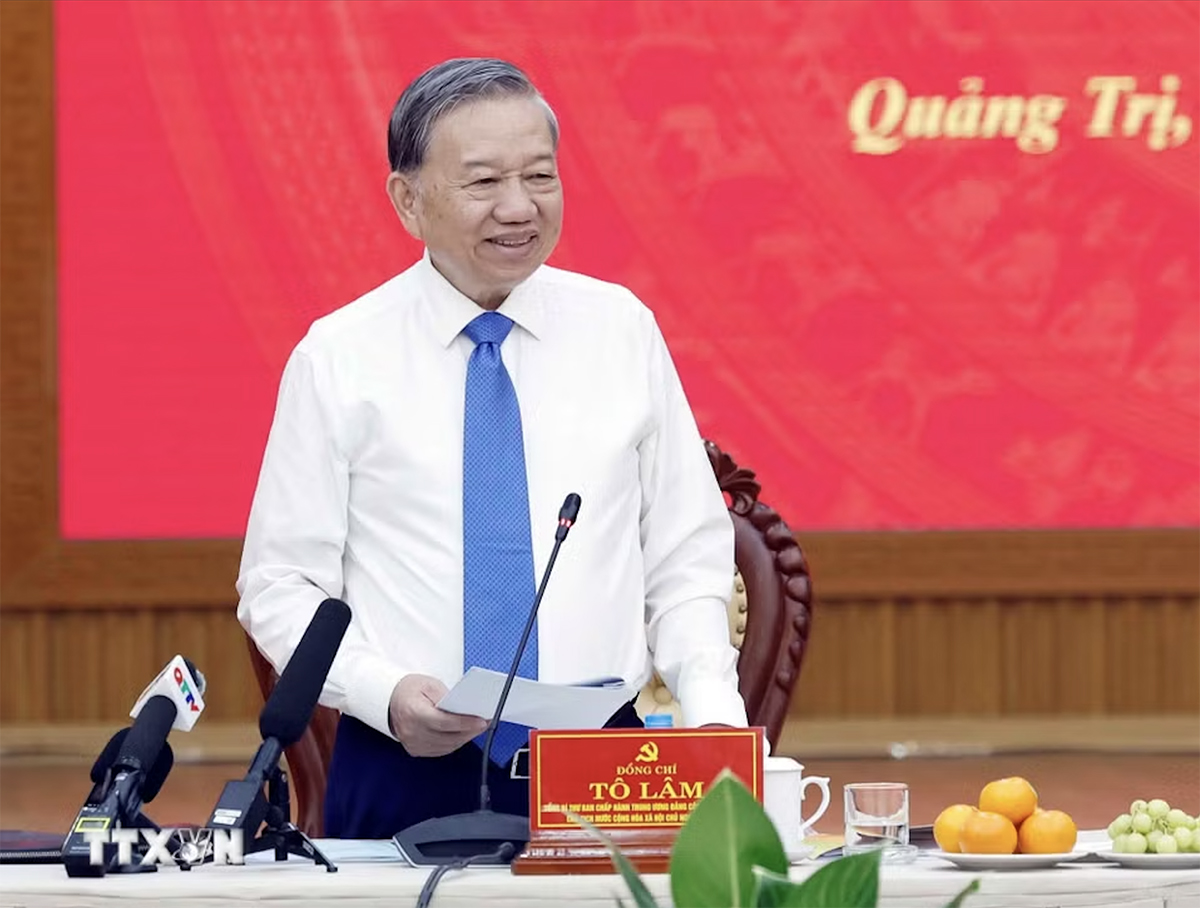 |
General Secretary, President To Lam delivers a keynote speech at the working session with the Quang Tri Provincial Party Standing Committee. Photo: TTXVN
In his concluding remarks, General Secretary, President To Lam praised the unity, proactiveness, and efforts of the Quang Tri Party Committee, authorities, and people. He commended the dedication, responsibility, and endeavors of the Party Committee, government, armed forces, business community, and residents of Quang Tri over the past period.
Despite the achievements, the General Secretary, President also highlighted several limitations. These include a restricted economic foundation and growth drivers, inadequate development infrastructure, and insufficient capacity to transform potential. The two-tier local government model, administrative reform, and digital transformation still face challenges. The general living standards of the people remain difficult, and the capacity for implementation needs focused improvement.
The General Secretary, President urged the province to innovate its thinking, act more decisively, select the right priorities, and organize implementation more rigorously and effectively. He called for the continued building of a clean, strong, united, disciplined, and proactive Party Committee and political system, using the effectiveness of serving the people as a benchmark. He emphasized operating the two-tier local government model substantively, smoothly, and efficiently, preventing the commune level from becoming a new bottleneck.
The General Secretary, President called for a repositioning of Quang Tri’s development space with a "reach east, spread west" strategy. "Reach east" means centering economic expansion on the sea, making it the main development direction through the east-west economic corridor. This involves integrating transport and logistics methods to extend marine economic functions westward and expand into other regions and territories.
The east-west axis should reorganize production space, logistics, urban areas, and regional linkages, strategically connecting with Laos, Thailand, Myanmar, and the Mekong sub-region. This will integrate Lao Bao, La Lay, border gates, seaports, economic zones, and border trade into a unified ecosystem.
The province must promptly re-plan its sea-forest-border development space with a clearer regional perspective, more integrated planning, and a sharper focus. It needs to synchronously connect the Southeast Quang Tri economic zone, My Thuy, Hon La, the port system, processing industries, energy, and coastal urban areas. The province should clearly choose growth poles and driving projects, avoiding widespread dispersion, without sacrificing the environment or allowing land speculation to distort development orientation.
The General Secretary, President suggested strongly developing advantageous economic sectors, including marine economy, energy, tourism, high-tech agriculture, and processing industries. He advised leveraging the east-west corridor’s gateway role to the sea to develop seaports, logistics, processing industries, border trade, and import-export. Seaports and coastal areas must become the nucleus of growth, while addressing bottlenecks in connecting infrastructure, procedures, human resources, and the investment environment.
Quang Tri should build its brand as a destination for history, peace, spirituality, ecology, caves, islands, and border culture. It should not only be a place "to commemorate" but also to understand history, cherish peace, and experience nature, culture, and people. Priority should be given to developing high-quality tourism products, increasing regional linkages, attracting strategic businesses, and protecting historical, cultural, and environmental values. The province should maximize the advantages of Phong Nha - Ke Bang, creating an "Asian capital for adventure tourism."
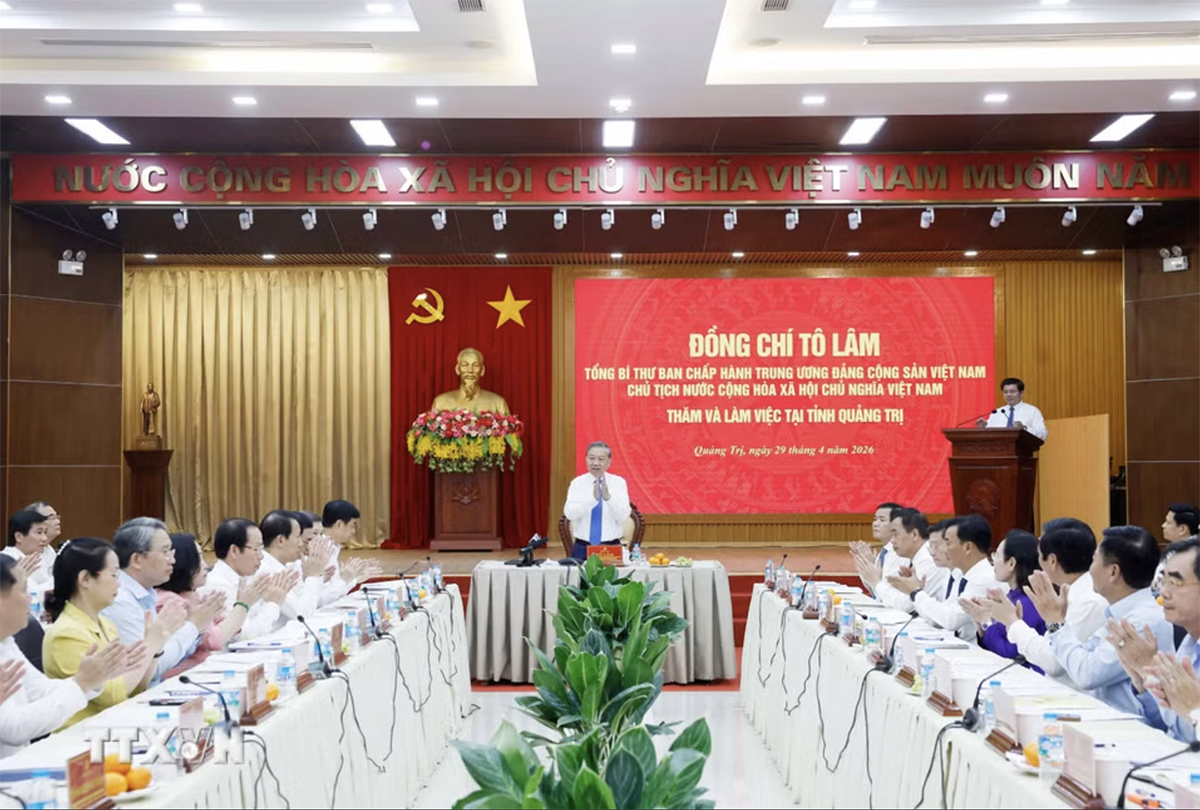 |
General Secretary, President To Lam works with the Quang Tri Provincial Party Standing Committee. Photo: TTXVN
To achieve the 10.6% growth target for 2026, the General Secretary, President emphasized that growth must be sustainable, based on productivity, effective investment, and new drivers. There must be specific operational scenarios for each month, quarter, sector, project, and locality, clearly defining resources, bottlenecks, and implementation responsibilities.
Public investment must be a leading driver, focusing on key infrastructure projects and strategic connections. For slow projects, the causes and responsibilities must be clear. The province needs to improve its business environment and develop businesses and the private sector. Support should be provided to enhance governance, digital transformation, access to capital, land, markets, and skilled labor, to foster strong local businesses that create good jobs and contribute long-term to the province.
Quang Tri cannot develop quickly if it relies only on resources and cheap labor. The province needs to implement Resolution 57 substantively in governance, production, public services, and key economic sectors. It must complete digital infrastructure down to the grassroots, improve digital skills, and build shared data on land, businesses, investment, planning, public assets, and administrative procedures. The province should innovate its working methods, service delivery, and decision-making, helping people and businesses complete procedures faster, more transparently, and with less cost.
The General Secretary, President called for better care for culture, education, health, social welfare, and the lives of the people, especially in border areas, ethnic minority regions, and areas facing many difficulties. Economic development must be linked with human development, placing policy families, people with meritorious services, the poor, children, and people in remote areas at the center of policy.
The province needs to complete multi-level boarding schools in border regions on schedule and with quality assurance. It should reorganize commune-level health stations to improve the effectiveness of primary healthcare. The province must deepen its work of showing gratitude and providing practical care for people with meritorious services, veterans, and residents affected by war.
Given its special position regarding borders, islands, and the east-west corridor, the General Secretary, President proposed that Quang Tri must link economic development with strengthening national defense and security. All planning must consider the requirements for protecting sovereignty, security, and social safety. The province needs to grasp the situation firmly, address issues at the grassroots, and effectively combat drugs, smuggling, trade fraud, illegal resource exploitation, high-tech crime, and the exploitation of ethnic and religious issues. It should strengthen cooperation with Lao localities and international partners, transforming the border into a space for trade, culture, tourism, education, health, and environmental protection.
Regarding the province's recommendations and proposals, the General Secretary, President acknowledged them, affirming that the Central Committee's general spirit is to accompany, resolve difficulties, and create maximum conditions for Quang Tri to develop quickly and sustainably in the new period.
In Quarter I of 2026, the gross regional domestic product (GRDP) increased by 8.02% compared to the same period, exceeding the target scenario of 7.43%. The economic structure continues to shift positively. Quang Tri has also developed specific growth scenarios for each quarter, identifying strategic pillars that contribute positively to growth, striving for a GRDP growth of 10.6% in 2026 as directed by the government.
The local budget revenue in Quarter I reached 3,354 billion dong, achieving 26.6% of the Central Committee's assigned estimate. Total realized investment capital reached 14,382 billion dong, representing 15.2% of the plan and an increase of 19.9% compared to the same period last year.
TTXVN