On 22/8, the National Assembly debated the direction for developing a consolidated State Budget Law. Delegate Nguyen Khanh Vu, Secretary of the Party Committee and Chairman of the People's Council of Quang Tri Ward, argued that salary policy should be more explicitly institutionalized within budget revenue and expenditure regulations.
Central Resolution 27 established the goal of salary reform: ensuring civil servants and public employees can live comfortably on their salaries. However, the draft State Budget Law does not fully incorporate the principle of prioritizing resources for this objective.
According to Vu, the draft outlines categories for prioritized budget allocation but lacks clear prioritization for salary policy. Funds allocated for salary reform are currently ranked after tasks such as reducing the budget deficit and supplementing the financial reserve fund when distributing increased budget revenue.
He contended that this arrangement does not align with the need to proactively secure resources for salaries. Furthermore, Article 62 only stipulates that salary expenditures are not subject to delay under the provisional budget allocation mechanism at the start of the year. This is merely a temporary solution, not a fundamental budget management principle designed to ensure a stable salary policy.
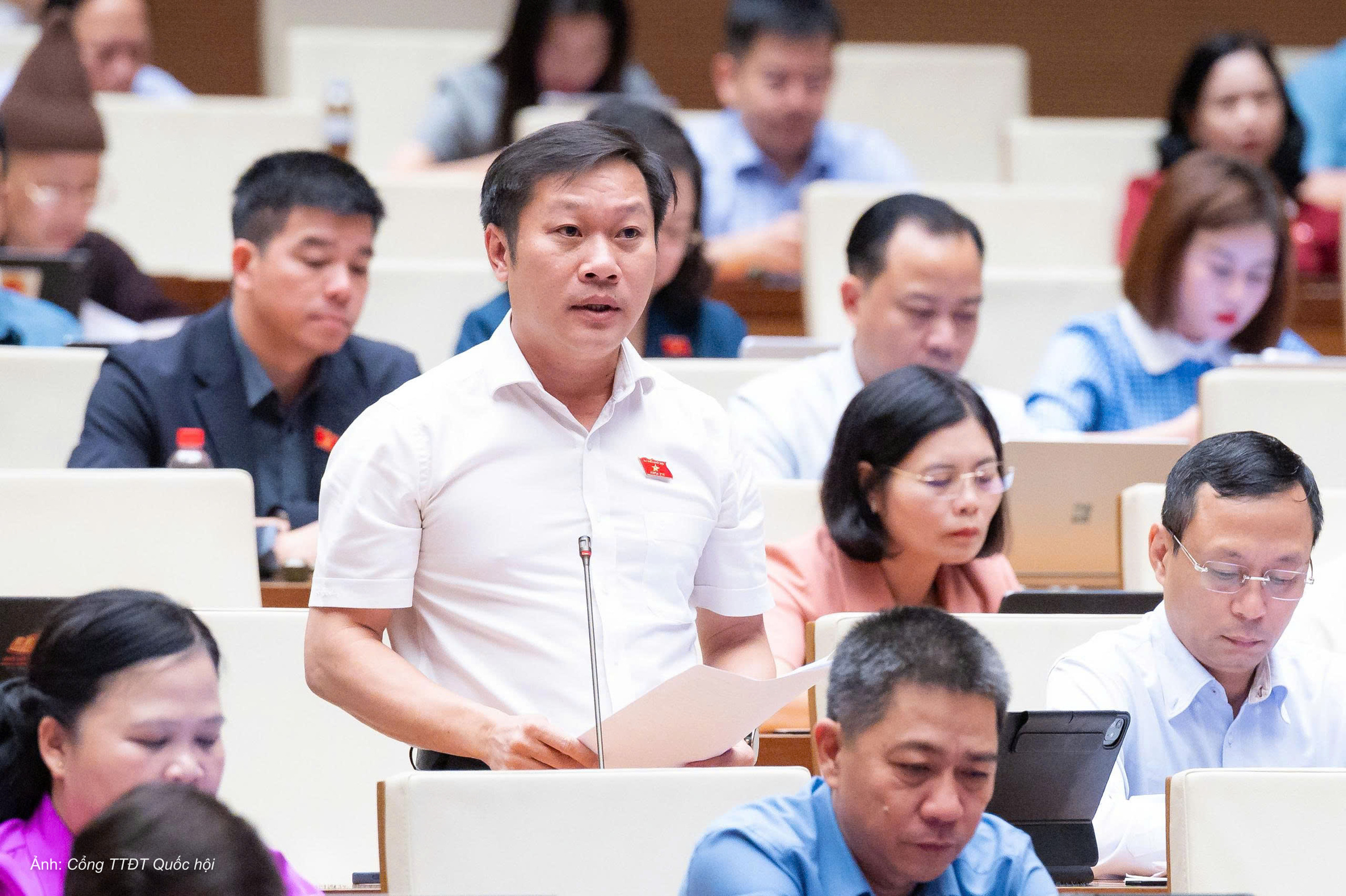 |
Delegate Nguyen Khanh Vu speaking before the National Assembly on 22/8. *Photo: National Assembly E-Portal*
Current salary levels present a significant challenge. In the public sector, the base salary is 2,53 million dong per month. For the private sector, regional minimum wages range from 3,7 to 5,31 million dong per month. Vu highlighted that these income levels create substantial pressure on both public sector employees and private sector workers, particularly in major urban areas.
Vu proposed amending the State Budget Law to include a principle of prioritizing resource allocation for public sector salary policy. He also suggested elevating the priority of supplementing funds for salary policy within the annual state budget revenue increase utilization plan, moving it from its current last position in the draft.
Regarding the private sector, the drafting committee should review and revise salary policies within the Labor Code. This aims to ensure workers' incomes are more aligned with living requirements and sustainable development goals.
In July, the Ministry of Home Affairs reported that current civil servant and public employee salaries are inadequate to meet living needs, especially for younger staff. Low incomes contribute to difficulties in housing, education, and childcare for many public sector workers. Additionally, providing facilities, housing, and living/working conditions for civil servants and public employees relocating to new administrative centers has been delayed.
To address these disparities, the Ministry of Home Affairs announced plans to research and propose a new resolution. This resolution would replace Resolution 27 of 2018 on salary policy reform and Resolution 28 on social insurance policy reform. The new salary policy is anticipated for presentation at the 5th Central Committee Plenum in 2027.
As part of the preparation, the Ministry of Home Affairs has collaborated with the Central Policy and Strategy Committee to conduct a preliminary review of Resolution 27's implementation, submitting a report to the Politburo and Secretariat for feedback.
The Ministry will also develop phased salary reform plans. It will advise on resolving emerging issues concerning salaries and allowances for civil servants, public employees, workers, and armed forces, ensuring alignment with organizational restructuring, the operation of two-tier local government, and personnel streamlining efforts.
With the current base salary, civil servant salaries typically range from approximately 3,4 million to 25,3 million dong per month, while public employees earn about 3,8 million to 20,2 million dong, excluding allowances.
Son Ha