General Secretary To Lam emphasized the urgent need for integrated transport infrastructure to connect Ho Chi Minh City (HCMC) with Long Thanh airport. Working in HCMC on 9/2, he stated that if travel takes two hours with frequent congestion, the airport would fail to attract passengers. He called for solutions to shorten the travel time from HCMC city center to Long Thanh airport to about 30 minutes, aiming to boost passenger numbers and operational efficiency.
Long Thanh airport in Dong Nai is nearing completion, with its first flights expected in late 2025 and commercial operations projected for mid-2026. As the country's largest airport, it is set to handle approximately 80% of the region's international passengers, primarily serving HCMC's travel demands and facilitating transfers from Tan Son Nhat airport.
 |
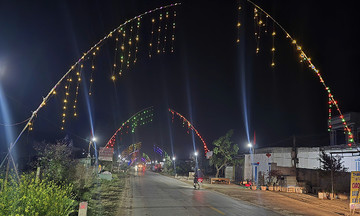
Long Thanh airport terminal is completing its final stages. Photo: Thanh Tung
Currently, connectivity between HCMC and Long Thanh airport is limited, relying mainly on the HCMC – Long Thanh expressway and National Highways 1 and 51, which are frequently overloaded. Despite the distance of about 50 km from the city center to the airport, travel time often takes 2-3 hours, extending even longer during expressway congestion.
Several key projects are underway to improve Long Thanh airport's connectivity. These include the expansion of the HCMC – Long Thanh – Dau Giay expressway, along with the Ben Luc – Long Thanh, Bien Hoa – Vung Tau expressways, and Ring Road 3. These projects are scheduled for completion in 2026 and early 2027, aiming to alleviate congestion and create additional access routes to the airport.
The expanded HCMC – Long Thanh expressway, coupled with the completed An Phu interchange, will reduce pressure on the city's eastern gateway. The 58 km Ben Luc – Long Thanh expressway is currently constructing its final major component, the Phuoc Khanh bridge, with an anticipated opening to traffic in September this year. This will complete a high-speed route connecting southern HCMC and the Mekong Delta provinces to the airport, easing traffic in the eastern area. Additionally, Ring Road 3 and the Bien Hoa – Vung Tau expressway are being expedited, and their full completion will provide more access options to Long Thanh airport.
 |
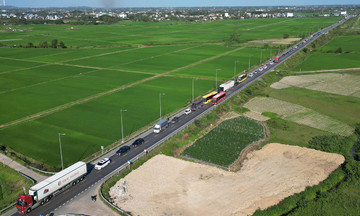
Congestion on Vo Chi Cong street while waiting to enter the HCMC - Long Thanh expressway, as authorities restricted vehicles to ease traffic pressure, 1/2026. Photo: Giang Anh
Dr. Ngo Anh Vu, Director of the HCMC Institute of Construction Planning, noted that Long Thanh airport, as the nation's largest, was planned with a comprehensive connecting infrastructure system, including numerous road and rail lines. However, project implementation has been inconsistent due to policy and investment resource challenges.
According to Dr. Vu, ongoing transport projects will be crucial for improving airport connectivity in the short term. For the long term, he emphasized the need for early investment in metro and rail systems, particularly the Thu Thiem – Long Thanh line. This would establish a high-capacity transport axis, offering a more direct, stable, and faster connection than roads.
The Thu Thiem – Long Thanh line, planned over 10 years ago, aims to link HCMC's inner and outer areas with Long Thanh and the Southeast region. Despite past efforts to attract capital and engage foreign partners, the project has yet to commence, with HCMC currently serving as the lead agency. Recognizing its urgency, HCMC has designated the Thu Thiem – Long Thanh line as a priority investment project for the period leading up to 2030. The line, approximately 48 km long (including 42 km of main line and depot access roads), has a total investment estimated at nearly 3.5 billion USD. When completed, this line, alongside the Ben Thanh – Thu Thiem metro line (with Thaco proposing participation), will create a direct connection between HCMC city center and Long Thanh airport.
 |
Nhon Trach bridge - a connection route from HCMC city center to Long Thanh airport. Photo: Quynh Tran
Long-term plans include further expansion of the metro network, such as extending the Ben Thanh – Suoi Tien line into Dong Nai and investing in a metro line to connect Tan Son Nhat with Thu Thiem – Long Thanh. This will establish a crucial link between the country's two largest airports. In parallel with these projects, HCMC and Dong Nai recently broke ground on three major river-crossing bridges: Phu My 2, Long Hung (Dong Nai 2), and Cat Lai. These bridges aim to enhance connectivity between the two localities and Long Thanh airport, with a target completion date before 2030. The Phu My 2 bridge is particularly important, connecting the North – South axis (Nguyen Huu Tho street) in HCMC with Road 25C in Dong Nai, creating a fast transport route to Long Thanh airport and easing pressure on existing lines.
Dr. Pham Viet Thuan, Director of the HCMC Institute of Economics and Environment, asserted that Long Thanh airport requires an integrated transport infrastructure ecosystem, a requirement not yet met. Congestion would impose "costs" on passengers in terms of time and lost opportunities, diminishing the airport's appeal. Addressing the urgent need to complete airport connection infrastructure, Dr. Thuan proposed minimizing investment procedures and expediting land clearance to accelerate project implementation, especially for railways. He also suggested that HCMC and Dong Nai consider assigning one locality as the lead agency for connection solutions to ensure unified and synchronous execution.
Beyond the timely completion of expressways, ring roads, and rail investments, Dr. Thuan advised exploring additional connection options such as bus and waterway routes. This diversification of transport modes would increase airport accessibility for residents. Previously, HCMC had studied several waterway solutions for Long Thanh airport, including opening a route from Bach Dang pier (former District 1) to SwanBay marina in Nhon Trach, followed by road access to the airport. The city also considered upgrading the Phu Xuan – Phuoc Khanh pier on the Soai Rap river to improve connectivity from Nha Be to Nhon Trach, then proceeding by road to the airport. Concurrently, HCMC is planning to introduce more bus routes connecting key areas to Long Thanh airport, aiming to facilitate passengers once the airport commences operations.
Giang Anh