Vietnam aims to expand its fully online public services to 80 nationwide by the end of 2026, a move intended to spare citizens from visiting government agencies. Nguyen Duy Ngoc, Head of the Central Organizing Commission, announced this ambitious goal during a meeting with Can Tho city voters on 28/4. This marked his first engagement in Can Tho since transferring his membership from the Hanoi city National Assembly Delegation.
Currently, 25 such services are available across the country. Fully online public services enable the entire process – from application submission and payment to receiving results – to be completed via the Internet. Operating 24/7, these services save time and costs, increase transparency, and eliminate the need for paper documents, allowing citizens to complete procedures with "one-touch" online.
The existing 25 services address essential needs, including: issuing/renewing identity cards, residency registration, vehicle registration, driving licenses, passports, criminal records, birth registration, marriage registration, health insurance, electricity services, and education.
 |
Head of the Central Organizing Commission Nguyen Duy Ngoc at the meeting with Can Tho city voters on 28/4. *Photo: An Binh*
In a related initiative, Nguyen Duy Ngoc also stated that the Central government would review the two-tier local government model next july. This review aims to further streamline administrative processes.
Regarding Can Tho city, Nguyen Duy Ngoc noted that its administrative apparatus is largely stable. However, he emphasized the need to review decentralization and delegation of authority, ensuring clear roles, responsibilities, and accountability. He further urged accelerating digital transformation to allow citizens to complete procedures at one location or through the online system.
He also proposed continued improvement of infrastructure and urban planning, alongside the efficient utilization of land along major transport axes to attract investors.
During the meeting, local voters raised concerns and made requests, including: upgrading grassroots healthcare facilities, increasing personnel and equipment, clarifying authority among different administrative levels, and enhancing supervision.
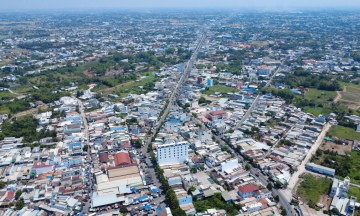
Can Tho city, following its recent merger, spans an area of over 6,360 km² and has a population exceeding 4,19 million people, comprising 103 communes and wards. It stands as one of Vietnam's six centrally-run cities.
An Binh